 Nic Dunn, CEO, Charle Agency

Overview: Shopify vs BigCommerce
Shopify launched in 2006 and has grown into the dominant force in ecommerce. With over 5.6 million active stores across 175+ countries, a cumulative gross merchandise volume surpassing $1 trillion, and approximately 29% of the US ecommerce platform market, Shopify powers everything from first-time sellers to global enterprise brands. The platform holds a 73% share among the top 800 DTC brands, and its ecosystem of 8,000+ apps, mature checkout experience, and pace of innovation make it the standard that other platforms are measured against.
BigCommerce entered the market in 2009 and positions itself as an "Open SaaS" platform, combining hosted simplicity with API-driven flexibility. BigCommerce serves around 50,000 merchants across 150 countries and is particularly popular with mid-market and B2B businesses. The platform takes a different philosophical approach to Shopify by including more features natively rather than relying on third-party apps, and its open architecture gives developers more freedom to customize the frontend without being locked into a proprietary framework.
Both platforms are fully hosted SaaS solutions, meaning you don't need to manage servers, security patches, or software updates. But the similarities become less clear once you look at how each platform handles pricing, customization, checkout, and growth. The scale difference is significant: Shopify's merchant base is over 100 times larger than BigCommerce's, which directly impacts the size of each platform's developer community, app ecosystem, and rate of innovation. In our experience working with brands on both platforms, the right choice depends on your specific business needs, budget, and growth plans. For a broader look at Shopify's strengths, see our guide on why brands choose Shopify.
Quick Comparison: Shopify vs BigCommerce at a Glance
| Category | Shopify | BigCommerce |
|---|---|---|
| Starting price | $39/month (Basic) | $39/month (Standard) |
| Transaction fees | 0% with Shopify Payments; 0.5-2% with third-party gateways | 0% on all payment gateways |
| Active stores | 5.6 million+ | ~50,000 |
| App ecosystem | 8,000+ apps | ~1,200 apps |
| Free themes | 13 | 12 |
| Product variants | 3 options, 100 variants (2,000 with Combined Listings app) | Up to 250 options, 600 SKUs per product |
| Ease of use | Excellent, beginner-friendly | Good, steeper learning curve |
| SEO | Strong, with larger ecosystem of SEO tools | Strong, with more flexible URL structures |
| B2B features | Available on Shopify Plus | Native on all plans |
| POS system | Full native POS with hardware | Third-party POS integrations only |
| Checkout conversion | 12% higher than BigCommerce (Shopify data) | Standard hosted checkout |
| Revenue caps | None | $50k-$400k depending on plan |
| Best for | DTC brands, multichannel sellers, fast-growing stores | B2B businesses, complex catalogs, budget-conscious merchants |
Pricing Comparison
Pricing is often the first thing merchants compare, but headline monthly fees only tell part of the story. The real cost of running a store on either platform includes subscription fees, transaction fees, app costs, and theme investments.
Shopify's plans (2026):
- Basic: $39/month. Includes online store, 2 staff accounts, basic reports, and up to 77% shipping discount
- Shopify: $105/month. Adds professional reports, 5 staff accounts, and improved shipping discounts up to 88%
- Advanced: $399/month. Includes custom report builder, 15 staff accounts, third-party calculated shipping rates, and the best card rates
- Shopify Plus: From $2,300/month. Enterprise-grade features including checkout customization, automation, and dedicated support. Read more about Shopify pricing
BigCommerce's plans (2026):
- Standard: $39/month Online store with unlimited staff accounts and no transaction fees
- Plus: $105/month Adds customer groups, abandoned cart saver, and stored credit cards
- Pro: $399/month Includes Google customer reviews, custom SSL, and product filtering
- Enterprise: Custom pricing. Includes priority support, custom facets, and unlimited API calls
There's a critical difference in how each platform handles transaction fees. Shopify charges additional transaction fees (0.5% to 2%) when you use a third-party payment gateway instead of Shopify Payments. BigCommerce does not charge any additional transaction fees regardless of which payment provider you choose. This can make a meaningful difference for high-volume stores, particularly those operating in countries where Shopify Payments isn't available.
To put this in context: on a $100 transaction using a third-party gateway on Shopify Basic, you'd pay your gateway's processing fee plus an additional $2 to Shopify. On BigCommerce Standard, you'd pay only your gateway's processing fee. For a store processing $500,000 annually through a third-party gateway, that's an additional $5,000-$10,000 per year in Shopify transaction fees alone.
BigCommerce also has revenue-based plan thresholds that force automatic upgrades. If your annual online sales exceed $50,000 on Standard, $180,000 on Plus, or $400,000 on Pro, you'll be moved to the next tier. Shopify has no such revenue caps on any plan, meaning you won't face surprise cost increases as you grow.
On the surface, BigCommerce appears cheaper at the entry level. But once you factor in app costs (many features that BigCommerce includes natively require paid Shopify apps) and potential transaction fee savings, the total cost of ownership varies significantly depending on your business model. Shopify's own research suggests their platform delivers 31% better total cost of ownership overall, with 88% lower implementation costs, though this naturally comes from a biased source. Independent analysis from Tooltester and others suggests the true picture is more nuanced and depends heavily on your specific configuration, payment provider, and app requirements.

Ease of Use
Shopify has consistently been praised as one of the most intuitive ecommerce platforms available. Its setup wizard walks new merchants through choosing a theme, adding products, configuring payments, and setting up shipping options in a straightforward, step-by-step process. The admin dashboard is clean and logically organized, making it accessible for merchants with no technical background. Shopify's own data claims that stores can be set up 36% faster on their platform compared to BigCommerce.
BigCommerce is also a well-designed platform, but its admin interface reflects its broader native feature set. There are more options, more menus, and more configuration possibilities out of the box. For experienced merchants who want granular control over every aspect of their store, this is an advantage. For beginners or small teams without dedicated technical staff, it creates a steeper learning curve. Several independent comparison studies have noted that new users take longer to set up a BigCommerce store compared to Shopify.
Both platforms provide drag-and-drop page builders for theme customization. Shopify's Online Store 2.0 framework introduced flexible sections across all pages, not just the homepage, which made visual customization significantly easier without requiring developer involvement. BigCommerce's Page Builder offers similar drag-and-drop functionality, though the experience can feel less polished in comparison and some merchants report needing developer help for changes that Shopify handles through its theme editor alone.
Where Shopify also excels is its mobile management app. The Shopify app for iOS and Android lets merchants manage orders, track analytics, process refunds, communicate with customers, and even fulfil orders on the go. BigCommerce offers a mobile app too, but it's more limited in functionality and has received lower ratings from users.
From what we've seen working with merchants migrating between platforms, most find Shopify faster to get productive on. That said, merchants who need complex product configurations, custom pricing rules, or advanced B2B workflows often appreciate BigCommerce's more capable backend once they've invested the time to learn it.
Design and Themes
The visual quality of your store directly affects conversion rates and brand perception. Both Shopify and BigCommerce offer theme marketplaces, but there are notable differences in quality, quantity, and flexibility.
Shopify offers around 200 themes in its Theme Store, including 13 free options. The paid themes typically cost between $150 and $350 as a one-off purchase. Shopify themes are built on the Liquid templating language and the Online Store 2.0 framework, which allows merchants to add, remove, and rearrange content sections on any page without touching code. The design quality across Shopify's theme library is generally high, with themes optimized for conversion and mobile performance. Beyond the official theme store, hundreds of additional Shopify themes are available from third-party marketplaces like ThemeForest. For help choosing, see our guide to the best Shopify themes.
BigCommerce offers around 180 themes, with 12 free options. Paid themes range from $150 to $400. BigCommerce themes are built on the Stencil framework using Handlebars templating. While the themes are functional and mobile-responsive, the overall design quality tends to feel less polished than Shopify's offerings. It's worth noting that BigCommerce inflates its theme count somewhat through color variations of the same base design, so the actual number of unique theme designs is lower than the headline figure suggests.
For advanced customization, both platforms allow direct code editing. Shopify's Liquid language is widely documented and has a large developer community, making it easier and often cheaper to find developers for custom work. BigCommerce's Handlebars framework is capable but has a smaller talent pool, which can affect development costs and timelines. According to Shopify, there are 2,380+ certified Shopify partners compared to around 1,237 BigCommerce partners.
If you're a brand that values design flexibility and wants access to a wider range of high-quality themes with strong community support, Shopify has the clear edge here. BigCommerce themes are perfectly serviceable, but the ecosystem is smaller and the design ceiling is lower without custom development. For guidance on building a standout store, see our article on how to design a Shopify website.
Built-in Features and App Ecosystem
This is where the philosophical difference between the two platforms becomes clearest. BigCommerce includes more features natively, while Shopify relies more heavily on its app ecosystem to extend functionality. Your preference here often comes down to whether you value out-of-the-box completeness or the flexibility to choose best-in-class tools for each function.
BigCommerce's native advantages:
- Up to 250 product options and 600 SKUs per product (Shopify is limited to 3 options and 100 variants natively, though the Combined Listings app now supports up to 2,000 variants)
- Built-in product customization fields (engraving, personalization, file uploads)
- Native customer groups and custom pricing on all plans
- Real-time shipping quotes included on all plans (Shopify requires Advanced or Plus)
- Unlimited staff accounts on every plan
- Built-in abandoned cart recovery (on Plus and above)
- Native product filtering and faceted search
- Built-in customer reviews and ratings
Shopify's ecosystem advantages:
- 8,000+ apps in the Shopify App Store (compared to around 1,200 on BigCommerce)
- Strict app review process ensuring quality, security, and performance standards
- A broader range of integrations across marketing, fulfillment, analytics, and operations
- Shopify Flow for automation (available on Shopify plan and above, not just Plus)
- Shop Pay, which converts up to 50% better than standard guest checkout
- Shopify Audiences for targeted advertising that cuts acquisition costs (Plus only)
- Shopify Inbox for live chat and messaging
- Shopify Email for built-in email marketing

The trade-off is clear: BigCommerce saves you money on apps by building more into the core platform, while Shopify gives you more flexibility to choose the exact tools and integrations that fit your workflow. For many growing brands, the depth of Shopify's ecosystem outweighs the convenience of BigCommerce's built-in features. We've seen this consistently across the stores we manage. Explore our roundup of the best Shopify apps for recommendations.
One practical consideration: app costs on Shopify can add up. A typical Shopify store might spend $100 to $500 per month on apps for reviews, email marketing, loyalty, subscriptions, and SEO tools. BigCommerce merchants often spend less on third-party tools because the platform covers more ground natively. When evaluating total cost, factor in what you'll actually need rather than comparing raw app counts. That said, having 8,000+ apps to choose from means you're far more likely to find the exact solution for your specific use case on Shopify than on BigCommerce.
SEO and Marketing
For a search-first agency like Charle, this is the section that matters most. Both platforms provide a solid foundation for SEO, but the details make a real difference to how well your store ranks.
Shopify's SEO capabilities:
- Customisable title tags, meta descriptions, and URL handles across all page types
- Automatic sitemap generation and robots.txt management
- Built-in canonical tags to prevent duplicate content issues
- Clean HTML output and structured data from modern Online Store 2.0 themes
- 8,000+ apps including dedicated SEO tools for schema markup, image optimization, and page speed
- Built-in blogging platform for content marketing with scheduling and categories
- Automatic image compression and lazy loading on newer themes
- JSON-LD structured data output for rich results in search
BigCommerce's SEO capabilities:
- Customisable title tags, meta descriptions, and URLs across all page types
- Full URL rewriting capability (Shopify URLs include /products/ and /collections/ prefixes that can't be removed)
- Built-in microdata and rich snippet support
- Automatic 301 redirect creation when URLs change
- Integration with Google Analytics and Search Console
- Built-in blogging (though less flexible than Shopify's)
- CDN-delivered content for faster page loads
- AMP support for product pages (though AMP's relevance has diminished significantly since 2023)
BigCommerce has a genuine advantage with its URL structure flexibility. Shopify forces certain URL patterns (/products/, /collections/, /pages/) that can't be changed without workarounds. BigCommerce allows full control over URL structure, which can be valuable for migration scenarios where you need to match existing URL patterns, and for advanced SEO strategies that benefit from cleaner URL hierarchies. That said, Shopify's URL structure is clean, consistent, and well-understood by search engines. We've never seen a Shopify store fail to rank because of its URL prefixes.
Where Shopify pulls ahead is in the breadth of its marketing ecosystem. Shopify Email provides built-in email marketing, Shopify Inbox handles live chat, and the platform integrates natively with Google, Facebook, Instagram, TikTok, and Pinterest for advertising and selling. Shopify's app ecosystem also means you have access to best-in-class tools for every aspect of digital marketing, from advanced schema markup to AI-powered content optimization. For a deeper dive into Shopify's search capabilities, see our complete Shopify SEO guide and our guide on how to do SEO on Shopify.
BigCommerce integrates with the major marketing channels too, but its smaller app marketplace limits your options for specialized marketing tools and analytics integrations. For stores where SEO is a primary growth channel, the depth of Shopify's ecosystem and the speed at which new SEO tools emerge for the platform give it a meaningful practical advantage. For more on ecommerce search strategy, see our ecommerce SEO statistics report.
Payment Gateways and Transaction Fees
Payment processing is where the two platforms diverge most sharply, and it's often the deciding factor for merchants choosing between them.
Shopify offers its own integrated payment solution, Shopify Payments, powered by Stripe. If you use Shopify Payments, you pay zero additional transaction fees on top of the standard card processing rates (which vary by plan, starting at 2.9% + 30¢ for Basic). Shopify Payments is available in 23 countries including the UK, US, Canada, and most of Europe. Learn more about Shopify payment gateway options.
If you choose to use a third-party payment gateway instead of Shopify Payments, Shopify charges an additional transaction fee of 0.5% to 2% on top of whatever your gateway charges. This is a significant consideration for merchants in countries where Shopify Payments isn't available, or those who need a specific payment provider for their industry. On the Basic plan, a $100 sale through a third-party gateway costs you an extra $2 in Shopify fees alone. On Advanced, that drops to $0.50 per $100.
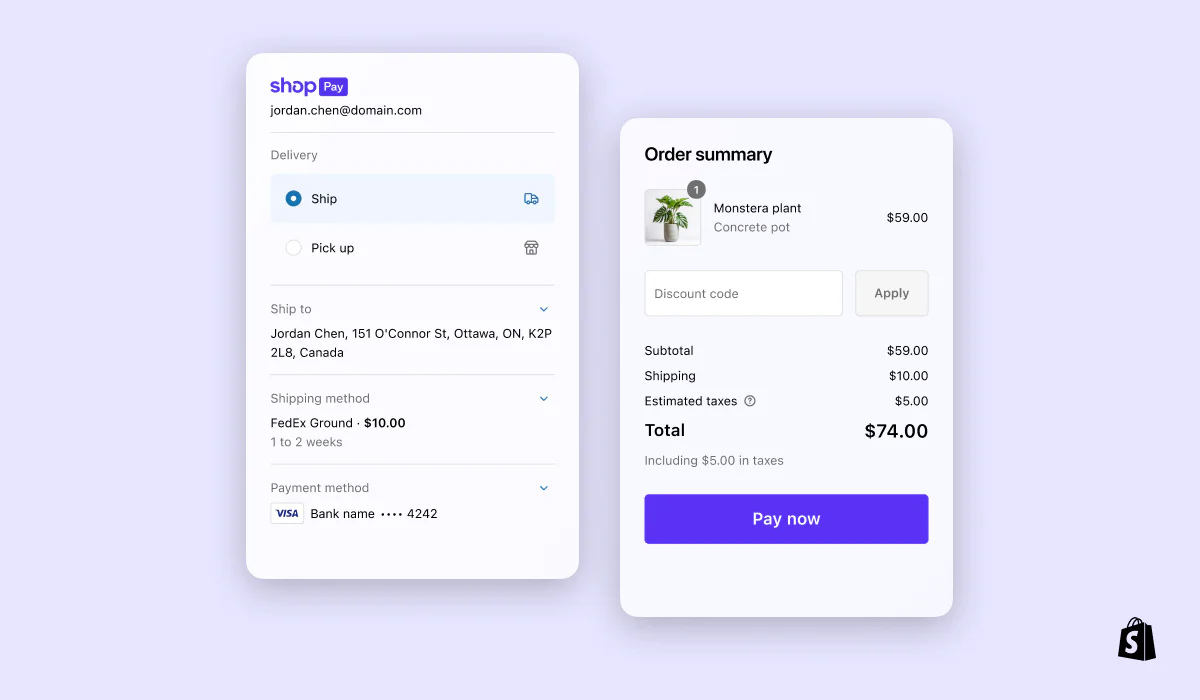
Shopify also offers Shop Pay, an accelerated checkout that stores customer payment and shipping details for faster repeat purchases. Shopify reports that Shop Pay converts up to 50% better than standard guest checkout and has the highest conversion rate of any accelerated checkout. With over 150 million buyers using Shop Pay, it represents a genuine competitive advantage that BigCommerce simply cannot match. Shopify also claims its overall checkout converts 12% better than BigCommerce's, based on their own benchmarking data.
BigCommerce supports 65+ payment gateways and charges zero additional transaction fees regardless of which provider you use. This is one of BigCommerce's strongest and most frequently cited selling points. You'll still pay the standard processing fees charged by your chosen gateway (PayPal, Stripe, Square, Adyen, etc.), but BigCommerce never adds a surcharge on top.
For merchants processing high volumes through third-party gateways, BigCommerce's no-fee approach can represent meaningful savings. But for merchants who can use Shopify Payments (which covers the UK, US, and most major markets), the combination of competitive card rates, zero transaction fees, and Shop Pay's conversion advantage often makes Shopify the more cost-effective choice overall. The payment gateway decision should be one of the first considerations when comparing these platforms, because it can significantly shift the total cost equation in either direction.
Performance and Security
Both Shopify and BigCommerce are fully hosted platforms with enterprise-grade infrastructure, meaning you don't need to worry about server management, software updates, or security patches.
Security: Both platforms are PCI DSS Level 1 certified, the highest level of security certification in the payment card industry. They provide free SSL certificates, regular security audits, and automated backups. Neither platform has experienced a major security breach, and both handle sensitive payment data in compliance with industry standards. For businesses handling customer payment information, both platforms meet the security requirements you'd expect from a professional ecommerce solution.
Performance: Shopify operates on a global CDN with data centers designed to handle massive traffic spikes. During Black Friday/Cyber Monday 2024, Shopify processed $11.5 billion in sales and handled 40,000 checkouts per minute at peak without significant downtime. Shopify's infrastructure is battle-tested at a scale that BigCommerce hasn't needed to match given its smaller merchant base. Shopify also claims the fastest server speed in commerce, based on independent testing.
BigCommerce also uses a global CDN and maintains a 99.99% uptime SLA on its Enterprise plans. The platform performs well for typical ecommerce workloads, and its Stencil framework produces reasonably fast-loading pages. Independent page speed tests from Tooltester and others have shown mixed results between the two platforms, often depending more on the specific theme, app configuration, and image optimization than the underlying platform infrastructure.
In practice, page speed on both platforms depends heavily on your theme choice, image optimization, number of third-party scripts, and app overhead. A well-optimized Shopify store and a well-optimized BigCommerce store will perform comparably for most traffic levels. The difference comes at scale, where Shopify's infrastructure has been proven to handle significantly higher volumes without degradation. For more on ecommerce technical SEO and performance, see our dedicated guide.
Shipping and Fulfillment
Shipping configuration can make or break an ecommerce operation, and the two platforms handle it differently. Getting shipping right on your store directly impacts conversion rates, customer satisfaction, and your bottom line.
Shopify's shipping features:
- Shopify Shipping provides discounted rates from major carriers (up to 88% off with DHL Express, UPS, and Royal Mail)
- Built-in shipping label printing and tracking directly from the admin
- Third-party calculated shipping rates available on Advanced and Plus plans (or as a monthly add-on for lower plans)
- Shopify Fulfillment Network for US-based merchants wanting distributed fulfillment
- Integration with hundreds of fulfillment apps including ShipStation, ShipBob, and Deliverr
- Local delivery and pickup options built into the platform
- Automatic shipping profiles for different product types and regions
BigCommerce's shipping features:
- Real-time shipping quotes from major carriers included on all plans (a genuine advantage over Shopify's plan-restricted approach)
- ShipperHQ integration for advanced shipping rules and rate calculations
- Built-in shipping label printing
- Carrier-calculated rates with no additional monthly fees
- Integration with third-party fulfillment services
- Configurable shipping zones and rules
BigCommerce has a real advantage here: real-time carrier-calculated shipping rates are included on every plan, including Standard at $39/month. On Shopify, you need to be on the Advanced plan ($399/month) or pay for a monthly add-on to get the same functionality. For merchants who rely on calculated shipping rates rather than flat-rate or free shipping, this can be a significant cost difference.
Where Shopify pulls ahead is in carrier discounts and the breadth of fulfillment integrations. Shopify Shipping's negotiated rates can save UK merchants up to 88% on shipping labels, which adds up quickly at volume. Shopify's app ecosystem also connects to virtually every fulfillment provider, 3PL warehouse, and shipping service globally, giving you more flexibility as your logistics needs evolve.
For stores shipping a handful of products with straightforward logistics, either platform works well. For brands with complex shipping needs, multiple fulfillment locations, or high shipping volumes, Shopify's deeper fulfillment ecosystem and carrier discounts typically provide more value, despite the higher plan cost needed for calculated rates.

Multichannel Selling
Modern ecommerce requires selling across multiple channels, not just your website. Both platforms support multichannel selling, but Shopify has invested more heavily in this area and it shows.
Shopify integrates natively with Amazon, eBay, Google Shopping, Facebook Shops, Instagram Shopping, TikTok, Pinterest, and Walmart Marketplace. All of these integrations sync inventory, orders, and product data from a single Shopify dashboard. Shopify was first to market with TikTok, Snapchat, and YouTube selling integrations, and these native channels are typically better maintained and more robust than third-party alternatives.
Shopify also offers a robust point-of-sale (POS) system for in-person retail, pop-ups, markets, and events. Shopify POS integrates seamlessly with your online store, unifying inventory, customer data, and order management across physical and digital channels. This is a significant differentiator. Shopify's own data shows that merchants using POS alongside their online store see an 8.9% sales increase and a 22% improvement in total cost of ownership for their retail operations.
Shopify's headless commerce capabilities through Hydrogen and Oxygen also allow brands to build fully custom storefronts while maintaining Shopify as the backend commerce engine. This opens up possibilities for selling through mobile apps, kiosks, IoT devices, and custom digital experiences.
BigCommerce supports integration with Amazon, eBay, Google Shopping, Facebook, and Instagram. It also offers headless commerce through its Channels API and partnerships with frontend frameworks like Next.js and Gatsby. BigCommerce's omnichannel features include inventory synchronisation and centralised order management across connected channels.
The key difference is depth and breadth. Shopify's native integrations are more numerous, more robust, and better maintained. Shopify POS in particular is a significant advantage for any brand with physical retail presence, as BigCommerce has no native POS solution and relies entirely on third-party integrations. BigCommerce's channel integrations work well for core marketplaces but rely more heavily on third-party connectors for newer and less established selling channels.
International Selling
For brands selling across borders, the platform's international capabilities matter enormously. Both Shopify and BigCommerce support multi-currency and multi-language selling, but the implementation and ease of use differ substantially. Read our full guide on selling internationally on Shopify for detailed strategies.
Shopify Markets is Shopify's built-in solution for international selling. It lets you manage multiple markets from a single store, with localised pricing, currencies, languages, domains, and duties and taxes. Shopify Markets Pro extends this further by handling cross-border logistics, compliance, and local payment methods across 150+ countries. This means a single Shopify store can serve customers globally with localised experiences, without the complexity of managing separate stores for each region.
BigCommerce supports multi-currency natively, allowing you to set specific prices in different currencies rather than relying solely on automatic conversion (Shopify also supports manual pricing by market). BigCommerce also supports multi-storefront on Enterprise plans, letting customers run multiple storefronts from a single backend, each with its own domain, theme, and product catalog. Multi-language support requires third-party apps on both platforms, though Shopify's native translation API and Markets features have made this significantly easier on the Shopify side.
For most growing brands, Shopify Markets provides a more complete and easier-to-manage international selling solution. The ability to handle duties, taxes, local payment methods, and regional pricing from a single store reduces operational complexity enormously. BigCommerce's multi-storefront approach works well for Enterprise customers who need maximum control over each market, but it requires more configuration, more ongoing management, and often more technical resources to set up properly.
B2B and Wholesale
B2B ecommerce is a growing priority for many brands, and both platforms have invested in this area. Learn more about our Shopify B2B and wholesale services.
BigCommerce has historically been the stronger platform for B2B, and it retains genuine advantages here. Its native features include customer groups with custom pricing, tiered price lists, quote management, purchase orders, trade/wholesale account functionality, and the ability to restrict products or categories to specific customer groups. These features are available without third-party apps and across multiple plan levels, making BigCommerce a genuinely strong option for merchants whose primary business is B2B or who need robust wholesale capabilities at a lower price point.
Shopify has closed the gap significantly with its B2B on Shopify feature set, available on Shopify Plus. This includes company profiles, custom catalogs, net payment terms (Net 15, Net 30, Net 60), quantity rules, volume pricing, draft orders, and a dedicated wholesale storefront that runs alongside your D2C store. The B2B experience runs on the same Shopify backend as D2C, meaning brands can serve both customer types from a single store with unified inventory and order management.
For brands that are primarily B2B and need robust wholesale features at a lower price point, BigCommerce remains a strong contender and is arguably the better choice. For brands that sell both D2C and B2B and want a unified platform experience, Shopify Plus provides a more integrated experience, particularly when combined with Shopify's broader ecosystem of apps and integrations. The key question is whether your B2B needs justify the higher cost of Shopify Plus, or whether BigCommerce's native B2B features on lower-tier plans give you better value.
Customer Support
When something goes wrong with your store, responsive and knowledgeable customer support matters. Both platforms offer 24/7 support, but the experience differs in quality and depth.
Shopify provides 24/7 support via live chat, email, and phone across all plans. The platform also has the most comprehensive self-service knowledge base in ecommerce, with extensive documentation, video tutorials, community forums with millions of posts, and the Shopify Community where merchants help each other. Shopify's support is generally praised for fast response times and the breadth of available help resources. The sheer size of Shopify's user base also means that almost any issue you encounter has been documented and solved by someone else before.
BigCommerce also offers 24/7 support via phone, live chat, and email. BigCommerce emphasises its US-based support team and claims an average response time of under two minutes on live chat, with over 85% of issues resolved on first contact. Enterprise customers get a dedicated account manager, priority support routing, and strategic guidance. For businesses that value a personal, high-touch support experience, BigCommerce's approach can feel more attentive, particularly at the Enterprise level.
In practice, both platforms provide competent support for common issues. The practical difference lies in the surrounding ecosystem. With Shopify, you have access to a far larger community of developers, agencies, and fellow merchants who can help with everything from basic setup questions to complex custom development. BigCommerce's community is smaller but often more specialized, with merchants who have deep platform knowledge. For most businesses, Shopify's combination of official support and vast community resources gives it the edge, but BigCommerce's dedicated account management on Enterprise plans is a genuine advantage for larger organisations that need it.
AI Search and Future-Proofing
The ecommerce landscape is changing rapidly. Google's AI Overviews, ChatGPT, Perplexity, and other generative AI tools are reshaping how consumers discover, evaluate, and purchase products. The platform you choose needs to support these emerging channels and adapt to an evolving search landscape.
Shopify has invested heavily in AI across its platform. Shopify Magic provides AI-powered product descriptions, email content, and image editing directly within the admin. Sidekick (Shopify's AI assistant) helps merchants manage their stores through conversational interactions. Shopify's checkout and product pages also output clean, structured data that AI search engines can parse effectively, and the platform's broader ecosystem means you have access to the latest AI-powered tools for everything from personalization to predictive analytics.
More importantly, Shopify's pace of innovation dwarfs BigCommerce's. Shopify releases 200+ platform updates per year through its Editions programme, and its R&D investment runs into billions annually. This investment gap is visible in the speed at which new features, integrations, and AI capabilities reach Shopify merchants compared to BigCommerce users. Shopify was first to integrate with TikTok, Snapchat, and YouTube as selling channels, and this pattern of leading adoption of new commerce channels is likely to continue as AI-driven shopping experiences emerge.
BigCommerce has introduced some AI features, including AI-driven product recommendations and improved on-site search. The platform's Open SaaS architecture means it can integrate with external AI services through APIs, which gives developers flexibility to build custom AI-powered experiences. But the pace of AI innovation on BigCommerce is noticeably slower, and the smaller app ecosystem means fewer third-party AI tools are available compared to Shopify.
For brands thinking about AI search optimization and Generative Engine Optimisation (GEO), the quality of your structured data, schema markup, and content is more important than the platform itself. Both Shopify and BigCommerce support product schema, but Shopify's broader ecosystem makes it easier to implement advanced schema types and keep up with evolving best practices. Our guide to schema markup and structured data covers implementation strategies for ecommerce stores.
Over the next three to five years, the R&D investment gap between Shopify (billions annually) and BigCommerce (millions annually) is likely to widen the feature and capability differences between the two platforms. For merchants making a long-term platform decision, this is an important factor to consider alongside today's feature comparison.
Migrating Between Platforms
If you're currently on BigCommerce and considering a move to Shopify (or vice versa), understanding the migration process is essential. We've handled numerous platform migrations for brands of all sizes, and the process is well-established but requires careful planning.
What can be migrated:
- Products (including descriptions, images, variants, and metadata)
- Customer data (accounts, order history, addresses)
- Historical orders and transaction records
- Blog content and pages
- URL redirects (critical for preserving SEO equity)
Key migration considerations:
- SEO preservation: The most critical aspect of any platform migration is maintaining your search rankings. This requires comprehensive 301 redirect mapping from old URLs to new URLs, preserving meta data, and ensuring schema markup is implemented correctly on the new platform
- URL structure changes: Moving from BigCommerce to Shopify means adapting to Shopify's fixed URL patterns (/products/, /collections/). Moving the other way gives you more URL flexibility. Either direction requires careful redirect planning
- App replacement: Apps and integrations don't transfer between platforms. You'll need to identify equivalent tools on the new platform and configure them from scratch
- Design rebuild: Themes don't transfer. You'll need a new theme or custom design on the target platform
- Timeline: A typical migration takes 4-12 weeks depending on catalog size, customization complexity, and integration requirements
Statista data shows that BigCommerce merchants switch to Shopify more frequently than the reverse, which reflects the broader market trend towards Shopify. If you're considering a migration, working with an experienced agency ensures that SEO equity is preserved, data integrity is maintained, and the transition is as smooth as possible for your customers.
As a Senior Shopify Plus Partner, we've handled hundreds of platform evaluations and migrations. Get in touch to discuss your specific migration needs.
Which Platform Should You Choose?
After years of building, optimizing, and migrating stores on both platforms, our recommendation at Charle comes down to the specific needs of your business.
Choose Shopify if:
- You want the fastest path to launching and growing an online store
- Design quality and theme variety matter to your brand
- You need a large ecosystem of apps and integrations to support your tech stack
- You sell across multiple channels (online, social, marketplace, retail)
- You want access to Shop Pay's conversion advantages and accelerated checkout
- You're scaling towards enterprise and want a clear upgrade path to Shopify Plus
- You need strong international selling capabilities from a single store
- You want to stay on the cutting edge of AI, GEO, and platform innovation
- You need a native POS system for physical retail
- You want access to the largest developer and partner community in ecommerce
Choose BigCommerce if:
- You need advanced product options and complex catalogs without third-party apps
- Your primary business model is B2B or wholesale and you need those features at a lower price point
- You want to avoid transaction fees when using third-party payment gateways
- You need full control over URL structures for SEO or migration purposes
- You prefer more features built into the core platform rather than relying on apps
- You need real-time carrier shipping rates on a lower-cost plan
- You have a development team comfortable with Open SaaS architecture and the Stencil framework
- You want unlimited staff accounts without paying for a higher-tier plan
For most DTC ecommerce brands, Shopify is the stronger choice. Its combination of ease of use, design quality, checkout performance, app ecosystem, multichannel capabilities, and pace of innovation makes it the platform we recommend most often. Shopify's 73% market share among the top 800 DTC brands reflects this reality, and the gap continues to widen as Shopify invests more heavily in platform development.
BigCommerce is a capable platform with genuine strengths, particularly for B2B businesses, merchants with complex product catalogs, and stores that need flexibility in payment gateway choice without additional fees. But its smaller market presence (under 50,000 active stores compared to Shopify's 5.6 million) means a smaller developer community, fewer apps, slower platform evolution, and a higher risk of the platform falling further behind as the ecommerce landscape evolves.
If you'd like expert guidance on choosing the right platform or you're ready to explore what Shopify can do for your brand, our team can help. Explore our Shopify Expert services or get in touch to discuss your specific needs.