 Nic Dunn, CEO, Charle Agency

Quick answer: the best Shopify apps in 2026
The fastest way to answer "what are the best Shopify apps in 2026": for most stores, a strong default stack is Klaviyo for email and SMS, Yotpo or Judge.me for reviews, Smile.io or LoyaltyLion for loyalty, ReCharge or Skio for subscriptions, Gorgias for customer support, Searchanise or Klevu for site search, AfterShip for post-purchase tracking, and TinyIMG for SEO and store speed. Pick one app per category rather than installing twenty, and budget for around six paid apps in total, which is the Shopify-wide average.
If you have never installed an app before, the rest of this guide explains what each one does, how much it costs, and which type of store should reach for it. If you already run a Shopify store, skip ahead to the five ready-made app stacks for a faster shortlist by store type, or jump to the comparison table for the top 15 with prices and free-trial status.
Comparison table: top 15 Shopify apps at a glance
This is the short list. Every app here has been used by a Charle client, has a 4.5+ average rating on the Shopify App Store, and has at least 500 live installs. Pricing is the entry-level paid plan in May 2026. Where a free plan exists, we have noted it.
| App | Category | Free plan | Starts from | Best for |
|---|---|---|---|---|
| Klaviyo | Email and SMS | Yes, 250 contacts | From $45/month | Shopify Plus brands serious about email |
| Yotpo Reviews | Reviews and UGC | Yes, 50 reviews/month | From $15/month | Brands wanting reviews plus loyalty in one |
| Judge.me | Reviews and UGC | Yes, unlimited reviews | From $15/month | Smaller stores that want unlimited reviews cheaply |
| Loox | Reviews and UGC | 14-day trial only | From $9.99/month | Photo and video reviews with strong design |
| Smile.io | Loyalty | Yes, up to 200 orders/month | From $49/month | Small to mid stores starting loyalty |
| LoyaltyLion | Loyalty | Yes, light tier | From $249/month | Plus brands ready to invest in retention |
| ReCharge | Subscriptions | No, 1% of subscription revenue on Standard | From $99/month plus 1.25% | Established subscription brands |
| Skio | Subscriptions | No | From $299/month plus 1% | New subscription brands wanting modern UX |
| Klevu | Site search | 14-day trial | From $49/month | Catalogs over 500 SKUs |
| Searchanise | Site search | Yes, basic search | From $19/month | Cost-effective search and filtering |
| Gorgias | Customer support | 7-day trial | From $10/month | Most Shopify support teams under 50 agents |
| AfterShip | Post-purchase | Yes, 50 shipments/month | From $11/month | Order tracking and branded shipment pages |
| TinyIMG | SEO and speed | Yes, 50 images/month | From $14/month | SEO audits, image compression and lazy loading |
| PageFly | Page builder | Yes, 1 published page | From $24/month | Custom landing pages without code |
| Tidio | Live chat | Yes, basic chat | From $29/month | Small teams wanting AI chat plus humans |
The other 35 apps on our list cover more specialist needs and are described in the category sections below. For deeper category-specific shortlists, see our guides to the best Shopify SEO apps, the best shipping apps for Shopify, the best Shopify payment gateways, and the best loyalty and rewards apps.
- AfterShip
- Algolia
- Boost
- BrightPearl
- Dynamic Yield
- Flare
- FourSixty
- Global-E
- Gorgias
- Instafeed
- Judge.me
- Klaviyo
- Klevu
- Linnworks
- Littledata
- London Dynamics
- Loox
- LoyaltyLion
- Matrixify
- Nosto
- Okendo
- Omnisend
- OrderGroove
- PageFly
- Penny Black
- Privy
- Rebuy Engine
- ReCharge
- Reviews.io
- Rewind
- Searchanise
- Shopify MCSL
- Shoplift
- Skio
- Smile.io
- Starshipit
- Swap
- Tidio
- TinyIMG
- TripleWhale
- Venn Apps
- Voyado
- Voyado Elevate
- Weglot
- Wishlist Hero
- Wishlist Plus
- Yotpo Loyalty
- Yotpo Reviews
- Yotpo Subscriptions
- Yotpo UGC
How we picked these 50 apps
Our selection criteria
To make the shortlist, an app had to clear four gates: an average Shopify App Store rating of 4.5 or higher, at least 500 live installs as of May 2026, hands-on use in at least one Charle client build over the past 18 months, and a clearly defined "best for" use case that we could justify in plain English. We started with a long list of more than 200 apps across the App Store and our own client recommendations, then dropped any app that had been deprecated, acquired into a worse product, or no longer maintained.
We deliberately limited the list to one or two leaders per category. Listing twelve loyalty apps would be more comprehensive but less useful, because nobody installs twelve loyalty apps. Where two apps genuinely deserve attention (Yotpo vs Judge.me on reviews, Skio vs ReCharge on subscriptions, Klevu vs Searchanise on search) we have included both with clear guidance on which type of store should pick which.
Pricing was checked directly against each app's Shopify App Store listing in May 2026. App pricing changes frequently, especially for Plus-tier features, so always verify the current price before installing. Free plans, free trials, and percentage-of-revenue charges are noted in each app's section because they materially affect total cost of ownership.
What changed in the Shopify app ecosystem in 2026
The app store has shifted meaningfully since our previous edition. Three trends matter for store owners deciding what to install this year.
AI features became table stakes. Yotpo, Klaviyo, Tidio, Searchanise, Wiser, Loox, and Klevu all shipped major AI updates between late 2024 and early 2026. AI-generated review summaries, predictive product recommendations, AI-written email subject lines, intent-based site search, and chatbot personalities are now standard rather than premium. If you are evaluating apps in 2026, an app without an AI roadmap is a red flag.
Shopify Magic, Shopify Sidekick and agentic commerce reshaped what merchants need from apps. Shopify's own AI now handles basic SEO suggestions, image alt text, and quick product description rewrites natively. This makes single-purpose AI helper apps less essential, but increases the value of apps that integrate deeply with Magic and Sidekick, or that do things Shopify's own AI cannot (multi-language translation, brand-voice email copy, full SEO audits). Agentic commerce, where AI buyers like ChatGPT and Perplexity start placing orders, also raises the bar for product schema, structured data, and the kind of GEO-ready content these apps help you build. For context, see our guide to agentic commerce and our GEO optimization guide.
Pricing went up across the board. Klaviyo, Yotpo, LoyaltyLion, ReCharge, Gorgias, Searchanise, and Loox have all raised either their entry price, their per-contact pricing, or their percentage-of-revenue cut between Q3 2024 and Q1 2026. The headline number you see in our comparison table is the May 2026 floor, but for stores doing six or seven figures of revenue, total app spend can climb fast. Budget accordingly: the average mid-sized Shopify store now spends $500 to $1,000 per month on apps.
Five ready-made Shopify app stacks
If you do not want to read all 50 entries, pick the stack that matches your store type. Each one is a curated set of apps Charle would actually install for that kind of brand, with the rationale for each pick. All five stacks include some free-tier apps and some paid apps so you can build incrementally.

Stack 1: essentials for a brand-new Shopify store
If you have just launched a Shopify store and want the smallest possible app stack that still covers the basics, install these five. Four are free at the volumes a new store will see, and the fifth (Klaviyo) is free until 250 contacts.
- Judge.me for product reviews (unlimited reviews on the free plan).
- Klaviyo for email and abandoned-cart flows (free up to 250 contacts).
- TinyIMG for SEO audits and image compression (50 free image optimizations a month).
- Tidio for live chat with an AI fallback (free chat tier).
- AfterShip for branded order tracking (50 free shipments a month).

Stack 2: app stack for a Shopify Plus fashion brand
For a typical Plus fashion brand doing $2.5M to $25M annually, this is the eight-app stack Charle installs on day one. Combined monthly cost runs roughly $1,200 to $3,200 depending on contact volume and revenue tier.
- Klaviyo for email and SMS, with full segmentation and Plus-tier flows.
- Yotpo Reviews for product ratings, photo and video reviews, and review schema.
- LoyaltyLion for tiered loyalty, VIP campaigns and Klaviyo integration.
- Searchanise or Klevu for AI-powered site search with merchandising controls.
- Gorgias for unified email, chat, social and SMS support.
- AfterShip for branded post-purchase tracking and returns.
- Nosto for product recommendations and content personalization.
- Shoplift for theme-level A/B testing across PDPs and category pages.

Stack 3: app stack for a Shopify B2B store
Shopify B2B on Shopify Plus has improved significantly but still benefits from app reinforcements for quoting, customer-specific pricing, and post-order operations. For more detail, see our Shopify B2B guide.
- Klaviyo for B2B nurture flows and re-order reminders.
- Gorgias for account-based support with conversation history.
- BrightPearl for inventory, purchase orders and supplier management at scale.
- Linnworks as an alternative ERP for multi-channel B2B operations.
- AfterShip for branded delivery tracking on large orders.
- Matrixify for bulk price-list imports and customer-specific catalogs.

Stack 4: app stack for an international Shopify store
If you sell across multiple countries or languages, this stack handles translation, local pricing, payment methods and customs. For deeper international guidance, see our guide to selling internationally on Shopify and our international ecommerce SEO guide.
- Global-E for fully localized checkout, 100+ currencies and duty calculation.
- Weglot for automatic translation in 110+ languages including checkout copy.
- Klaviyo with multi-language flows segmented by market.
- AfterShip for international order tracking with carrier coverage in 1,100+ couriers.
- Searchanise for search results in the visitor's chosen language.

Stack 5: app stack for high-volume dropshipping
Dropshipping stores live or die on supplier integration, fast iteration on landing pages, and aggressive upsells. This stack reflects that.
- PageFly for custom landing pages on every ad campaign.
- Klaviyo for abandoned-cart and post-purchase email and SMS automation.
- Rebuy Engine for cart-drawer upsells and frequently-bought-together logic.
- AfterShip for branded tracking on supplier-fulfilled orders.
- TinyIMG for SEO audits and image speed.
- Tidio for live chat with AI to handle high message volume.
None of these stacks are gospel. They are the apps Charle would default to. Different store types will swap apps for category-specific specialists (a 3D-product brand might add London Dynamics, a print-on-demand store might add Printful, a subscription-only box might lead with Skio rather than ReCharge). Use these as starting points, not blueprints.
What is a Shopify app and how do they work?
A Shopify app is a piece of third-party software that adds features to your Shopify store without you needing to write code. Apps install in a few clicks from the Shopify App Store, hook into your store's checkout, product pages, customer accounts, or admin, and add functionality that does not come built in. Some apps are free, some run on monthly subscriptions, and some take a percentage of revenue generated through the app itself.
The Shopify App Store is Shopify's official marketplace for these apps. As of May 2026, it contains over 15,000 apps across more than 100 categories, every one of which has been reviewed by Shopify before listing. The store also publishes verified install counts, average star ratings, and aggregated customer reviews for every app, which is why the App Store rating is the single most useful filter when choosing between two similar apps.
Most Shopify merchants run between four and eight apps. Heavy users on Shopify Plus regularly run twenty or more. There is no right number, but there is a wrong direction: every app you install adds JavaScript and database calls to your store, which can hurt page speed and Core Web Vitals scores. We cover the trade-off in how to choose a Shopify app later in this guide. For a primer on how Shopify itself works, see our explainer on how Shopify works.
Best Shopify reviews and UGC apps
Product reviews are the single highest-impact app category for most stores. Reviews lift conversion rates, they build trust for first-time visitors, and they enable review schema for rich-result stars in Google search results. Every store should have a reviews app installed before considering anything else. For a deeper dive, see our guide to the best Shopify reviews apps.
1. Yotpo Reviews

Yotpo Reviews is the market-leading reviews platform on Shopify, with deep integrations into loyalty, SMS, subscriptions, and visual marketing. Yotpo's strength is breadth: brands that want reviews plus loyalty plus referrals plus SMS in a single platform tend to consolidate on Yotpo. The 2025 AI updates added smart prompts, AI review summaries on PDPs, and intent-based review sorting that surfaces the most relevant reviews per visitor.
Our take: If you are on Shopify Plus and want to stop juggling four review and loyalty apps, Yotpo is usually the right consolidation play. Where it falls short is on smaller stores: the entry pricing climbs fast once you exceed the free tier, and Judge.me costs less for the same core function.
Why it's on the list: Yotpo offers the most advanced reviews platform on Shopify, with sitewide widgets, photo and video reviews, AI summaries, social proof on product pages, and direct integrations with Klaviyo, Gorgias, and Shopify Flow. From small store to enterprise Plus brand, Yotpo scales without you having to rip and replace.
Best alternative: Judge.me if budget matters more than feature breadth.
View Yotpo on Shopify App Store2. Okendo

Okendo is a customer-marketing platform built around reviews, photos, videos, and Q&A. It is an Official Google Reviews partner, integrates natively with Klaviyo for trigger-on-fulfilled-order review requests, and is one of the strongest options for brands that put visual social proof at the center of their PDPs. Okendo's segmentation lets you target specific customer cohorts with tailored review-request flows.
Our take: Okendo and Klaviyo work together so tightly that for Klaviyo-first brands it almost always beats Yotpo on review-request open rates. The downside is it does not bundle loyalty or SMS, so you will run Okendo alongside other apps rather than instead of them.
Why it's on the list: Okendo helps brands capture and showcase high-impact social proof, including product ratings and reviews, customer photos and videos, and Q&A message boards. It is a must-have for Klaviyo-led brands and one of the cleanest review UIs on the App Store.
Best alternative: Yotpo if you want loyalty and reviews from one vendor.
View Okendo on Shopify App Store3. Judge.me

Judge.me is the best-value reviews app on Shopify. Unlimited reviews on the paid plan, fast widget load, support for photo and video reviews, and 24/7 support that genuinely responds in under a minute via chat. It is what we recommend to almost every small to mid-sized brand that is starting out with reviews.
Our take: The price-to-feature ratio is unmatched. For under $200 a year you get everything most stores need from reviews. We have moved more clients from expensive review tools to Judge.me than the other way round.
Why it's on the list: Collect unlimited photo and video reviews via automated emails. Display eye-catching widgets, show user-generated content, share ratings on social media to build trust, and drive traffic by showing review stars on Google and Meta. Setup is genuinely fast.
Best alternative: Loox if you specifically want photo-first reviews with the strongest design.
View Judge.me on Shopify App Store4. Loox

Loox is the best photo and video review app on Shopify. It is built exclusively for Shopify, works on every theme, and displays reviews with a polished design that visibly lifts perceived trust on product pages. Big-name users include Bench, Zumba, and Discovery. The trade-off is price: Loox is more expensive than Judge.me for comparable functionality.
Our take: If your brand is image-heavy (fashion, home, beauty, food) the default upgrade from Judge.me is Loox rather than Yotpo. The customer-facing widgets simply look better and lift conversion on PDPs in a way you can see in the heatmaps.
Why it's on the list: Automatically collect product reviews with photos and videos, display them via customizable widgets without slowing your site, and reach new customers with one-click referrals. Loox supports multiple languages and offers 24/7 customer support.
Best alternative: Judge.me if budget matters, Yotpo if you need loyalty too.
View Loox on Shopify App Store5. Reviews.io
Reviews.io is a strong all-rounder reviews platform that bundles product reviews, third-party reviews, video reviews, SMS review collection, in-store reviews, and a built-in loyalty and referral add-on. It is especially well-suited to brands that want a Pinterest-style immersive review wall on PDPs and to consolidate vendors.
Our take: Reviews.io has held its own against Yotpo and Loox by being feature-rich without the enterprise complexity. It is a quieter pick that consistently delivers, especially for brands that care about both product and merchant reviews.
Why it's on the list: The platform offers SEO-friendly reviews that show in Google result descriptions, third-party reviews, UGC with a video-first approach, social proof ads, and a merchant dashboard with competitor analysis and review process publishing. Feature-rich without overwhelming.
Best alternative: Yotpo for tighter loyalty bundling, Judge.me for simpler product-only reviews.
View Reviews.io on Shopify App StoreBest Shopify loyalty apps
Loyalty apps make repeat purchases cheaper than new customer acquisition. The right loyalty app pays for itself in lifted lifetime value, but the wrong one becomes shelfware that nobody on the team has logged into in months. For deeper category coverage, see our guide to the best loyalty apps for Shopify.
6. Voyado

Voyado is a retail marketing platform that bundles loyalty, customer data, segmentation, and campaign management into one product. It is strongest for brands operating both online and physical retail, where Voyado lets you treat one customer across both channels as one customer record. Native Shopify integration handles transactional data automatically.
Our take: Voyado is the right pick when loyalty and customer data unification matters more than ticking a feature box. The pricing is enterprise, so it is a Plus brand decision rather than a small store one.
Why it's on the list: A well-designed loyalty program can be the difference between boom and bust. Voyado helps you act on customer data with the insights you need to spot micro trends and campaign tools to create seamless customer engagement, online and offline.
Best alternative: LoyaltyLion for Plus brands that want loyalty only, Smile.io for smaller stores.
View Voyado on Shopify App Store7. LoyaltyLion

LoyaltyLion is the go-to loyalty app for Shopify Plus brands that have outgrown Smile.io. It supports tiered VIP programs, deep Klaviyo integration, A/B testing, and the kind of data export that lets a brand actually measure loyalty program ROI. Used by thousands of fast-growth ecommerce merchants worldwide.
Our take: LoyaltyLion is the default loyalty app Charle installs on Plus builds. The Klaviyo integration alone justifies the cost: triggering an email when a customer hits a points threshold lifts redemption rates more than any other single mechanism we have tested.
Why it's on the list: A data-driven loyalty and rewards platform that powers ecommerce growth. Merchants can design and A/B test loyalty programs, deliver exclusive experiences for customers, and connect loyalty data into their existing marketing stack.
Best alternative: Yotpo Loyalty for brands already using Yotpo Reviews, Smile.io for smaller stores.
View LoyaltyLion on Shopify App Store8. Yotpo Loyalty & Referrals

Yotpo Loyalty is the natural choice if you already run Yotpo Reviews. The data flows back and forth (review submissions earn loyalty points; loyalty tier shows on review widgets), and you only manage one vendor invoice. The platform comes with 20+ out-of-the-box campaign templates and works without developer support.
Our take: The reason to pick Yotpo Loyalty is consolidation. As a standalone loyalty product it sits behind LoyaltyLion on depth, but as a Yotpo bundle it removes friction and a recurring invoice.
Why it's on the list: An agile loyalty platform that lets you launch quickly and iterate without developer time. Customers earn and redeem points across 20+ campaign types, driving repeat purchases, lifting LTV, and boosting engagement with detailed analytics.
Best alternative: LoyaltyLion if you want best-in-class loyalty as a standalone tool.
View Yotpo Loyalty on Shopify App Store9. Smile.io
Smile.io is the easiest loyalty app to launch. Setup takes minutes, the points program runs itself, and there is no coding required. It is the loyalty equivalent of Judge.me on reviews: deliberately simple, well priced, and ideal for stores that want a loyalty program live by the end of the day rather than after a discovery call.
Our take: If you have never run a loyalty program before, start with Smile and upgrade to LoyaltyLion or Yotpo Loyalty only when you outgrow it. The decision criterion: when you start needing custom Klaviyo flows triggered by loyalty events, you have outgrown Smile.
Why it's on the list: Smile.io powers loyalty, referrals, and VIP rewards programs that increase sales and repeat purchases, save on acquisition costs, and boost brand loyalty. Easy integrations with the most popular Shopify apps and supportive customer success team.
Best alternative: LoyaltyLion when you outgrow Smile, Yotpo Loyalty if you run Yotpo Reviews.
View Smile.io on Shopify App StoreBest Shopify subscription apps
Subscription apps turn one-off purchases into recurring revenue and have transformed the economics of countless DTC brands. The right subscription platform handles billing, customer portals, dunning, gifting, and pause logic without you writing a line of code. The wrong one becomes the largest source of customer service tickets in your store.
10. Skio

Skio is the fast-growing modern alternative to ReCharge. Used by brands like Heights, Skio's standout feature is the customer-facing subscription portal, which uses passwordless login and a clean UX that genuinely reduces support tickets. Built natively on Shopify Checkout Extensibility.
Our take: If you are launching subscriptions for the first time in 2026, Skio is the default pick over ReCharge. The customer portal alone saves enough in support time to justify the price difference. ReCharge still wins for brands already migrated and at scale.
Why it's on the list: Skio offers the highest number of features in the subscription ecosystem including passwordless login, an exceptional subscription portal, gifting subscriptions, and more. The seamless customer experience is how Skio truly sets itself apart from the competition.
Best alternative: ReCharge for established subscription brands, Yotpo Subscriptions for Yotpo-stack brands.
View Skio on Shopify App Store11. ReCharge

ReCharge is the incumbent subscription platform on Shopify and the one most enterprise subscription brands use. It powers billions in subscription revenue across thousands of brands and is built for scale: deep API access, predictable webhooks, mature analytics, and integration with virtually every other tool in your stack.
Our take: ReCharge is rock solid and the safest pick for any brand processing more than a few hundred subscription orders per month. The customer portal lags Skio on UX, but the integration depth and operational maturity are unmatched.
Why it's on the list: ReCharge simplifies launching and scaling a subscription business. Powerful subscription payments, automation, notifications, customer portals, and a deep integration ecosystem mean you spend less time on subscription management and more on customer relationships that increase LTV.
Best alternative: Skio for new brands, OrderGroove for enterprise needs.
View ReCharge on Shopify App Store12. OrderGroove
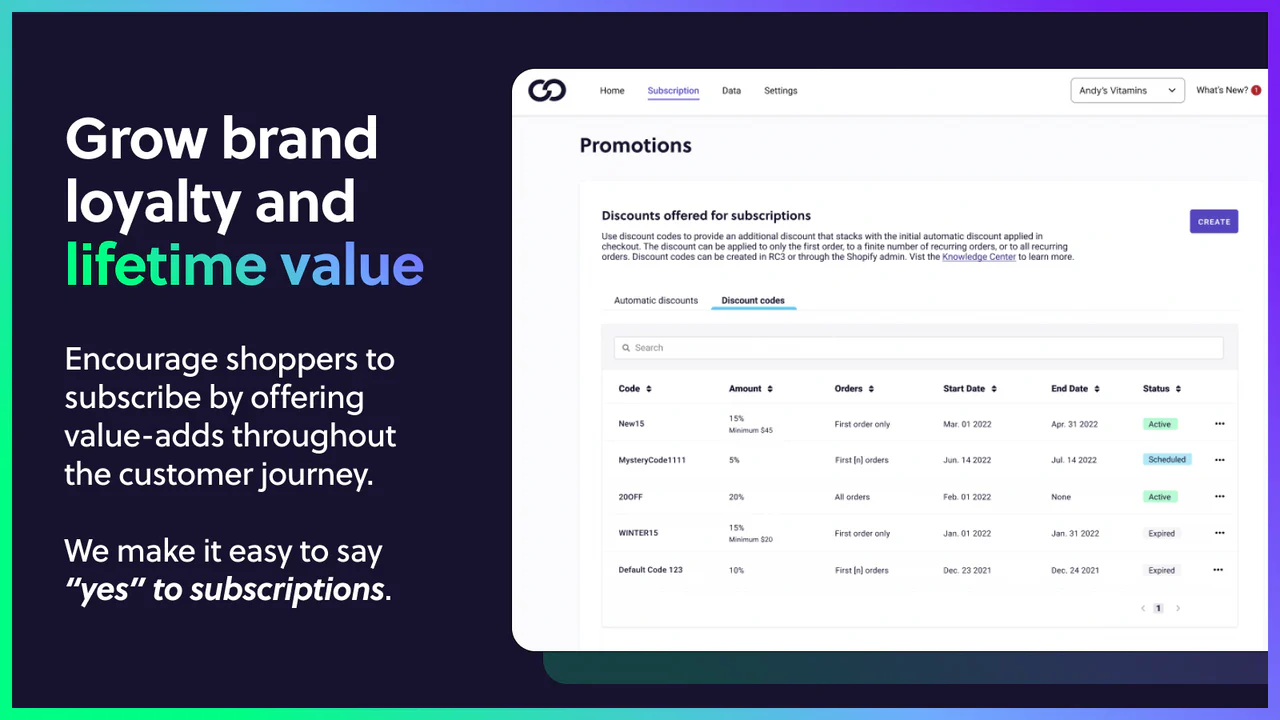
OrderGroove powers subscriptions for the largest brands on Shopify Plus. The platform is built for the kind of complexity that breaks lighter subscription tools: hybrid one-time-and-subscription carts, prepaid plans, complex discounting rules, and predictive replenishment timing based on consumption modelling.
Our take: Reach for OrderGroove when ReCharge has been ruled out for being too rigid. The price reflects this: it is a six-figure annual commitment, not a $99/month decision.
Why it's on the list: OrderGroove powers subscriptions for enterprise and fast-growing brands. The world's largest brands leverage its flexible platform, scalable architecture, and unmatched consumer expertise to grow recurring revenue while providing convenience.
Best alternative: ReCharge for almost everyone else.
View OrderGroove on Shopify App Store13. Flare

Flare is a different category of subscriptions: future-order scheduling. Instead of recurring billing, customers choose when their next order ships, giving the brand visibility into future demand without committing customers to a traditional subscription. The data flips the planning model: stock decisions become demand-led rather than forecast-led.
Our take: Flare is the right pick for brands where customer preference for traditional auto-renew is low, but where forward demand visibility would transform stock and marketing planning. It is a specialist tool that, when it fits, is the only tool that fits.
Why it's on the list: Flare makes it easier for shoppers to buy what they want by scheduling future orders. Brands use the data to gain certainty on stock and resource decisions, reducing wasted spend on guesswork.
Best alternative: Skio if you want traditional subscriptions instead.
View Flare on Shopify App Store14. Yotpo Subscriptions
Yotpo Subscriptions is the right pick for brands already standardised on Yotpo Reviews and Loyalty. It works with Shopify Checkout Extensibility, includes smooth catalog management, and ships with robust analytics that segment subscriber behavior by cohort. Bundling subscriptions with the rest of the Yotpo stack removes friction across customer data and reporting.
Our take: If you already own Yotpo Reviews and Loyalty, Yotpo Subscriptions removes a vendor and unifies customer reporting. As a standalone subscriptions tool it does not beat Skio or ReCharge, but as a bundle it usually wins on TCO.
Why it's on the list: An intuitive subscriptions solution that enables brands to grow recurring revenue. Native Shopify integration, smooth catalog management, and robust analytics to dig into customer data and scale.
Best alternative: Skio for modern UX, ReCharge for scale.
View Yotpo Subscriptions on Shopify App StoreBest Shopify product discovery apps
Site search and product discovery is where conversion is silently lost on most Shopify stores. Shoppers using site search convert at 2-4x the rate of shoppers who browse, but only if the search returns useful results. Wishlists capture intent for return visits, and personalization engines turn category pages into something different for each visitor.
15. Voyado Elevate

Voyado Elevate (formerly Apptus) is an enterprise-grade AI search and personalization platform for Shopify Plus. It syncs behavioral data from your store into the Voyado marketing platform so search results, category ordering, and recommendations all reflect the same customer signal.
Our take: Elevate makes sense as part of the broader Voyado stack rather than as a standalone search tool. If you are not running Voyado for loyalty, Klevu or Searchanise will deliver 90% of the value at 20% of the cost.
Why it's on the list: Sync behavioral data from your online store into Voyado Engage where you orchestrate experiences in marketing, in-store, and online from a single customer view.
Best alternative: Klevu for standalone AI search.
View Voyado Elevate on Shopify App Store16. Klevu

Klevu is the leading AI-powered site search and product discovery suite for Shopify. Powering brands like Oliver Bonas, Klevu combines algorithmic site-wide product suggestions, intelligent collection page filtering, and Smart Category Merchandising that lets merchandisers tune category page ordering with AI in the background.
Our take: Klevu beats Shopify's native search comfortably and is the default upgrade once a catalog exceeds 500 SKUs. The merchandising controls are what tip it past Searchanise for category-page-heavy brands.
Why it's on the list: AI-driven search, algorithmic product suggestions, and category merchandising that combines world-class AI with merchandiser-friendly controls. Klevu dynamically ranks category page products with visual merchandising overrides where you need control.
Best alternative: Searchanise for budget, Algolia for custom-API needs.
View Klevu on Shopify App Store17. Searchanise

Searchanise is one of the original Shopify search apps and still one of the most cost-effective. Instant autocomplete, in-search add-to-cart, filtering, recommendations, and analytics for a fraction of what Klevu costs. For mid-sized stores, it is often the right pick.
Our take: If Klevu is over-spec, Searchanise is almost always the right answer. The autocomplete in particular is one of the smoother UX implementations on the App Store and it ships with merchandiser tools for product boosting and filter ordering.
Why it's on the list: Searchanise helps shoppers narrow their query with autocomplete, suggestions, and instant search results. Customers can select products and add to cart directly from the results, with filtering and recommendations built in.
Best alternative: Klevu for larger catalogs and full merchandising.
View Searchanise on Shopify App Store18. Boost AI Search & Filter

Boost is one of the most-installed filtering and search apps on Shopify, used by 13,000+ merchants. Plans start at $19/month for advanced filtering on collection pages, real-time suggestive search, analytics, and merchandising controls.
Our take: Boost is strongest on the filter side and slightly weaker on the search autocomplete UX vs Searchanise. For category-page-heavy fashion or homeware brands, Boost is often the better pick.
Why it's on the list: Cost-effective filtering and search used across the Shopify ecosystem. Boost powers advanced filtering on collection pages and real-time suggestive search, with analytics and merchandising tools for store owners to control product ordering.
Best alternative: Searchanise for stronger search-bar UX.
View Boost on Shopify App Store19. Algolia

Algolia is the developer-favorite search platform behind brands like Under Armour, Gymshark, and Decathlon. It is ultrafast, reliable, and ships with a public API that lets you build custom integrations beyond the standard Shopify app. Three core pillars: search, discovery with filtering, and recommendations.
Our take: Algolia is the right pick when your search use case has stopped fitting any off-the-shelf app. The developer experience is excellent but you do need engineering capacity to get value from it.
Why it's on the list: A leading digital search and discovery platform powering enterprise ecommerce brands. The platform spans search, discovery with filtering, and recommendations, with a public API for custom integrations.
Best alternative: Klevu for non-technical teams.
View Algolia on Shopify App Store20. Wishlist Plus

Wishlist Plus lets shoppers save products and return to them later, with deep features including multi-wishlist, save-for-later, sharing with friends, social proof, and Klaviyo integration for triggered email and SMS flows on wishlisted products. Used by Emma Bridgewater and Dormify among others.
Our take: Wishlists are underused on most stores. For fashion, homeware, or any considered-purchase category, the Klaviyo integration on Wishlist Plus alone often pays for the app within a month through wishlist-abandonment flows.
Why it's on the list: Deep wishlist feature set including multi-wishlist, marketplaces, customer behavior management, coupons, social sharing, and Klaviyo integration for automated email and SMS targeting of customers with items in their wishlist.
Best alternative: Wishlist Hero for a lighter, lower-cost option.
View Wishlist Plus on Shopify App Store21. Wishlist Hero

Wishlist Hero is a faster-to-deploy, lower-cost wishlist alternative. It supports guest wishlists without login, auto-installs into most popular Shopify themes, and sends email reminders when wishlisted items go low-stock or drop in price. Tracking integrations include Klaviyo, GA4, Meta Pixel, and TikTok Pixel.
Our take: If you cannot justify Wishlist Plus pricing, start with Wishlist Hero. The free plan covers smaller stores comfortably and the guest wishlist feature is useful in its own right.
Why it's on the list: Fast, responsive customer care, automated install for popular Shopify themes, works on product, collection, and quick views. GDPR compliant. Email reminders for low stock and price drops, multi-currency support, and a full REST and JavaScript API.
Best alternative: Wishlist Plus for richer features.
View Wishlist Hero on Shopify App Store22. Rebuy Engine
Rebuy is the personalization and upsell platform behind brands like Patagonia and Magic Spoon. It handles cart-drawer upsells, post-purchase offers, repeat-order experiences, smart cart links, and merchandising across the funnel. The result is a 5-20% lift in AOV on the stores we have deployed it on.
Our take: Rebuy is the highest-ROI app in the discovery and upsell category we install. The cart-drawer logic is what delivers the lift: most stores never tune their cart upsell offer and Rebuy lets you do it without a developer.
Why it's on the list: Rebuy's personalization platform fuels data-driven shopping experiences to help brands win customers, keep them, and accelerate growth. The platform handles merchandising, post-purchase experiences, re-order ability, custom cart, and smart links.
Best alternative: Searchanise recommendations for simpler stores.
View Rebuy on Shopify App StoreBest Shopify page builder apps
Page builders let marketing teams create custom landing pages without touching theme code. Critical for stores running paid ads or seasonal campaigns where the default theme template is wrong for the campaign.
23. PageFly
PageFly is the most popular page builder on Shopify with over 100,000 installs. Drag-and-drop interface, mobile-first responsive design, integration with virtually every other app on the App Store, and a free plan that includes one published page.
Our take: PageFly is what we recommend to clients running paid acquisition who need a new landing page every fortnight. The drag-and-drop interface is genuinely good and the output is fast enough not to ruin Core Web Vitals.
Why it's on the list: The drag-and-drop Shopify page builder for merchants who want custom pages without developers. Supports product pages, landing pages, blog templates, and section overrides, with mobile-first responsive layouts and integration with all major Shopify apps.
Best alternative: Shogun for enterprise needs, native Shopify Online Store 2.0 for simpler builds.
View PageFly on Shopify App StoreBest Shopify SEO and speed apps
SEO and store speed are the two areas where the right app delivers compounding value. A faster store ranks higher and converts better; a store with proper SEO foundations earns free traffic for years. For category-specific guidance, see our guide to the best Shopify SEO apps.
24. TinyIMG
TinyIMG is the all-in-one SEO, image optimization, and page speed app for Shopify. It runs SEO audits to identify URL, metadata, and content issues, compresses images automatically without quality loss, enables lazy loading in one click, and bulk-edits image alt text and file names.
Our take: TinyIMG is on our default stack for every new Shopify client we onboard. The image compression alone usually trims 20-40% off page weight, which improves Core Web Vitals out of the gate.
Why it's on the list: Image compression, lazy loading, SEO audits with one-click fixes, bulk metadata editing, and SERP optimization suggestions in a single app. Built specifically for Shopify and accessible directly from the admin dashboard.
Best alternative: Plug in SEO for SEO-only, Crush.pics for image-only.
View TinyIMG on Shopify App StoreBest Shopify inventory and fulfillment apps
Inventory and fulfillment apps make the difference between a store the operations team enjoys running and one they dread. The right ERP or fulfillment app removes hundreds of hours per year in manual work. For a deeper category breakdown, see our guide to the best shipping apps for Shopify.
25. BrightPearl by Sage

BrightPearl is a Retail Operating System for retailers and wholesalers built for hyper-scalability. The platform covers financial management, inventory and sales order management, demand planning, purchasing and supplier management, CRM, fulfillment, warehouse, and logistics in one product.
Our take: BrightPearl is what you reach for when QuickBooks plus a spreadsheet has stopped working. The Sage acquisition has stabilised the roadmap and the Shopify integration is rock solid.
Why it's on the list: A full ROS that automates back-office operations so merchants can grow without expanding headcount. Strong fit for omnichannel brands selling across Shopify, marketplaces, and wholesale.
Best alternative: Linnworks for multi-channel sellers, NetSuite for true enterprise.
View BrightPearl on Shopify App Store26. Linnworks

Linnworks is the inventory and order management platform of choice for multi-channel sellers. Connect to Shopify, Amazon, eBay, and your warehouse or 3PL, automatically sort and prioritise orders, and ship from anywhere without your customers ever seeing the back-end stitching.
Our take: Linnworks beats BrightPearl on multi-channel order routing and is cheaper. BrightPearl wins on financial integration. If you sell on more than one channel, Linnworks is usually the right pick.
Why it's on the list: Integrated inventory, order management, and listings software. Ship orders from your warehouse, your 3PL partners, or both. Eliminate manual effort and automate the download, sort, and prioritisation of orders from everywhere you sell online.
Best alternative: BrightPearl for stronger financial integration.
View Linnworks on Shopify App Store27. Matrixify

Matrixify is the bulk import and export tool that every Shopify agency keeps installed. Excel and CSV import or export of products, collections, customers, orders, discounts, draft orders, pages, blog posts, redirects, files, and metafields. Handles stores from 300 items to 300,000 items.
Our take: Matrixify is on every single Charle build. There is no faster way to bulk-edit Shopify data than dropping a CSV through Matrixify, and the migration mode is the cleanest way to import data from Magento, WooCommerce, BigCommerce, or any other source.
Why it's on the list: Bulk import and export for human-readable Excel and CSV files across every Shopify data type. Especially valuable for Shopify migrations, where Matrixify lets you adjust values in spreadsheets before they hit the store.
Best alternative: Shopify's own bulk editor for very simple jobs.
View Matrixify on Shopify App Store28. Penny Black

Penny Black turns the parcel-opening moment into a marketing channel. Personalized inserts printed on-demand based on customer data, delivering reported conversion rates of 15% and 4-6x return on investment for brands like Paul Valentine. A different category from typical Shopify apps and worth knowing about.
Our take: Penny Black is a specialist tool that, when it fits, delivers some of the highest reported ROI we have seen from any app. Best suited to repeat-purchase categories where the cost-per-insert pays off through return orders.
Why it's on the list: Penny Black personalizes the offline moment when customers open their package. The platform delivers personalized messages, offers, and incentives that turn packaging into a conversion lever.
Best alternative: Generic packaging inserts (lower personalization, lower ROI).
View Penny Black on Shopify App Store29. Rewind Backups

Rewind backs up your Shopify store data so that when something goes wrong (corrupt CSV import, accidental product deletion, cyber attack, disgruntled ex-employee), you can restore in clicks. Compliance-friendly: audit logs are a benefit if your business sells in regulated categories.
Our take: Shopify itself does not back up your data in the way most store owners assume. Rewind is the insurance policy you will be grateful for the first time a bulk import goes wrong.
Why it's on the list: Up-to-date backup and restore for Shopify merchant stores, protecting against accidental deletion, corrupt imports, and cyber attacks. Critical data restorable in clicks plus full audit logs for compliance.
Best alternative: BackupMaster as a lower-cost alternative.
View Rewind on Shopify App Store30. Starshipit

Starshipit is an integrated fulfillment platform that streamlines the entire shipping process from order through to delivery. Integrates with a large range of couriers across the UK, EU, US, and APAC, reducing handling time and minimising human error in shipping labels and manifests.
Our take: Starshipit is a UK and Australia favorite because the local carrier integrations are excellent. For US-only stores ShipStation is usually the better pick.
Why it's on the list: A leading provider of integrated and automated fulfillment solutions. Streamlines every step of fulfillment, reduces handling time, minimises human error, and improves customer experience through branded tracking.
Best alternative: ShipStation for US-only stores.
View Starshipit on Shopify App Store31. AfterShip

AfterShip is the complete post-purchase suite: order tracking, returns management, shipping protection, branded tracking pages, and carbon emission reports. Connected to 1,100+ couriers worldwide, used by Toms, Aesop, and Mano Mano.
Our take: AfterShip's branded tracking page is one of the highest-ROI post-purchase changes we deploy. Customers visit the tracking page multiple times per order, which is free retargeting space most brands waste on a generic UPS or Royal Mail page.
Why it's on the list: A complete post-purchase suite covering tracking, returns, shipping protection, and reporting. Industry-leading carrier coverage and one of the cleanest implementations of branded tracking pages on the App Store.
Best alternative: Shop app's native tracking for simpler stores.
View AfterShip on Shopify App Store32. Shopify Multi Carrier Shipping Label App

A powerful all-in-one shipping solution that lets you print shipping and return labels, schedule carrier pickups, and generate shipping manifests from your Shopify dashboard. Supports 50+ global carriers including FedEx, UPS, USPS, DHL, Aramex, and Blue Dart.
Our take: If you need to consolidate label printing across more than two carriers, this is the cheapest competent way to do it. International store owners get the most value from the customs and duties handling.
Why it's on the list: Comprehensive multi-carrier shipping with real-time tracking, custom rate adjustment, and flexible packing methods. Handles domestic and international shipping efficiently from a single Shopify admin.
Best alternative: Starshipit for cleaner UX, ShipStation for US-only.
View Shopify MCSL on Shopify App Store33. Swap Returns

Swap turns returns into exchanges and store credit by default, reducing the actual refund rate on your store. Negotiated carrier rates lower the cost-per-return, fully customizable customer-facing flows match your brand, and the operations team handles direct relationships with return carriers.
Our take: Swap is the right pick for fashion brands where return rates exceed 15%. The exchange-first UX genuinely shifts customer behavior and the savings on shipping more than cover the per-return fee.
Why it's on the list: Incentivises instant exchanges and store credit over refunds, reducing logistics costs through negotiated shipping rates. Fully customizable to your brand at every stage of the journey, with the Swap team managing carrier relationships.
Best alternative: Loop Returns for similar functionality, AfterShip Returns for bundled platform.
View Swap on Shopify App StoreBest Shopify email and SMS apps
Email and SMS remain the highest-ROI marketing channels for ecommerce. A single Klaviyo abandoned-cart flow typically recovers 5-10% of abandoned carts; the right welcome series can pay back the entire annual cost of the app within weeks. For deeper guidance, see our ecommerce email marketing strategy guide, and our piece on Klaviyo pricing.
34. Omnisend

Omnisend is a powerful email and SMS marketing platform built specifically for ecommerce. Combines newsletters, advanced segmentation, automation workflows, popup signup forms, and web push from one dashboard. The Shopify integration is among the cleanest on the App Store.
Our take: Omnisend is the right pick for brands intimidated by Klaviyo's depth. The interface is friendlier, the templates are cleaner, and the free tier is more generous. Klaviyo wins for stores ready to invest in deep segmentation, but Omnisend wins for fast-moving smaller brands.
Why it's on the list: Coordinated email, SMS, and web push campaigns from one dashboard, with native Shopify integration, signup forms, popups, and performance analytics. A go-to solution for revenue-focused marketing without unnecessary complexity.
Best alternative: Klaviyo for advanced segmentation, Brevo for tightest free tier.
View Omnisend on Shopify App Store35. Klaviyo

Klaviyo is the world-leading email and SMS platform for ecommerce and arguably the most-used marketing tool on Shopify. Newsletters, segmentation, automation flows, A/B testing on flows, AI subject line writing, and predictive analytics for CLV and churn. Integrates with virtually every other Shopify app: ReCharge, Okendo, LoyaltyLion, Yotpo, and 200+ more.
Our take: Klaviyo is the default email app Charle installs on every Plus build. The integration depth and segmentation power are unmatched and the AI features added in 2025 close the gap on workflow speed. The only real downside is per-contact pricing scales steeply.
Why it's on the list: Newsletters, segmentation, automation flows, drag-and-drop email builder, SMS, and A/B testing on every flow. Klaviyo offers far more than Shopify Email and integrates with everything else in the Plus stack.
Best alternative: Omnisend for simpler stores, Brevo for budget alternative.
View Klaviyo on Shopify App Store36. Privy
Privy combines email, SMS, and on-site popups in one app, with a strong focus on list growth. Popup creator with exit-intent triggers, spin-to-win wheels, and email capture flows that integrate directly into Klaviyo or Shopify Email. Used by 600,000+ stores.
Our take: Privy is the right pick when you want one app that handles both popups and email rather than installing separate tools for each. The popup designer is genuinely good and the templates work without design effort.
Why it's on the list: A single app for email, SMS, and popups with exit-intent triggers, spin-to-win promotions, and a strong template library. Integrates with Shopify and other major marketing tools for a unified workflow.
Best alternative: Klaviyo with built-in popups for richer email needs.
View Privy on Shopify App StoreBest Shopify personalization apps
Personalization engines take the store from showing every customer the same thing to showing each customer something different. The best ones lift conversion and AOV by 10-30%; the worst ones add bloat without measurable impact.
37. Nosto

Nosto is a full Commerce Experience Platform that bundles personalization, merchandising, content personalization, popups, dynamic bundles, and category page merchandising. Used by enterprise brands across fashion, home, and beauty.
Our take: Nosto is overkill for most stores and exactly right for some. Reach for it when product recommendations need to feel meaningfully more personal than "frequently bought together" and when you have the analytics team to actually drive the tool.
Why it's on the list: Personalization, merchandising, content personalization, dynamic bundles, popups, and category merchandising in one platform. Strong dashboard for understanding store performance and ecommerce growth metrics.
Best alternative: Rebuy for simpler stores, Dynamic Yield for tech-heavy teams.
View Nosto on Shopify App Store38. Dynamic Yield

Dynamic Yield (owned by Mastercard) is the heavyweight personalization and A/B testing platform for enterprise stores. The Experience OS lets you algorithmically match content, products, and offers to each customer, with deep audience management and testing on top.
Our take: Dynamic Yield is for brands where Nosto has been ruled out for being too packaged. Both tools are powerful; the choice usually comes down to which integration team you have access to and what existing tools are already in the stack.
Why it's on the list: Algorithmically match content, products, and offers to each customer. The platform spans audience management, A/B testing, and personalization in one product, with deep optimization features.
Best alternative: Nosto for ecommerce-first focus.
View Dynamic Yield on Shopify App StoreBest Shopify mobile apps
Mobile apps remain the highest-LTV channel for brands with repeat-purchase customers. Push notifications drive 10-30% repeat conversion lift and app users typically spend 2-3x more than web-only customers.
39. Venn Apps
Venn Apps transforms your Shopify store into iOS and Android mobile apps using a drag-and-drop builder or a custom-build path with their experts. Used by Motel, Lazy Oaf, and Never Fully Dressed across fashion, lifestyle, and homeware verticals.
Our take: Mobile apps are a serious commitment. Venn Apps does the heavy lifting on the build, but you still need to drive installs and maintain content. Reach for it when your top 20% of customers buy weekly or monthly.
Why it's on the list: Drag-and-drop builder for fast launches, custom-build path for premium brands, and a track record across clothing, lifestyle, and other verticals where mobile apps have transformed retention.
Best alternative: Tapcart for the largest US brands.
View Venn Apps on Shopify App StoreBest Shopify customer support apps
Customer support apps are the difference between a support team that scales and a support team that burns out. The right helpdesk plus chat combination handles the same volume with half the staff. For deeper coverage, see our guide to the best customer support apps for Shopify.
40. Gorgias

Gorgias is the default helpdesk for Shopify stores. Unified view of email, live chat, phone, Facebook, Instagram, and contact-form tickets in one inbox. AI automation handles common queries (order tracking, returns, basic FAQs) without an agent ever picking them up. Used by thousands of Shopify and Shopify Plus brands.
Our take: Gorgias is built for Shopify and it shows. The order data, customer history, and one-click refund actions are why most teams pick it over Zendesk or HubSpot Service Hub. The AI features added in 2025 measurably reduce ticket handle time.
Why it's on the list: The ultimate helpdesk for ecommerce. Manage every support channel in one place, reduce first response time, increase team efficiency, and deliver an all-in-one customer service experience that turns support into a sales lever.
Best alternative: Tidio for chat-first stores, Zendesk for enterprises with non-ecommerce SLAs.
View Gorgias on Shopify App Store41. Tidio

Tidio is a top-rated live chat plus AI chatbot for small and medium ecommerce businesses. Visually polished design, easy theme integration, and an AI chatbot (Lyro) that handles 50%+ of common queries without an agent. Especially strong for stores where the support team is one or two people.
Our take: Tidio is the right pick when you want chat plus AI but Gorgias is overkill. The Lyro AI bot is one of the better implementations on the App Store and the visual designer makes it easy to brand.
Why it's on the list: A top-rated messenger for SMB stores with automations to minimise tickets and a clean, design-led interface. Built to provide visually engaging customer communications and support exchanges.
Best alternative: Gorgias for unified multi-channel support.
View Tidio on Shopify App StoreBest Shopify analytics and reporting apps
Shopify's native analytics cover the basics. For DTC brands where the difference between profitable and unprofitable is single-digit percentage points of margin, the right analytics app pays for itself in better marketing decisions within weeks.
42. TripleWhale

TripleWhale brings the metrics that matter into one dashboard: real-time attribution, contribution margin, customer lifetime value, and cross-channel ROAS. The Triple Pixel solves the post-iOS-14 attribution problem better than most native marketing platform analytics.
Our take: TripleWhale is the default analytics tool we recommend to any DTC brand serious about paid media. The contribution margin view in particular is what separates teams that know whether they are profitable from teams that just know GMV.
Why it's on the list: Real-time insights into traffic and the metrics that drive growth. Integrates with major ad platforms and ecommerce tools to surface the source of truth for store performance. The Triple Pixel restores post-iOS attribution accuracy.
Best alternative: Northbeam for enterprise, Polar for budget alternative.
View TripleWhale on Shopify App Store43. Littledata
Littledata fixes the data plumbing on DTC stores. Server-side tracking for GA4, Meta CAPI, and Klaviyo, accurate cross-device customer tracking, and proper handling of subscriptions, refunds, and recurring orders. Solves the GA4-versus-Shopify-numbers discrepancy that frustrates most marketing teams.
Our take: Littledata is the right pick when you want clean, accurate analytics data feeding your dashboards rather than trying to reconcile three different numbers across Shopify, GA4, and Meta. Less of a dashboard tool than a data-quality layer.
Why it's on the list: Accurate data for modern DTC brands. Connects sales, marketing, and customer data with the tools you already use. Complete tracking across sales, marketing, and customer behavior beyond quick-fix solutions.
Best alternative: Elevar for similar tracking-fix functionality.
View Littledata on Shopify App StoreBest Shopify social media apps
Social media apps bring Instagram, TikTok, and influencer content into your store as shoppable galleries. The right one turns social proof into conversion lift; the wrong one is just decoration on the homepage.
44. Instafeed

Instafeed is the simplest way to embed an Instagram feed (including Reels) on your Shopify store. Setup is under a minute, the design is minimal and elegant, and the feed automatically pulls fresh content from your Instagram account.
Our take: Instafeed does exactly one thing and does it well. For more advanced features (UGC rights management, influencer tracking) reach for FourSixty instead.
Why it's on the list: Embed minimal, elegant Instagram feeds including photos and Reels in under a minute. Showing Instagram content on your store builds social proof, converts visitors into customers, and drives new Instagram followers.
Best alternative: FourSixty for shoppable galleries.
View Instafeed on Shopify App Store45. FourSixty

FourSixty turns your social media content, Instagram posts, UGC images, and ambassador content into shoppable galleries across your store, email campaigns, and other channels. UGC rights management, auto-publishing back to Instagram, and influencer tracking built in.
Our take: FourSixty is what you upgrade to from Instafeed when Instagram content has started doing real conversion work. The shoppable galleries are noticeably more clickable than static product grids.
Why it's on the list: Shoppable galleries for store, email, and other channels. Secures rights to UGC, tracks influencer attribution, and bridges the Instagram-to-Shopify gap with omni-channel social strategies.
Best alternative: Yotpo UGC for Yotpo-stack brands.
View FourSixty on Shopify App Store46. Yotpo UGC
Yotpo UGC is the user-generated content add-on within the broader Yotpo platform. Smart prompts to capture richer review content, custom questions tailored to product categories, and SMS-based review requests that boost submission rates over email-only flows.
Our take: Useful add-on for Yotpo customers. As a standalone tool, FourSixty does this better.
Why it's on the list: Capture reviews and UGC at scale with smart prompts, custom questions, and SMS review requests that produce higher-quality content than basic review forms.
Best alternative: FourSixty for standalone UGC.
View Yotpo UGC on Shopify App StoreBest Shopify international apps
Selling internationally on Shopify means handling currency, language, payment methods, customs duties, and local shipping. Shopify Markets covers the basics; these apps handle the edge cases that Markets does not.
47. Global-E

Global-E is the dedicated localization platform for Shopify Plus international expansion. Localized checkout in 30+ languages, 100+ currencies with local rounding conventions, calculated duties and taxes with prepayment options, 150+ local payment methods, and competitive shipping with transparent returns.
Our take: Global-E is the right pick when international revenue justifies a revenue-share model. For smaller cross-border ambitions, Shopify Markets plus Weglot handles the basics at a fraction of the cost.
Why it's on the list: Localized welcome popups, marketing banners, local pricing, one-step checkout in 30+ languages, calculated duties and taxes with prepayment, and 150+ local payment methods. Direct enterprise partnership with Shopify.
Best alternative: Shopify Markets Pro for direct-to-Shopify, Weglot for translation only.
View Global-E on Shopify App Store48. Weglot
Weglot is the fastest way to translate a Shopify store into 110+ languages without running multiple Shopify stores. Automatic content detection, machine translation, glossary management, and human-translator workflow built in. Translates checkout copy and email notifications too.
Our take: Weglot is the default translation pick for stores not big enough for Global-E. The 110-language coverage and the way it handles checkout translation are why it has stuck around as the leader in this category.
Why it's on the list: Translate your store in minutes including checkout. Automatic content detection, machine translation, and translation management features like glossaries deliver an instantly translated site without managing multiple Shopify storefronts.
Best alternative: Langify for purely automated, GTranslate for budget.
View Weglot on Shopify App StoreBest Shopify A/B testing apps
A/B testing on Shopify has historically been hard, especially since the deprecation of Google Optimize. The new generation of Shopify-native testing tools makes theme-level experimentation possible without engineering involvement. For deeper coverage, see our guide to the best split A/B testing apps for Shopify.
49. Shoplift
Shoplift is the leading Shopify-native A/B testing tool. Built on Shopify's theme editor, you create alternative page variants without code, run statistical tests across PDPs, category pages, or homepage layouts, and the app surfaces winning variants automatically.
Our take: Shoplift is the default pick for CRO programs on Shopify in 2026. The Shopify-native build means tests don't break with theme updates and the statistical engine is solid enough to trust on real decisions.
Why it's on the list: Highly competitive pricing, native Shopify integration, and Shopify-aware test builder including new sections built specifically for variant testing. The best split testing tool on Shopify as of 2026.
Best alternative: Intelligems for price testing specifically, Convert for advanced statistical needs.
View Shoplift on Shopify App Store50. London Dynamics

London Dynamics is a 3D product configurator and visualisation platform. Customers can interactively customize products on the page (color, finish, material, components) and see a photoreal 3D render of their configuration before adding to cart.
Our take: Specialist tool. When your product category benefits from configuration (furniture, jewellery, eyewear, automotive accessories), London Dynamics delivers measurable conversion lift. For commodity products, the investment is not justified.
Why it's on the list: Interactive 3D product configuration that lets customers visualise and customize products before purchase. Improves customer experience and nurtures brand loyalty in considered-purchase categories.
Best alternative: Threekit for enterprise, Doogma for budget.
View London Dynamics on Shopify App StoreHow to choose a Shopify app: what to consider
With over 15,000 apps in the Shopify App Store, the hardest part is not finding an app but picking the right one. Use these criteria when shortlisting any new app for your store.
Average rating and install count. Filter out anything below 4.5 stars or under 500 installs. The exception is brand-new apps from established vendors (a 2026 launch from Yotpo or Klaviyo can be trusted even without install volume yet). The Shopify App Store rating is the single most reliable filter because it is verified and not gameable.
Pricing model. Watch for percentage-of-revenue charges (common in subscriptions and international) that escalate as your store grows. A $99/month app that takes 1% of revenue costs $99 at $9,900 GMV and $1,099 at $99,900 GMV. Budget accordingly.
Performance impact. Every installed app adds JavaScript, CSS, and database calls. Check the app's impact on Core Web Vitals before installing using PageSpeed Insights. Apps that inject popup or video logic are usually the worst offenders. Apps that work via Shopify Functions or Theme App Extensions are usually the best behaved.
Integration depth. If you run Klaviyo, Yotpo, or Gorgias, prioritise apps with direct integrations into those tools. The data flow between apps is where compound value comes from, and it is hard to retro-fit. Charle's own choice on every Plus build is to pick the apps that talk to each other rather than the best-in-class single-purpose option.
Support quality. Read recent reviews specifically for support feedback. An app with strong core features and weak support will burn far more of your time than an app with average features and excellent support. The Shopify App Store reviews surface support quality consistently and honestly.
For Charle clients we also stress-test apps against Shopify Plus tier specifically. Some apps that work fine for Shopify Standard struggle with Plus-tier volumes, custom checkout extensibility, or multi-store setups. If you are on Plus, ask the app vendor directly about their largest Plus customer before installing.
Charle's view
What we install on day one for new Shopify Plus clients
After roughly 100 Shopify Plus builds and migrations, the day-one app stack barely changes. We install Klaviyo first because email infrastructure decisions are hardest to reverse later. We add Yotpo Reviews or Judge.me depending on whether the brand wants loyalty bundled in. We default to Searchanise for search unless catalog size or merchandising complexity pushes us to Klevu. Gorgias goes in for customer service before the first new customer arrives, with AfterShip handling post-purchase tracking the moment the first order ships.
The pattern we have seen repeatedly: the apps that win on day one tend to stay for years, and the apps clients add later, subscription tools and personalization engines and A/B testing platforms, are the ones most likely to be churned within twelve months. The lesson is to be conservative early and aggressive later, not the other way round. When brands migrate from a fragmented stack of single-purpose marketing apps to a consolidated Klaviyo and Yotpo setup, the lift in repeat-purchase revenue and the reduction in monthly app spend usually pay back the migration in the first quarter. The right consolidation almost always costs less than the wrong proliferation.