 Nic Dunn, CEO, Charle Agency
What Hosted Ecommerce Actually Means
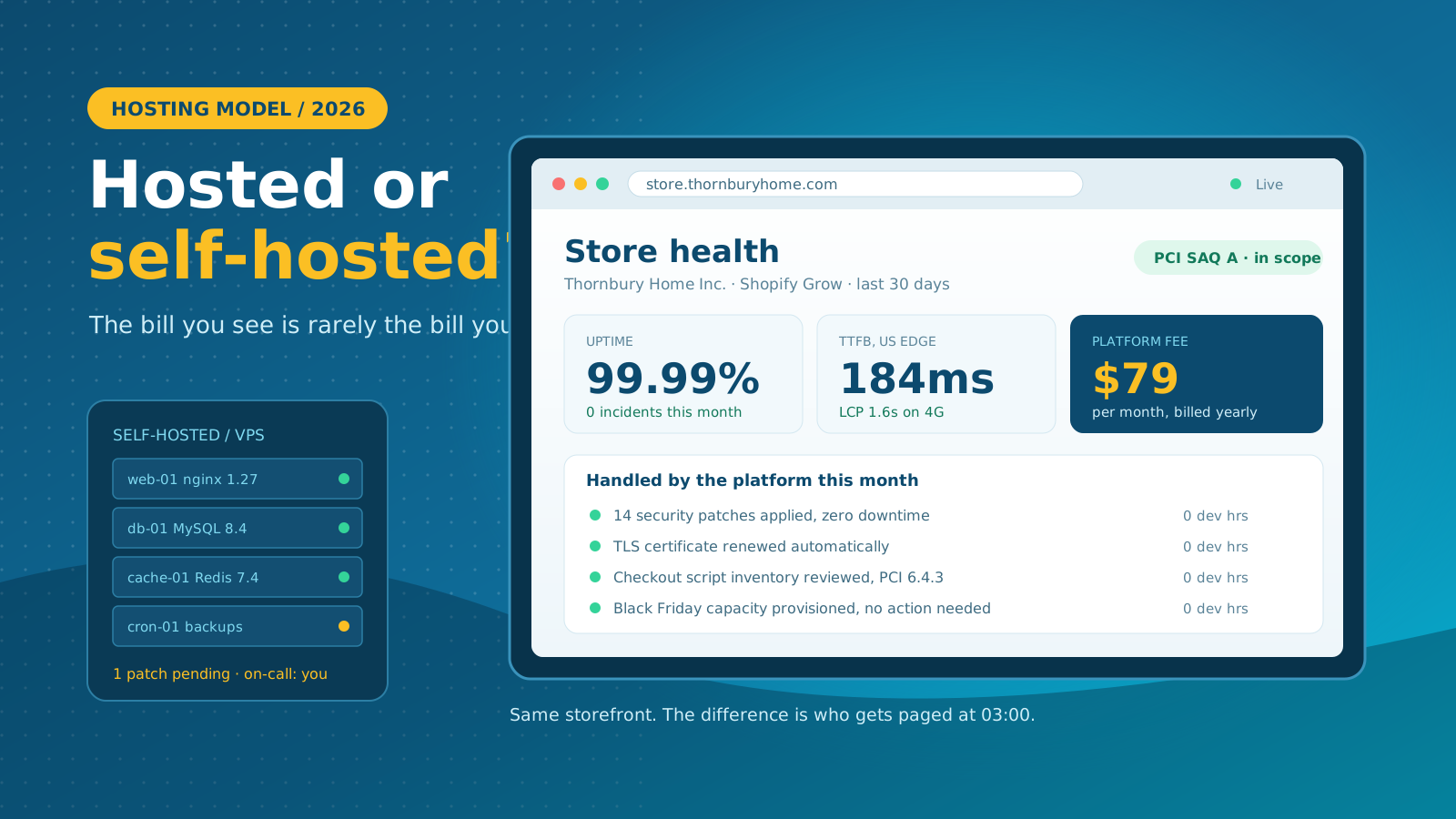
A hosted ecommerce platform is software you rent rather than install. Shopify, BigCommerce, Wix and Squarespace run the servers, the database and the checkout on infrastructure you never touch. Your business gets an admin login, a theme layer, an app ecosystem and an API, plus the commerce features most online stores need as standard: a shopping cart, a payment gateway, inventory management, analytics and SSL certificates. You do not get the source code, and you cannot change how the platform behaves below the surface it exposes.
A self-hosted ecommerce platform is software you install on servers you rent or own. WooCommerce on WordPress, Adobe Commerce, PrestaShop, OpenCart and the newer API-first solutions such as Medusa, Saleor and Vendure all sit here. You have the source code, the database schema and the deployment pipeline, which is where the flexibility comes from. You also have the security patches, the backups, the scaling and the 3am alerts when the site goes down.
The word most guides use for the difference is control. That is accurate but incomplete. What actually changes hands is responsibility. Every capability a self-hosted platform gives you arrives attached to an operational duty, and those duties are staffed by people who charge by the day. That is the trade being made, and it is the one worth pricing against your business needs.
One other definition matters, because the search results for this topic blur it constantly. Ecommerce hosting is not the same as an ecommerce platform. Web hosting is where the code runs. The platform is the code. A self-hosted store needs both decisions made separately, which is a large part of why it takes longer to get right.
Hosted vs self-hosted at a glance
- Servers and infrastructure. Hosted: the provider owns them. Self-hosted: you rent or own the servers, the CDN and the database.
- Security and updates. Hosted: patched centrally, no downtime. Self-hosted: your team applies every patch, on your schedule.
- Features out of the box. Hosted: shopping cart, payment gateway, inventory, analytics, SSL certificates and backups included. Self-hosted: assembled from plugins, extensions and your own code.
- Customization. Hosted: themes, apps and APIs, capped below the platform layer. Self-hosted: unlimited, at the cost of maintenance.
- Data. Hosted: yours, exportable, held on the provider's infrastructure. Self-hosted: yours, on your own site and database.
- Scalability. Hosted: automatic, priced into the plan. Self-hosted: a project you scope, test and pay for.
- Performance. Hosted: consistent load times across the network. Self-hosted: as fast as your infrastructure and your tuning allow.
- Who carries PCI scope. Hosted: mostly the platform. Self-hosted: almost entirely your business.
The Four Models You Are Choosing Between
Hosted versus self-hosted is a useful opening frame, but in 2026 there are four practical options on the table for a US business. Most ecommerce platforms sit clearly in one of them.
- SaaS ecommerce platforms. Shopify, BigCommerce, Wix, Squarespace. The vendor owns the servers, the updates, the PCI scope and the uptime. You own catalog, content and configuration. Fastest to launch, hardest to customize below the theme layer.
- Self-hosted platforms on your own infrastructure. WooCommerce, Adobe Commerce, PrestaShop, Medusa, running on a VPS, a cloud account or bare metal. Full source access, full operational load, maximum flexibility.
- Managed application hosting. WP Engine and similar hosting providers for WooCommerce, or Adobe Commerce Cloud for Magento. The host takes the server layer and some of the patching. You still own the application, the plugins and the custom code.
- Hybrid, or hosted backend with a self-hosted frontend. A SaaS platform keeps the checkout and the commerce engine while you build and deploy the storefront yourself. This is the option almost nobody writing about hosted ecommerce covers properly, and it is where a growing share of ambitious businesses have landed.
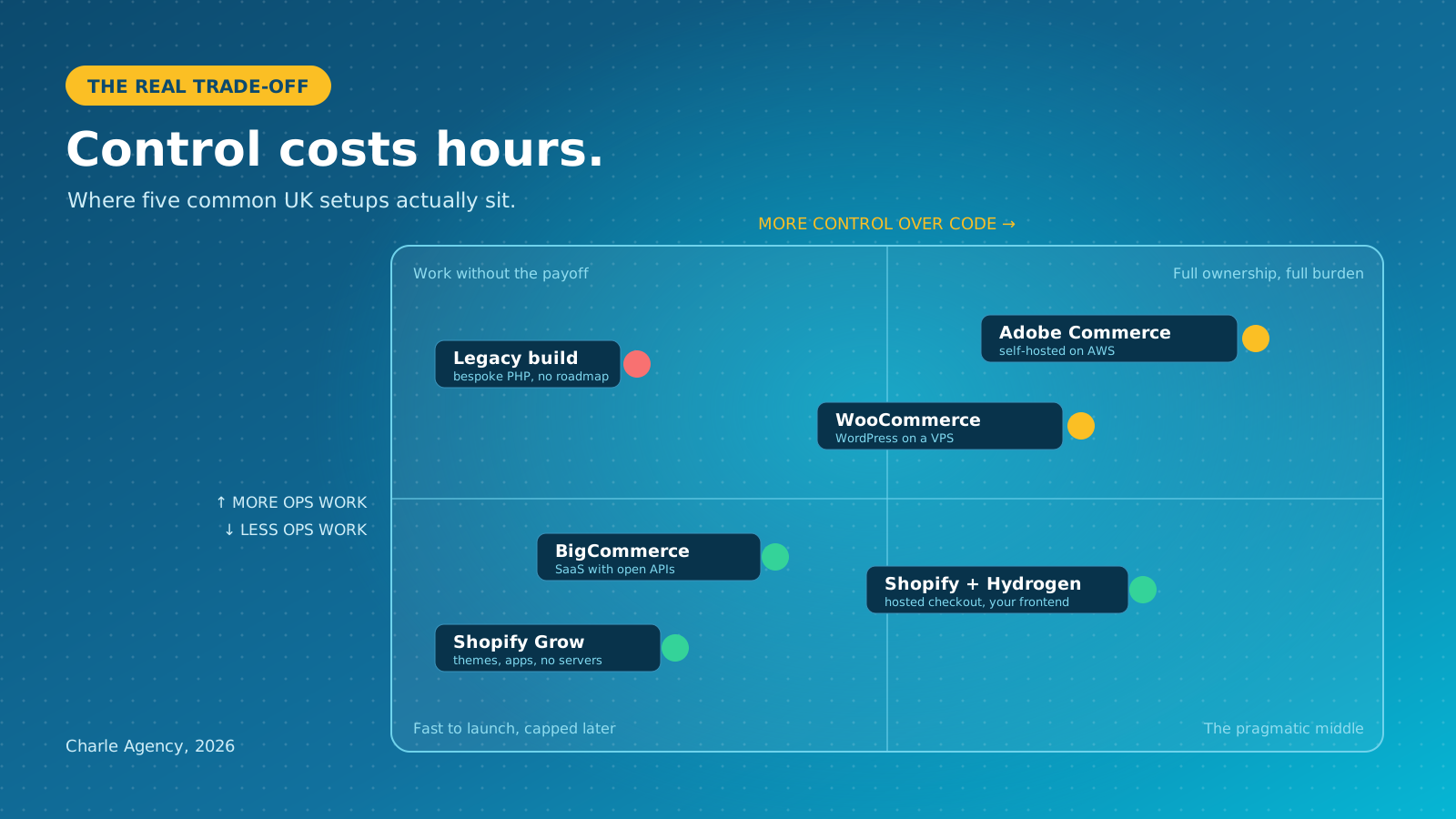
These are not four points on a straight line from simple to powerful. They differ on two independent axes: how much control you get over the code, and how much operational work you take on. Managed WordPress hosting, for example, buys back some ops time without buying back any of the customization ceiling. A bespoke legacy build can hand you total control over the site and no useful features at all.
The reason the distinction matters commercially is that each model prices a different thing. SaaS platforms price access to features. Self-hosted platforms price nothing and charge you in staff time. Managed hosting prices the servers. Hybrid prices the servers and leaves the features to the vendor. Comparing monthly figures across those four models tells you very little on its own.
What Hosted Ecommerce Costs in the US in 2026
Hosted platforms publish their pricing, which is exactly why it dominates the conversation. In the US, Shopify currently runs from $29 per month on Basic to $79 on Grow and $299 on Advanced when billed annually, or $39, $105 and $399 billed monthly, with Shopify Plus starting around $2,300 per month. BigCommerce publishes $39, $105 and $399 tiers for Standard, Plus and Pro. Our full breakdown of Shopify pricing covers the tiers and the fees underneath them.
Those figures cover the platform, the servers, the security patching, the backups and the scalability headroom, which is the point people miss when they compare a hosted subscription against a $5 a month VPS. You are not buying hosting. You are buying an operations team you do not have to hire.
Payment processing sits alongside the subscription and scales with revenue rather than with the hosting model. Shopify Payments in the US charges 2.9% plus 30 cents on Basic, 2.7% plus 30 cents on Grow and 2.5% plus 30 cents on Advanced. Using an external gateway adds a platform transaction fee of 2% on Basic, 1% on Grow and 0.6% on Advanced. Those percentages apply whether you are hosted or not, so they are best left out of any hosted versus self-hosted comparison.
The real hosted costs that surprise people are apps and development. A typical US online store on Grow runs somewhere between $100 and $300 a month in app subscriptions covering reviews, subscriptions, bundling, returns, analytics and search. Theme work, campaign landing pages and integration fixes then need a developer, whether that is a freelancer or an agency retainer. Across the Shopify stores we support, app spend plus development is consistently four to six times the platform fee.
What you are not paying for is the part that makes the comparison lopsided. No servers. No CDN contract. No SSL certificates to renew. No patching window, no backup strategy, no penetration test, no on-call rota, and no scalability project before peak. Those line items do not appear on a hosted invoice because the platform absorbs them into the subscription, which is precisely why hosted pricing looks so much simpler than it is.
What Self-Hosted Costs Once You Count People
Self-hosted solutions are usually described as free. The software often is. The system around it is not, and the published figures from hosting providers make the gap clear once you read past the headline.
Server costs for a self-hosted store typically land between $5 and $250 a month depending on traffic, with a domain name at $10 to $30 a year and SSL certificates anywhere from free to $200. Build cost is the first real jump: $5,000 to $25,000 for a small shop, and north of $100,000 for enterprise implementations. Ongoing maintenance is quoted at $1,000 to $2,000 a month as a store grows. Adobe Commerce is a useful upper marker, with on-premise deployments starting around $22,000 and Adobe Commerce Cloud closer to $40,000 before a single line of custom work.
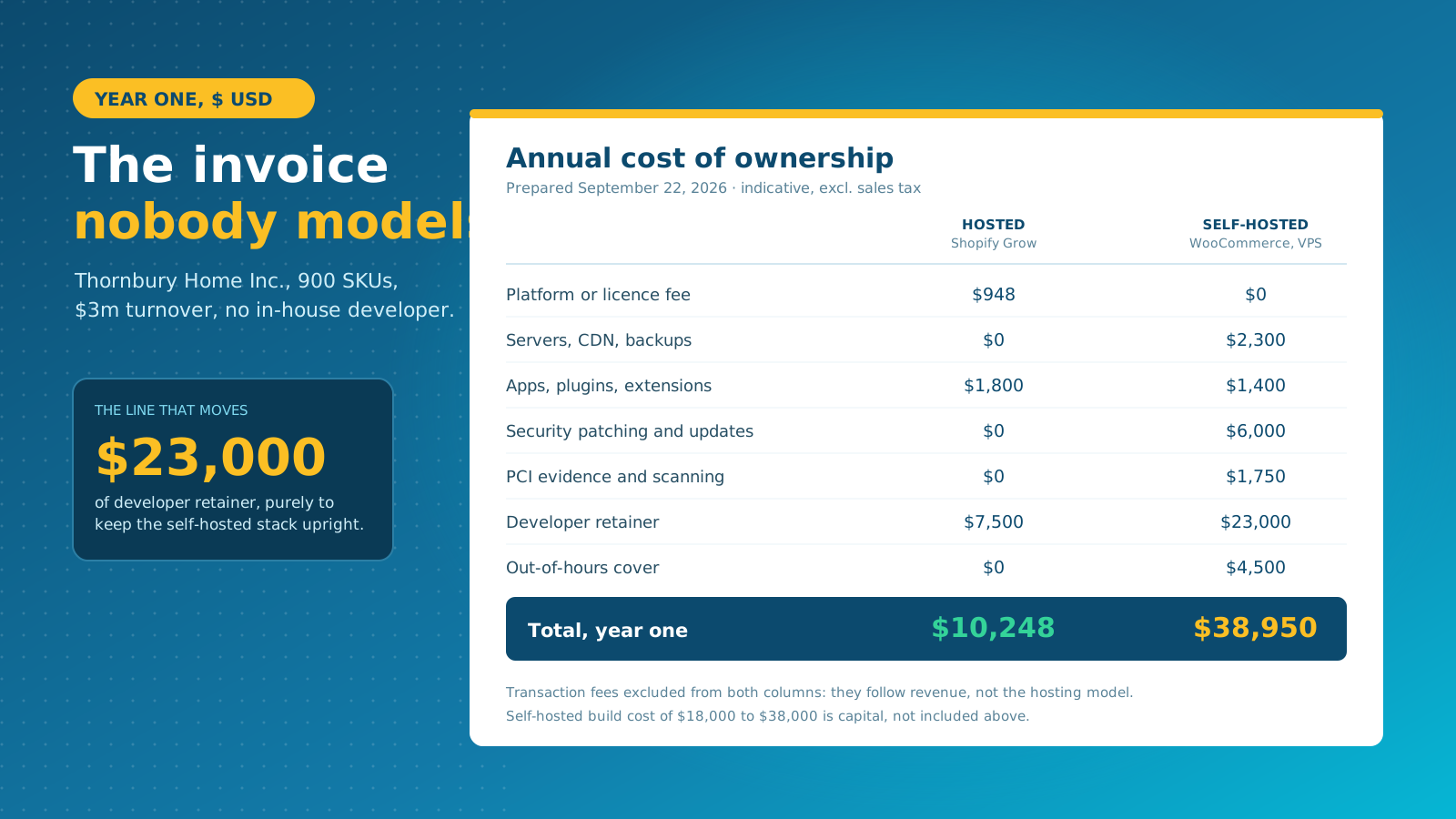
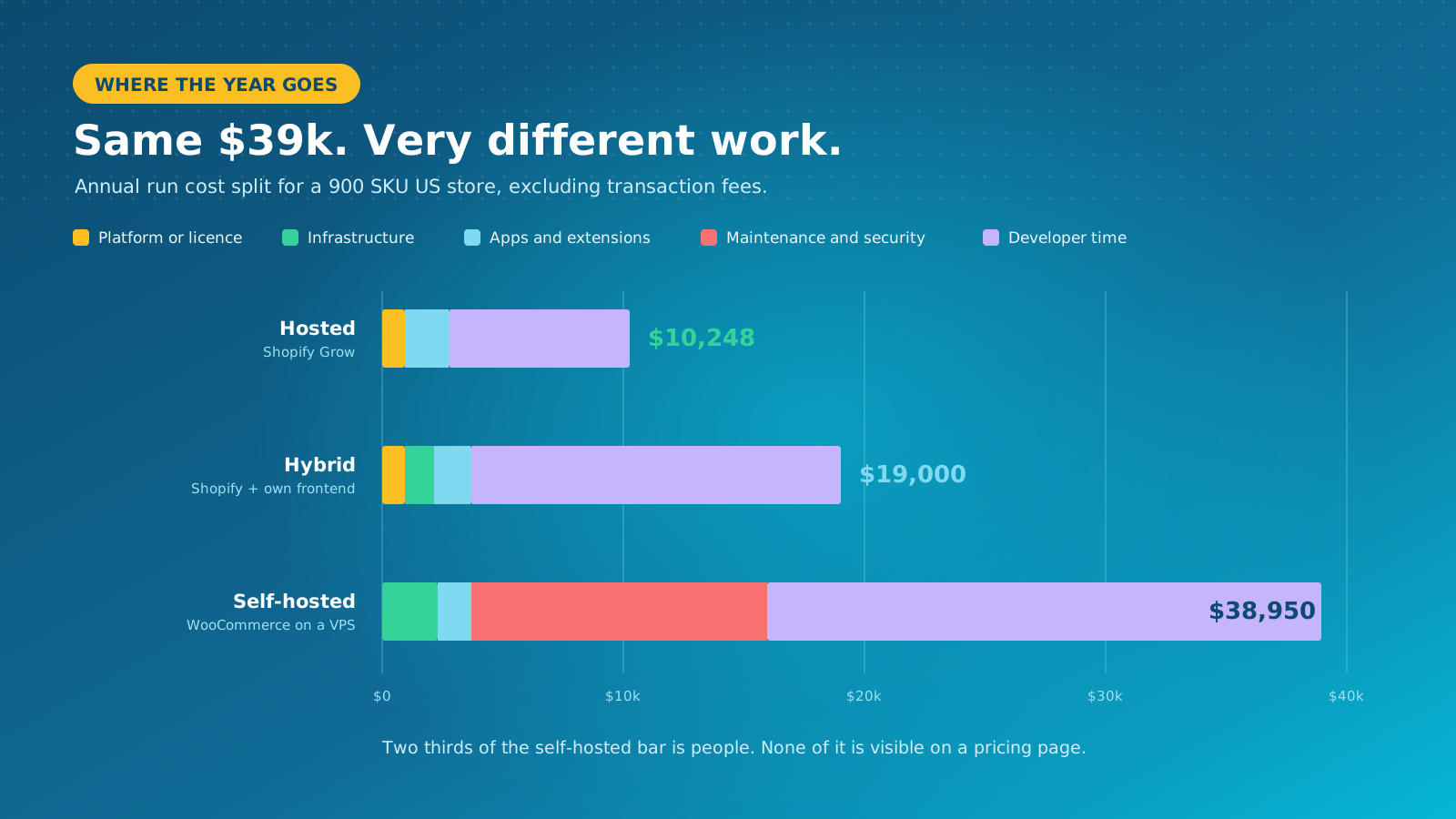
Put a real shape on that. A 900 SKU homeware business selling online, turning over $3m with no in-house developer will spend roughly $2,300 a year on servers, CDN and backups, $1,400 on plugins, $6,000 on patching and updates, $1,750 on PCI scanning and evidence, $4,500 on out-of-hours cover and $23,000 on a developer retainer that exists purely to keep the stack upright. That is around $39,000 a year against roughly $10,000 for the equivalent hosted setup, and the $18,000 to $38,000 build cost sits on top as capital.
Self-hosting becomes the cheaper option when the control it buys earns more than the operations it costs. That happens at scale, with unusual commercial logic, or with a business already staffed to run infrastructure and monitor its own servers. It rarely happens for a business whose differentiator is the products it sells rather than the platform it sells them on.
Two costs are routinely left out of self-hosted business cases and both are material. The first is downtime. An hour offline during a promotion costs more than a year of hosting, and the response plan needs people who are awake and authorised. The second is the replacement cost of knowledge. A self-hosted build depends on whoever understands it, and when that developer leaves, the next one charges for the time it takes to learn a system nobody documented.
PCI Compliance Is Where the Models Diverge Most
This is the change since most of the competing guides on this topic were written, and it materially shifts the maths.
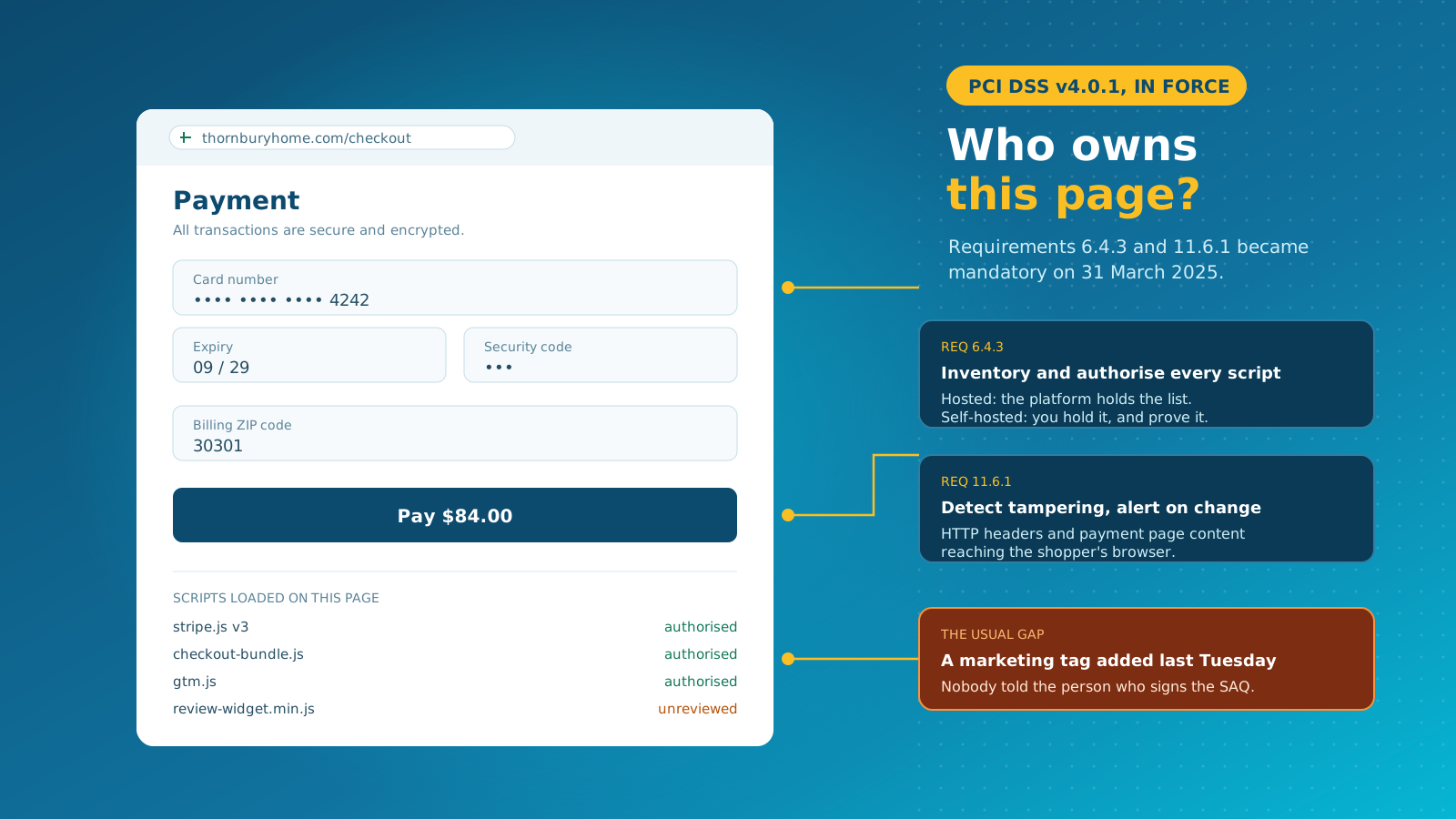
PCI DSS v4.x introduced two requirements that took effect on 31 March 2025 and are now mandatory. Requirement 6.4.3 says every script loaded on a payment page must be inventoried, authorised and integrity-checked. Requirement 11.6.1 says you need a tamper-detection mechanism that alerts on unauthorised changes to HTTP headers and to the payment page content reaching the shopper's browser. Both exist because of digital skimming attacks, where an attacker modifies a script rather than breaching a database.
On hosted platforms, the checkout is the vendor's page on the vendor's servers. Shopify and BigCommerce maintain Level 1 PCI compliance and carry the script inventory and tamper detection as part of the service, alongside the SSL certificates, the firewall and the security monitoring. Your obligation shrinks to a short self-assessment questionnaire and sensible administrative hygiene around who has admin access.
On a self-hosted site, the payment page is yours. You need a documented inventory of every script on it, a justification for each, integrity checks, a change-alerting mechanism and evidence that all of it is working. The usual failure is not technical. It is a marketing or analytics tag added last Tuesday that nobody mentioned to whoever signs the questionnaire. Budgeting for a self-hosted platform without budgeting for this security work is the most common costing mistake we correct during replatforming conversations.
There is a customer-facing dimension too. Customers abandon a shopping cart when a checkout looks or behaves unusually, and a security incident on your own infrastructure is a brand problem long before it is a compliance problem. Hosted platforms give you a payment experience thousands of other online stores have already normalised, which is worth something on a page where trust decides the sale.
Speed, Uptime and Peak Trading
Performance is where the hosted argument is strongest and least appreciated, because it only becomes visible on the days that matter most.
The highest ecommerce conversion rates, averaging around 3%, occur on pages that load in one to two seconds. Every additional second of load time costs revenue across the whole session, not just the page it delays. BigCommerce publishes 99.99% annual uptime and has held 100% uptime through Cyber Week since 2016. Shopify provisions Black Friday capacity centrally, so an online store on Grow gets the same infrastructure headroom as a store on Plus.
A self-hosted online store gets whatever infrastructure it provisioned. Autoscaling a WooCommerce or Adobe Commerce stack through a traffic spike is possible and routinely done, but it is a project with a cost, a test plan and a failure mode. Businesses that skip the load test discover the ceiling on the one afternoon of the year when discovering it is most expensive, and downtime during peak trading is the single most expensive form of infrastructure debt.
Performance also feeds search. Core Web Vitals influence rankings, and AI search engines cite pages they can fetch quickly and parse cleanly. A slow or intermittently available site loses visibility in both classic organic results and assistant answers. Our guide to technical SEO for ecommerce covers how infrastructure decisions surface in search performance.
The counter-argument for self-hosting on performance is real but narrow. Owning the servers means owning the caching strategy, the database tuning and the CDN configuration, and a well-run self-hosted stack can beat a badly configured hosted store. That advantage only materialises when someone is actively working on it. Left alone, a self-hosted site degrades as plugins accumulate, while a hosted platform stays roughly where it started.
The Middle Option Most Brands Land On
The binary framing is the weakest part of most hosted ecommerce comparisons, because the option that resolves it has been production-ready for years. Businesses that want the control of self-hosted solutions and the reliability of hosted platforms no longer have to pick one.
A headless setup keeps the commerce engine, the checkout and the PCI scope on a hosted platform while you build and deploy the storefront yourself. Shopify's Storefront API feeds a Hydrogen, Next.js or Remix frontend that you host on your own infrastructure or on Oxygen. You get full control over markup, routing, performance budget and the customer-facing experience. The vendor keeps the servers, the payment page and the uptime guarantee.
That combination answers most of the reasons businesses cite for wanting self-hosted platforms in the first place. Custom checkout steps, unusual merchandising logic, a bespoke frontend, multi-region routing, custom analytics and deep integration with an existing ERP or inventory system are all achievable without owning a database server. What you do not get is the ability to rewrite core commerce logic, which for the vast majority of businesses is a constraint rather than a limitation. Our guide to headless ecommerce on Shopify covers when the added complexity is justified.
The honest caveat is that hybrid is not free. You now own a deployment pipeline, a frontend codebase and the development time to maintain both. It costs roughly twice a standard hosted setup to run, and about half of a self-hosted one. Choose it because you need the control, not because it sounds modern.
How to Choose
Five questions settle this faster than any feature comparison.
Who patches the server on a Friday afternoon? If the honest answer is nobody, you need a hosted platform. This single question resolves most cases.
What features can you not build today? Write down the specific thing your current platform blocks and what it costs the business. If the list is vague, self-hosting will not fix it, and the flexibility you are buying will sit unused. If it is concrete and commercially material, price a hybrid build before pricing a full self-hosted one.
Who signs the PCI questionnaire? If that person is not a security specialist, keep the payment page and the shopping cart on hosted infrastructure.
What happens on your biggest trading day? If the answer involves load testing, scalability headroom and a capacity plan you have not built yet, hosted servers are buying you something real.
Three businesses, three answers
A 40 SKU skincare business turning over $750,000 online. Two people, no developer, growth coming from paid social and email. Every hour spent on servers is an hour not spent on products and customers. Hosted ecommerce, Shopify Basic or Grow, and the difference in cost put into content and retention. The flexibility of self-hosted platforms would sit entirely unused.
A 6,000 SKU trade supplier turning over $11m across B2B and B2C. Complex pricing tiers, account-level catalogs, an ERP holding the inventory data and a customer base that needs quoting and reordering rather than browsing. This is the business that historically self-hosted Magento. Today, a hosted platform with B2B features plus a headless storefront covers the same requirements with a fraction of the operational load. Our comparison of Shopify against Magento walks through the specifics.
A subscription business whose product is the software. Custom billing logic, per-customer entitlements, usage data feeding the price. Here the commerce layer is genuinely part of the product, the control has commercial value, and the team already runs infrastructure. Self-hosted solutions make sense, because the operational work was happening anyway.
The pattern across all three is the same. The right answer follows what the business actually sells and who is available to look after the site, not which model sounds more capable on a comparison page.
What does exit look like? Hosted platforms create dependency on a vendor roadmap. Self-hosted platforms create dependency on whoever understands your particular build. Both are lock-in. Judge them on how hard the data, the URLs and the integrations are to move, which our comparison of Shopify against other ecommerce platforms works through in detail.
Most US online businesses turning over between $1.5m and $25m are better served by hosted ecommerce platforms, with the investment redirected into merchandising, retention and search rather than servers. Above that, or with genuinely unusual commercial logic, hybrid earns its keep. Full self-hosting makes sense when infrastructure is part of the product your customers are buying. If you are weighing this up for your own store, our Shopify Plus agency team runs this comparison with real numbers from your own P&L. Get in touch and we will cost both routes properly.