 Nic Dunn, CEO, Charle Agency
Quick answer: how to sell B2B on Shopify
To sell B2B on Shopify, you use Shopify Plus, which has native wholesale tools built into the admin of your online store. You create company profiles for each trade customer, assign custom price lists so buyers see their own prices, set net payment terms such as net 30, and give buyers a dedicated B2B checkout. Products, catalogs and inventory are shared with your DTC store, so you run both channels from one store and one platform without a separate wholesale site. Advanced needs like quoting, volume pricing rules and bulk order forms are handled with Shopify Functions or apps such as Sparklayer. The rest of this guide covers each step in detail, including pricing, integrations and the limitations to plan around.

What is Shopify B2B?
Shopify B2B is the platform's built-in solution for wholesale and trade selling, available on Shopify Plus. It lets brands manage both direct-to-consumer (DTC) and business-to-business operations from a single store, with features designed for the complexities of B2B ecommerce: company accounts, customer-specific catalogs, and tailored prices for each buyer.
Unlike the now-deprecated Wholesale Channel, Shopify B2B is fully integrated into the core admin. Merchants create company accounts, assign unique price lists, set payment terms, and provide customized purchasing experiences without third-party apps or duplicate stores. Since Shopify's "B2B for all" rollout, some entry-level wholesale features have reached lower plans, but the full B2B toolset, including multiple price lists, company-level catalogs and B2B checkout, remains a Shopify Plus offering.
Because Shopify B2B sits within Plus, it shares the same infrastructure, order processing and inventory as your DTC business. This unified approach removes the need for a separate wholesale site, which reduces costs and streamlines workflows. Whether you are building a private portal for trade buyers or offering exclusive prices to distributors, Shopify B2B provides the tools to run a scalable wholesale business from the same online store you already trust. You can explore the full feature set on Shopify's B2B page.
Setting Up a Shopify B2B Store
To use Shopify's native B2B features, you'll need an active Shopify Plus plan. If you're weighing up which version is right for your business, see our comparison of Shopify vs Shopify Plus and the benefits of Shopify Plus for scaling brands.
Once you're on Plus, you enable B2B directly from the admin, without third-party apps. Setup focuses on a few core components that define how wholesale customers interact with your store.
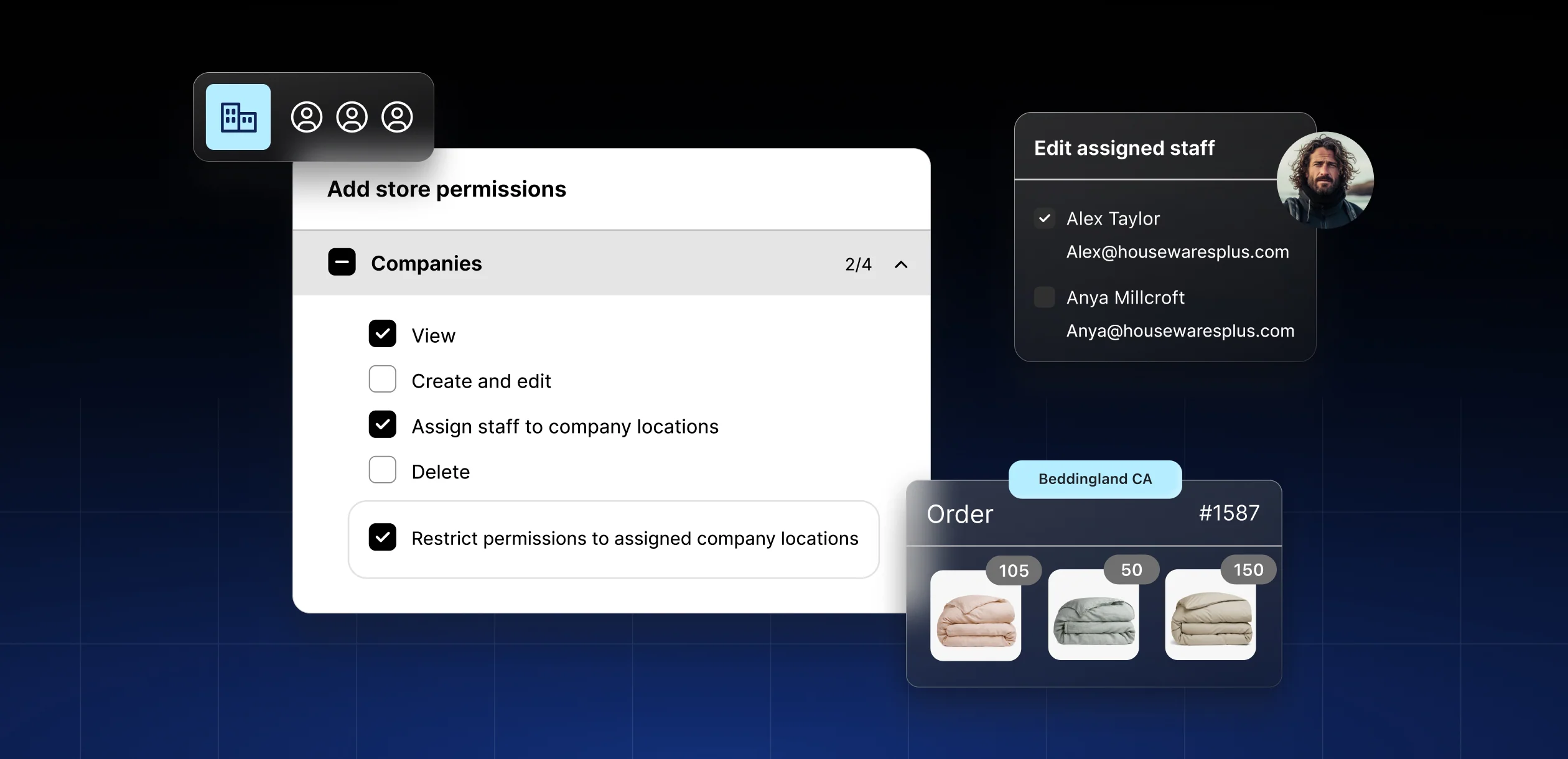
First, you'll create company profiles for each B2B customer. A company can have multiple contacts, associated locations and custom permissions. This mirrors how larger organizations place orders: a head office may approve purchases while branches handle fulfillment.
Next, set up price lists that apply customer-specific or product-specific prices. You can offer volume discounts, trade rates or tiered pricing, all controlled in the admin. Each price list can be assigned to one or more companies, giving you control over visibility and margins.
You'll then define payment terms such as net 30, due on fulfillment, or pay upfront. These terms are tracked by Shopify, helping you manage outstanding invoices and keep your finance team aligned.
Finally, you can build a tailored B2B storefront. This might include login-gated access, unique templates, or dynamic content that changes by customer account. Alternatively, run B2B and DTC from a single store, using Shopify's conditional logic to customize prices, content and checkout flows for logged-in trade users. With these foundations in place, your Shopify Plus store is ready for modern B2B ecommerce, and to scale as your customer base grows.
Key Features of Shopify Plus B2B
Shopify Plus offers a suite of native B2B features built for the complexity of trade and wholesale selling. These tools live directly in the Shopify admin and are purpose-built for brands managing multiple buyer types, pricing structures and order workflows.
Here are the key features that make Shopify B2B a compelling choice for modern ecommerce businesses:
- Company Profiles: Create and manage detailed profiles that represent a business, not just an individual. Each company can have multiple locations and contacts with assigned permissions and roles.
- Custom Price Lists: Offer customer-specific prices across your catalog. Create tiered pricing based on volume, assign different rates to different companies, or apply special discounts to specific SKUs.
- Customer-Specific Catalogs: Control which products and prices each company sees. B2B catalogs are ideal for exclusive product lines, regional restrictions, or distributor-only SKUs, and keep DTC and trade ranges cleanly separated.
- Net Payment Terms: Set flexible terms such as 7, 30 or 60 days. Terms are visible at checkout and tracked in the admin, streamlining invoicing and accounts receivable.
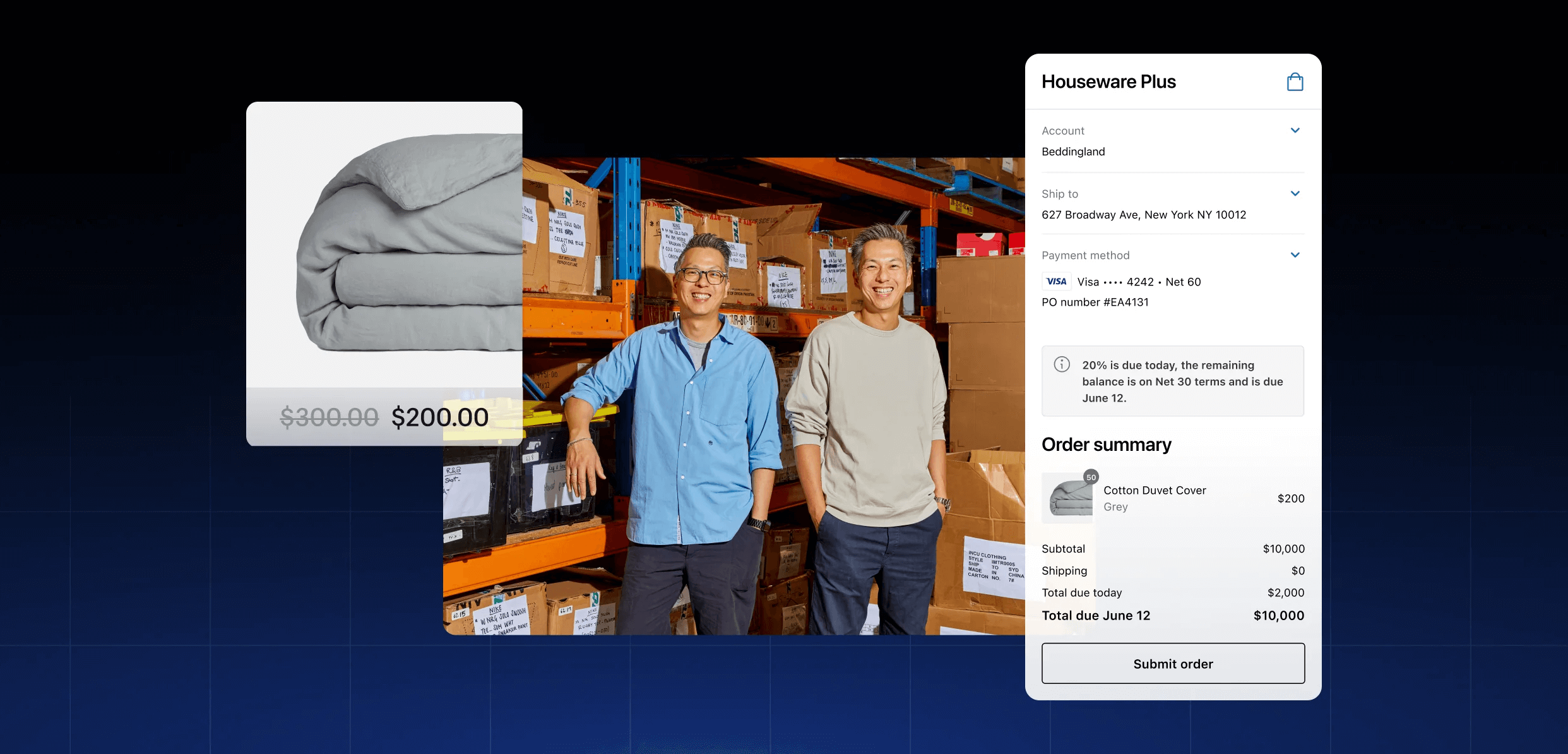
- B2B Checkout: A dedicated checkout for wholesale customers, including payment terms, pre-filled details and optional PO numbers. This speeds up order placement.
- Draft Orders & Bulk Order Forms: Sales teams can build draft orders on a buyer's behalf and send them for payment, while bulk order forms let buyers add many SKUs and quantities in one view, which suits repeat wholesale ordering.
- Multi-Location Support: Allow one company to order across multiple locations, with separate delivery addresses, buyers and order histories under a single account.
- Staff Permissions: Give your team precise control over who can manage prices, approve terms and fulfil B2B orders.
Together, these features give B2B customers a professional buying experience while giving your team the flexibility to scale efficiently. They also remove the need for most third-party B2B apps, reducing your tech stack and maintenance overhead.
Customizing Your B2B Storefront
While Shopify B2B works out of the box, a polished, brand-aligned storefront matters when selling to trade customers. B2B buyers expect a more functional experience than typical DTC shoppers, and Shopify Plus lets you tailor design, content and customization to meet those expectations without compromising your existing setup.
You can run a dedicated B2B-only storefront or a hybrid model where DTC and B2B customers share the same site. In either case, Shopify uses customer tags, Liquid logic and metafields to control what each group sees. That means you can adjust product visibility, display exclusive content, and show custom messaging to logged-in B2B customers.
For brands operating a private portal, Shopify Plus can gate access behind a login and present separate navigation, design or layout. This is especially useful when selling high volumes or complex catalogs that differ from your DTC range. From tailored homepage banners to modified cart logic and checkout fields, you control the frontend, including hiding certain payment or shipping options, adjusting tax display, or offering downloadable catalogs and spec sheets to logged-in buyers.
If you're looking to go further, working with a Shopify Plus agency like Charle can help you design and build a bespoke storefront. Whether you're after a clean functional portal or a fully branded trade interface, our team delivers custom Shopify web design, advanced Shopify development, and tailored theme builds that meet complex business requirements.

Managing B2B Customer Accounts
Effective account management is a cornerstone of successful B2B ecommerce. Shopify B2B introduces company-level account structures that go beyond the standard customer model used for DTC, letting you replicate how real businesses operate, with multiple buyers, branches and locations under a single organization.
Each company profile can include one or more contacts, each with individual logins and permission levels. An accounts manager might view invoices and payment terms, while a buyer can place orders but not manage users or settings. This flexibility lets your wholesale portal align with your customers' internal processes.
Companies can also have multiple locations linked to a single account, which suits distributors, franchise models or multi-site retailers. Each location can have unique shipping details and purchase histories while reporting under a central customer record.
From the Shopify admin, your team can manage B2B accounts just like DTC customers: editing details, assigning price lists, adjusting payment terms, or viewing order history. You can also filter and segment B2B customers for reporting, CRM syncing or marketing workflows. This structured approach brings clarity and control to customer management, reducing errors and making it easier to scale your wholesale operations as your trade base grows.
B2B Pricing, Price Lists & Costs
Pricing is one of the most important levers in B2B ecommerce. Unlike DTC, where prices are typically fixed and public, B2B often needs a flexible, tailored approach. Shopify B2B manages this through native price lists and company-specific pricing rules, so each buyer sees their own prices at every step.
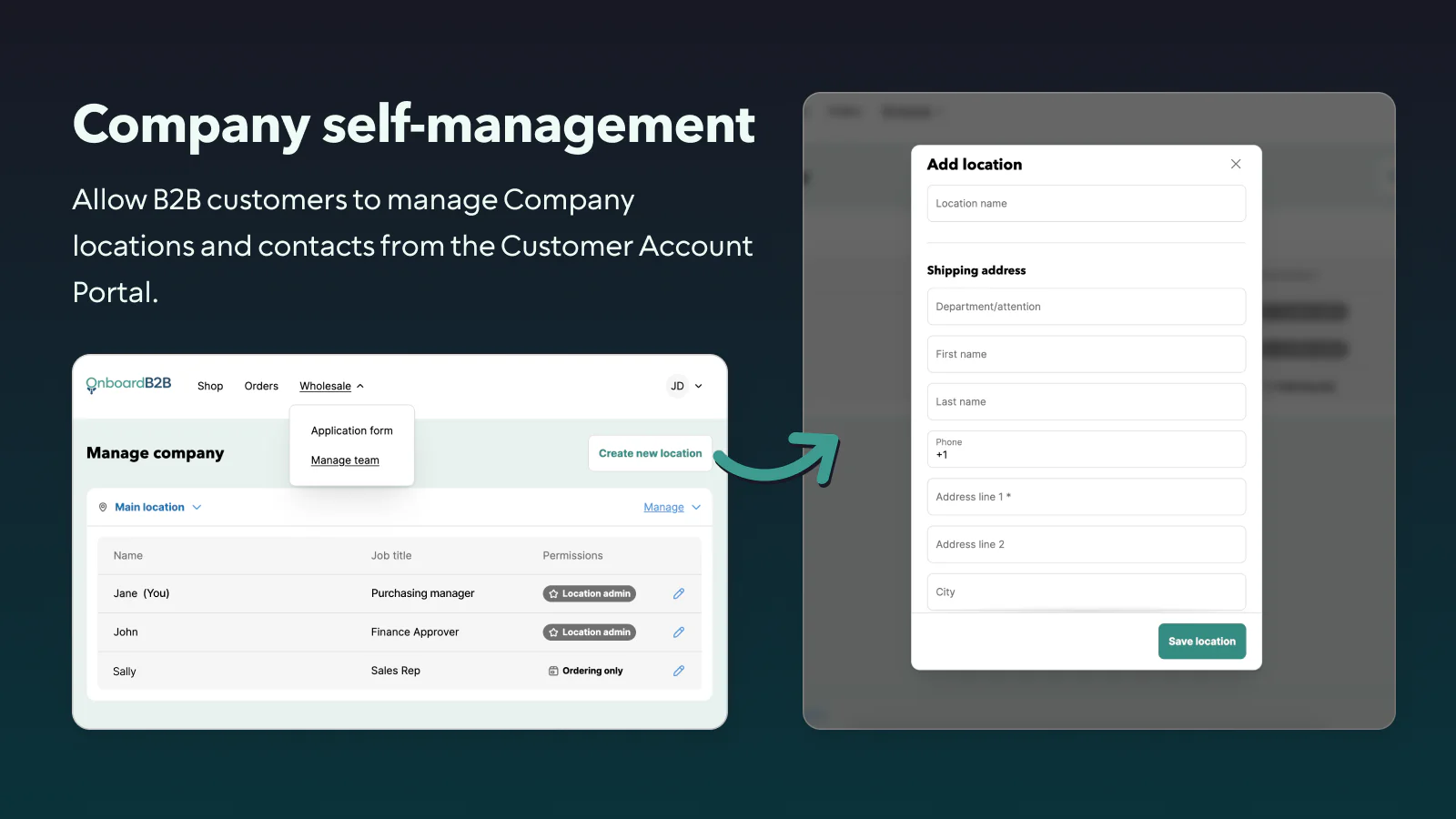
Using price lists, you assign unique prices to different companies or customer groups. This lets you offer wholesale rates, volume pricing and exclusive trade prices without third-party apps or discount codes. Each price list can apply to your entire catalog or selected items, giving you control over margins and visibility.
You can also create tiered pricing and volume price breaks based on order quantities. For example, a customer might pay $10 per unit up to 50 items, and $9 per unit at 51 or more. This incentivises higher order values and streamlines negotiations with high-volume buyers.
On costs, Shopify B2B itself carries no separate license fee: it is included with Shopify Plus, which in 2026 typically starts from around $2,300 to $2,500 per month depending on term and revenue. That single plan covers both your DTC and B2B channels, which is often cheaper than running a standalone wholesale platform alongside your consumer store. For more advanced pricing logic, Plus also supports custom apps, Shopify Functions or ERP integrations to sync prices in real time, ideal for dynamic pricing models across multiple sales channels.
By structuring your pricing carefully, you can serve a wide range of B2B customer types while protecting profitability and operational efficiency.
Bulk Ordering & Draft Orders
Trade buyers rarely add products one at a time. B2B ordering is about repeat, high-volume purchases, so Shopify B2B supports patterns that make bulk buying fast. A bulk order form lets a buyer enter many SKUs and quantities on a single screen, which is far quicker than browsing the storefront product by product, and it mirrors how buyers work from a spreadsheet or order sheet.
Draft orders are equally important. A sales rep can build a draft order on a customer's behalf, apply the right price list and terms, and send it to the buyer for payment or approval. This is useful for negotiated deals, phone or email orders, and accounts that prefer a quote before committing. Combined with volume price breaks, draft orders let your team assemble large wholesale orders accurately without manual workarounds.
For brands that need more, such as a full quoting engine, saved order lists or reorder-from-history flows, apps like Sparklayer extend native bulk ordering while keeping everything inside Shopify. The goal is the same: reduce friction on large orders so buyers can reorder in seconds.
Inventory Management Best Practices
Managing inventory effectively is essential for B2B ecommerce, particularly with high order volumes, large SKU ranges or multiple warehouses. Inaccurate stock levels or delays in replenishment can damage customer relationships and lead to lost revenue. Shopify B2B supports several strategies to help you stay in control.
At the core is real-time stock tracking across all products and variants. For B2B, this ensures trade customers only see products available to ship, reducing backorders and overselling. You can allocate specific inventory to B2B-only products or restrict certain SKUs to wholesale customers using customer tags or product visibility rules.
If you manage stock across multiple locations, Shopify lets you assign fulfillment priorities and route orders based on location availability, optimizing delivery times as your B2B volume scales.
For growing brands, integrating Shopify with inventory or warehouse management systems is key. Whether you use Patchworks, Peoplevox or a bespoke ERP, syncing inventory between your storefront and backend reduces errors and keeps customers informed in real time. B2B-specific considerations such as minimum order quantities, case pack restrictions or lead-time visibility can all be managed within Shopify or through tailored customizations, strengthening trust with your trade customers.
Payment Options & Net Terms
Payment terms play a crucial role in B2B commerce. While DTC customers expect to pay at checkout, trade buyers often require flexibility such as net terms or invoice-based workflows. Shopify B2B makes it easy to configure and manage these without third-party tools.
Within each company profile, you can assign specific payment terms such as due on fulfillment, net 15, net 30 or custom durations. These are reflected automatically at checkout, giving B2B customers a familiar, frictionless experience. Shopify also tracks outstanding balances in the admin, so your finance team can stay on top of accounts receivable and invoices.
For businesses that require partial upfront payment, Shopify B2B can support deposit workflows, for example a 15% deposit at checkout with the balance due on agreed net terms. This suits made-to-order products, large-volume purchases or international accounts, and with custom scripting deposits can be recorded and tied to the original order for full reconciliation.
Shopify also supports standard methods such as credit card, PayPal or manual bank transfer, which can be enabled or restricted per account. Many merchants integrate Shopify with accounting platforms such as Xero, QuickBooks or NetSuite to sync payment status and automate invoice reconciliation. Flexible payment options make it easier for customers to do business with you and can be a genuine competitive differentiator.
Shipping Solutions for B2B Orders
Shipping in a B2B context often needs more complexity than standard DTC fulfillment. From pallet deliveries and bulk shipping rates to location-specific carriers and scheduled dispatches, your shipping strategy must accommodate the operational realities of wholesale customers. Shopify B2B provides the flexibility to configure and scale this logistics.
In the admin, you can define custom shipping rates and rules based on customer tags, order value or location. This lets you offer wholesale-specific methods or free-delivery thresholds to incentivise larger orders, and many brands configure flat-rate shipping by region or account type to simplify pricing.
If B2B orders are fulfilled from multiple warehouses, Shopify supports location-based shipping logic, so orders can be split and routed to the appropriate fulfillment center to reduce delays. For advanced requirements, integrating with platforms such as ShipStation, Shippit or custom 3PL systems can automate rate calculation, label generation and tracking, which helps with high-volume accounts and scheduled deliveries.
It's also worth communicating delivery expectations clearly. Metafields or customer-specific messaging can show estimated lead times, handling policies or shipping documentation at checkout, improving transparency with trade partners. Ultimately your shipping setup should reflect your customers' needs while keeping internal processes scalable.
Essential Integrations for Shopify B2B
For B2B ecommerce to operate efficiently at scale, integrations are often as important as your storefront. Shopify B2B connects with a wide range of systems, enabling seamless data flow across inventory, finance, customer service and logistics.
ERP integration is often the most critical. Platforms like Microsoft Dynamics 365 Business Central, NetSuite and SAP can connect to Shopify to sync product data, stock, prices and customer records in real time. This removes manual input, improves accuracy, and ensures wholesale buyers always see up-to-date information.
CRM tools such as HubSpot or Salesforce support account-based sales and trade marketing. With customer data flowing between platforms, your sales and account teams can track engagement, manage pipelines and segment B2B contacts more effectively.
Automation ties it together. Shopify Flow can trigger internal workflows automatically, for example tagging a new company account, alerting a sales rep when a large order lands, or applying a price list when a buyer is approved. Paired with fulfillment systems such as warehouse management platforms, 3PL providers and shipping aggregators like ShipStation or Mintsoft, automation reduces shipping errors and speeds up pick, pack and dispatch across high-volume accounts.
Pricing and payment logic can also extend via custom integrations. If your ERP houses complex pricing or tiered agreements, Shopify can pull that data directly to display accurate trade prices per customer, with no manual entry. Integration with accounting software such as Xero, QuickBooks or NetSuite automates invoicing and keeps finance aligned with B2B terms and order volumes. Charle regularly supports clients in planning and delivering complex integration projects tailored to their tech stack and commercial needs.
Analytics & Reporting Tools
Strong analytics are vital to understanding and optimizing B2B performance. While many platforms fall short on wholesale reporting, Shopify Plus offers a robust set of tools that give you visibility into how your B2B operation performs across customers, products and orders.
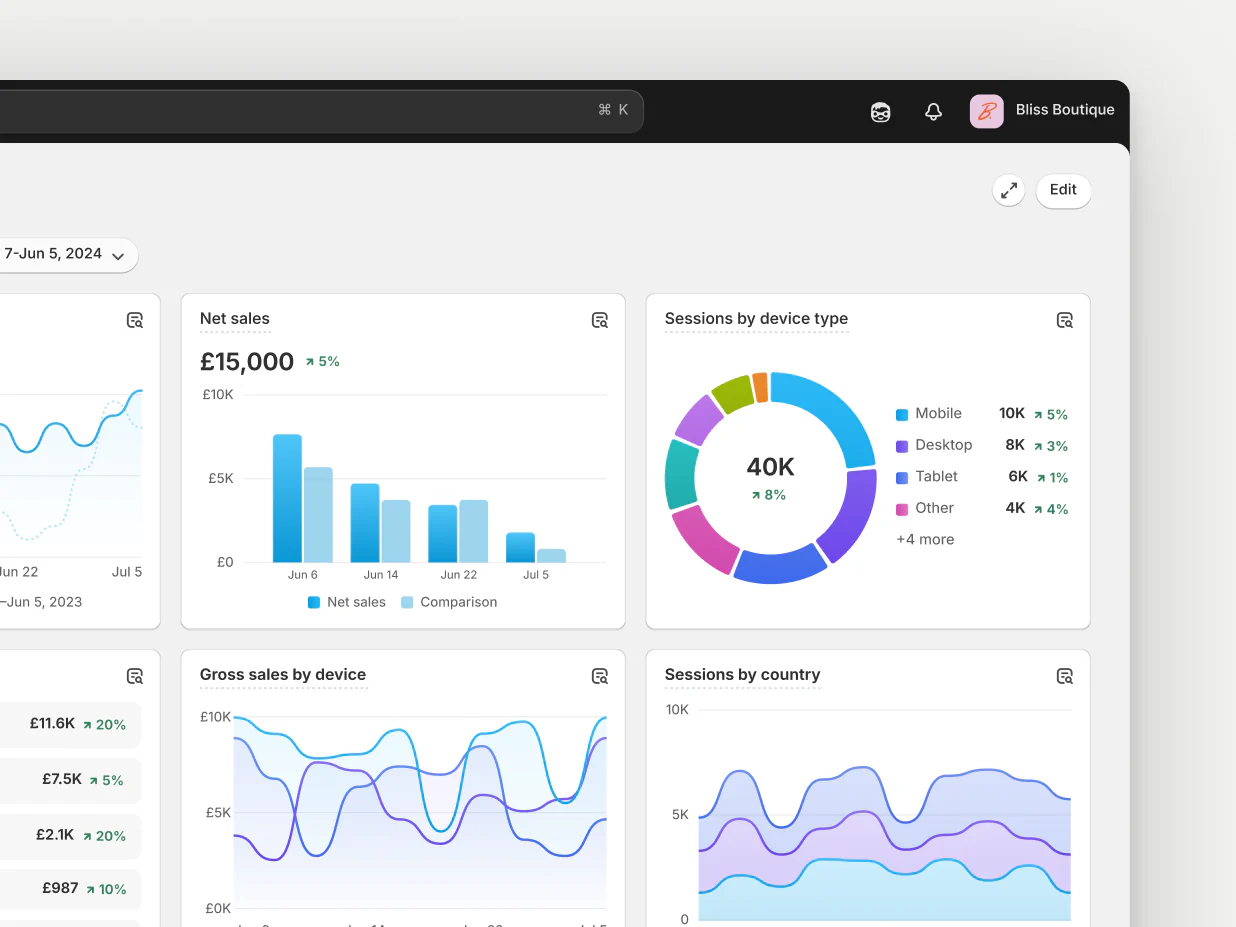
In Shopify's native analytics, you can access key metrics such as average order value, customer lifetime value, top-selling SKUs and sales by customer group. These can be filtered by B2B-specific segments, letting you isolate trade performance from DTC data.
Shopify Plus users also gain advanced reporting, including custom report building and raw data export for deeper analysis, useful for businesses with unique KPIs or internal reporting to finance, sales or operations. For more complex needs, you can integrate Shopify with Google Looker Studio, Power BI or Glew to build real-time dashboards tracking B2B revenue, order frequency, fulfillment speed and customer segmentation.
You can also extend reporting through CRM and ERP integrations. Syncing Shopify order data with HubSpot or Salesforce lets your team track deal stages, pipeline value and account activity alongside web analytics and order history. Investing in the right reporting early helps you make smarter decisions, forecast demand more accurately and identify high-value customers or underperforming segments with clarity.
Marketing Strategies for B2B Growth
Marketing to B2B buyers requires a different approach from DTC campaigns. While consumer marketing often focuses on emotion and impulse, B2B decision-makers are influenced by long-term value, operational fit and purchasing efficiency. Shopify B2B gives you the tools to run targeted campaigns that resonate with trade customers.
Email marketing remains one of the most effective channels for B2B ecommerce. Platforms like Klaviyo integrate with Shopify to deliver segmented campaigns, automated reorder flows and personalized recommendations. You can trigger content based on company profiles, order history or account type to keep every touchpoint relevant.
Content marketing is another valuable strategy. Educational resources such as buying guides, spec sheets and case studies help position your brand as a trusted supplier. Host these on gated B2B pages, or use them in lead generation aimed at trade buyers searching for solutions online.
LinkedIn Ads, account-based marketing (ABM) and direct outreach are also highly effective for identifying and engaging high-value customers, especially in niche industries. With Shopify's integration capabilities, marketing activity can be tracked alongside order data for clearer attribution and ROI. Consider customer-specific incentives too, such as early access to new products, exclusive price tiers or loyalty-based discounts, delivered through automated flows to drive repeat orders and strengthen relationships over time.
Limitations & Workarounds
While Shopify B2B has come a long way, some limitations remain. Most can be addressed with workarounds or custom development, but it's worth planning around them during setup or migration.
The most common challenge is advanced pricing logic. Native price lists support tiered and customer-specific prices, but may not be enough for businesses with rules based on customer type, contract duration or real-time market conditions. In these cases, integrating with your ERP or building a custom pricing app provides the flexibility required.
Another area is account-level permissions and approval workflows. If your buyers require multiple approval steps before ordering, or need spending limits per user, this isn't supported natively, but it can be achieved through custom storefront logic or B2B apps.
Multi-language and multi-currency support is available in Shopify Plus, but becomes more complex when combined with B2B prices and catalog restrictions. For global B2B brands, a multi-store architecture may be the best route, with each storefront tailored to the region's language, prices and tax configuration. And while the B2B checkout is streamlined, deeper customization requires Shopify's checkout extensibility APIs or Shopify Functions for custom fields, dynamic shipping logic or external payment flows.
For brands with more complex requirements, many pair Shopify with Sparklayer. Sparklayer adds a full quoting engine, order draft tools and more advanced account permissions, plus custom catalog visibility and tiered pricing overlays. The quoting engine in particular lets sales teams or buyers generate formal quotes inside the B2B portal, which can later be converted into orders. For teams that want more control without heavy custom development, it's a strong middle ground between native Shopify B2B and fully bespoke builds. Despite these limitations, Shopify B2B remains a strong, scalable option for most wholesale operations, and an experienced Shopify Plus agency can design workarounds that preserve your customer experience.
When to Choose Shopify for B2B
Shopify B2B is a powerful option for brands looking to simplify operations, modernise their wholesale experience and consolidate multiple sales channels into a single platform. With native B2B built into Shopify Plus, it's easier than ever to manage DTC and trade customers in one unified environment.
Shopify B2B is ideal for businesses that:
- Sell to both trade and DTC audiences and want to manage both from one platform
- Need flexible prices, customer-specific catalogs and payment terms
- Are moving away from legacy B2B systems or custom-built platforms
- Want to integrate cleanly with ERPs, CRMs and fulfillment providers
- Value fast deployment and the ability to customize storefronts as they scale
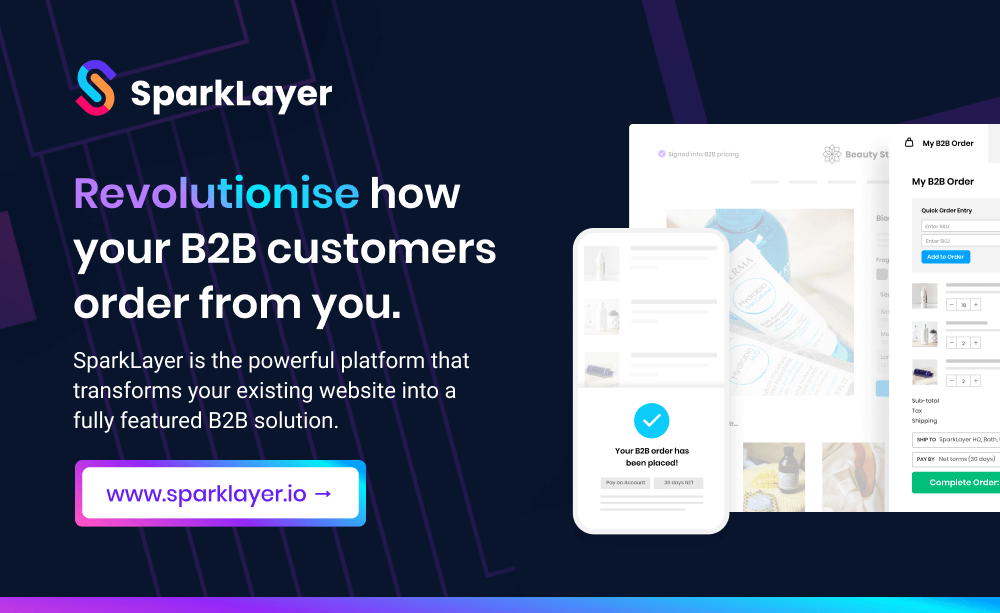
For brands with more complex requirements such as quoting workflows, advanced account permissions or configurable catalogs, apps like Sparklayer can be layered on top of Shopify to add functionality. Sparklayer integrates with Shopify Plus and offers a dedicated B2B portal, live stock visibility, custom price lists, draft order tools and a full quoting engine, letting brands create tailored B2B experiences without leaving the Shopify ecosystem.
With the right architecture, Shopify Plus can support a wide range of B2B use cases, from simple wholesale portals to highly bespoke trade environments. If you're planning a new B2B store or migrating from an older platform, Shopify is a future-proof choice that balances usability, scalability and performance. If you're unsure how to approach setup, our team can help define the right strategy and build a B2B experience that aligns with your goals.
Our view on native B2B vs apps
After building wholesale setups on Shopify Plus across fashion, beauty, luxury and food and drink brands, here's the honest position we take with clients: start with native Shopify B2B and only reach for an app when a specific requirement forces it. Native B2B covers company accounts, price lists, catalogs and net terms cleanly, and every feature you add on top is another integration to maintain. We've built B2B portals where the whole brief was met natively, and the store was faster and cheaper to run for it.
The one place we consistently recommend going further is quoting. If your sales team negotiates deals or your buyers expect a formal quote before they commit, native draft orders get you part of the way but a tool like Sparklayer earns its keep with a proper quoting engine and saved order lists. That's the decision we'd make: native by default, Sparklayer when quoting or advanced approvals are non-negotiable, and full custom development only for genuinely complex pricing logic that neither can handle.
Explore our full Shopify B2B and wholesale services to see how we support brands like yours. Or, if you're ready to discuss a project, get in touch with our team.