 Nic Dunn, CEO, Charle Agency
Best BNPL Apps for Shopify: Comparison Table
| Rank | App | Payment Model | Best For | Merchant Fees |
|---|---|---|---|---|
| 1 | Shop Pay Installments | Pay in 4 or monthly | All Shopify merchants | Included with Shopify Payments |
| 2 | Afterpay | Pay in 4 interest-free | Gen Z and millennial shoppers | Flat % per transaction |
| 3 | Affirm | Monthly installments up to 60 months | High-value purchases | Merchant fee varies |
| 4 | Klarna | Pay in 4, Pay Later, Financing | Fashion and lifestyle brands | From 2.49% + variable |
| 5 | PayPal Pay Later | Pay in 4 | Brands with PayPal checkout | Standard PayPal rates |
| 6 | Sezzle | Pay in 4 interest-free | Budget-conscious shoppers | 6% + $0.30 per transaction |
| 7 | Zip | Pay in 4 interest-free | Mid-range purchases | Origination fee |
| 8 | Splitit | Use existing credit card | High-ticket items | Per-transaction fee |
8 Best Buy Now Pay Later Apps for Shopify (2026)
The following apps represent the best BNPL solutions currently available for Shopify merchants in the US. Each has been selected based on real-world integration experience, conversion impact, customer reach, and merchant fee structures. Whether you are looking for maximum market coverage or a niche solution tailored to your specific product category, one of these providers will meet your needs.

1. Shop Pay Installments
- Best For: All Shopify and Shopify Plus merchants
- Pricing: Included with Shopify Payments (no extra app cost)
- Payment Options: 4 interest-free payments or monthly financing
- Availability: UK, USA, Canada
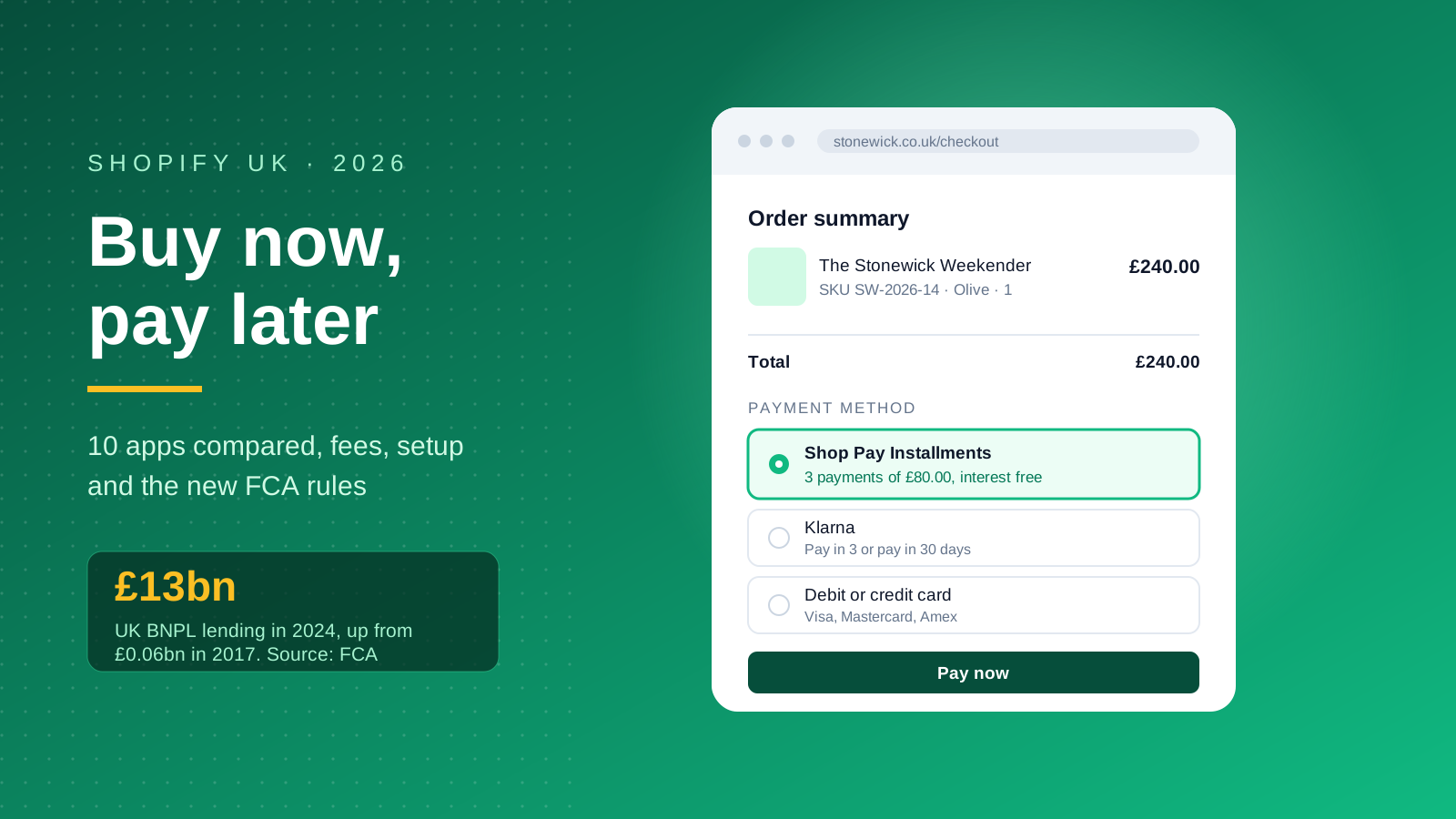
Shop Pay Installments is Shopify's native BNPL solution, powered by Affirm. If you are already using Shopify Payments, Shop Pay Installments should be your first choice for one simple reason: it requires zero additional integration work and remains entirely within the native Shopify checkout environment. There is no redirect to a third-party site, no additional loading screens, and no friction points introduced by switching to an external provider's interface.
This frictionless experience delivers measurable conversion benefits. Merchants enabling Shop Pay Installments typically report 20-30% increases in conversion rates and 30-50% increases in average order value. The feature appears seamlessly within the payment method selector, positioned as a native part of the Shopify checkout experience. Customers choosing this option never leave your environment, which is psychologically powerful from a trust and conversion perspective.
The pricing is the strongest differentiator here. Because Shop Pay Installments is included with Shopify Payments, there is no incremental app fee. You pay the standard Shopify Payments transaction fees you are already paying, and the BNPL feature costs you nothing additional. For merchants already committed to Shopify Payments, this represents exceptional value and gives you a competitive advantage over smaller stores that may find third-party BNPL fees unaffordable.
Key features: Native integration, no app required, zero additional costs, integrated decisioning, no customer redirect, Shop Pay one-click checkout compatibility, detailed reporting, instant approval for most customers, compliance managed by Shopify.
Why choose them: If you are already on Shopify Payments, Shop Pay Installments is the obvious choice. The conversion metrics are the strongest in the industry because of the frictionless checkout experience. The pricing is unbeatable for established merchants already paying Shopify Payments fees. We recommend Shop Pay Installments as your primary BNPL option and a second provider (like Afterpay or Affirm) as a backup for customer choice.

2. Afterpay
- Best For: Gen Z and millennial-focused brands
- Pricing: Flat percentage per transaction
- Payment Options: Pay in 4 interest-free bi-weekly installments
- Availability: US, UK (as ClearPay), Australia, New Zealand, Canada
Afterpay is the dominant BNPL provider for the US market, with over 20 million US customers and partnerships with major retailers including Nike, Target, Ulta Beauty, and many more. Owned by Block Inc. (formerly Square), Afterpay has built a reputation as the go-to BNPL provider for younger generations, with particularly strong appeal among Gen Z and millennial shoppers. The platform's integrated shopping discovery feature helps merchants reach new customers beyond their immediate audience.
The Afterpay model is refreshingly simple. Customers pay in 4 equal bi-weekly installments, entirely interest-free. If a payment is missed, a late fee applies, but there is no interest charged. The straightforward nature of this offering appeals to younger customers who appreciate the simplicity compared to competitors' multiple options. Afterpay's underwriting is lenient, meaning approval rates are generally high, which boosts conversion metrics for merchants.
The platform's shopping discovery network is particularly valuable for brands wanting to reach new audiences. Afterpay customers browse merchants on the platform itself, creating a source of incremental traffic beyond your own marketing efforts. This makes Afterpay especially valuable for growing brands that need both conversion uplifts from existing traffic and access to new customer cohorts. The brand recognition is exceptional in the US market.
Key features: Simple pay-in-4 model, shopping discovery network, integrated messaging, merchant dashboard with forecasting, fraud protection, flexible refund handling, next-day settlement.
Why choose them: If your target audience is Gen Z or millennials and you operate in the US market, Afterpay delivers both conversion benefits and customer discovery. The simplicity of the pay-in-4 model means less customer confusion at checkout compared to platforms offering multiple payment options. The shopping discovery feature provides a direct channel to potential new customers in a market where Afterpay has massive penetration.

3. Affirm
- Best For: High-value purchases on Shopify
- Pricing: Merchant fees vary by plan
- Payment Options: Monthly installments from 4 payments to 60 months, 0-36% APR ($50-$30,000)
- Availability: USA, Canada, expanding UK
Affirm is the largest pure-play BNPL provider globally and the US-founded technology behind Shop Pay Installments. In addition to powering Shopify's native BNPL, Affirm is available as a standalone integration for merchants wanting access to Affirm's broader financing options. The key strength of Affirm is the range of financing terms available, from short-term pay-in-4 up to 60-month financing plans at various APR levels.
Affirm's decisioning engine is sophisticated, offering different terms and APR to different customers based on their creditworthiness. For high-value purchases like furniture, appliances, or luxury goods, this ability to offer longer-term financing (up to 60 months) or variable APR is transformative. A customer might be able to finance a $3,000 sofa over 36 months at a reasonable APR, whereas traditional BNPL providers cap out at $500 or $1,000 limits.
Affirm's US dominance and institutional relationships mean the platform is increasingly available across multiple channels. The real-time decisioning means customers see exactly what terms they qualify for before committing to purchase, reducing surprises and chargebacks. For US merchants selling high-value items, Affirm is the leading choice.
Key features: 60-month financing options, variable APR terms, real-time decisioning, white-label option, merchant dashboard with insights, fraud protection, highest spending limits in BNPL industry, Shop Pay integration.
Why choose them: If you sell high-value items or want to offer longer-term financing options, Affirm is the gold standard. The flexibility to offer everything from four-payment plans to five-year finance at various APRs means you can serve a wider range of customer financial situations. Affirm's dominance in the US market and institutional relationships make this the safest choice for high-ticket sellers.

4. Klarna
- Best For: Fashion and lifestyle Shopify stores
- Pricing: From 2.49% + variable per transaction
- Payment Options: Pay in 4, Pay Later 30 days, monthly financing
- Availability: US, UK, Europe, Australia
Klarna is a global BNPL leader that continues to grow its US presence and reach. The platform processes billions in annual spending across the US and counts household names like Sephora, Adidas, Expedia, and many major retailers among its merchant partners. The Shopify integration is straightforward via the Klarna app, and the platform offers sophisticated on-site messaging widgets that appear contextually during the customer shopping journey, encouraging larger basket sizes before checkout.
What sets Klarna apart is the flexibility of its payment options. Unlike competitors offering fixed installments, Klarna presents customers with Pay in 4, Pay Later (full amount in 30 days), or monthly financing options, allowing each customer to select the payment method that suits their cash flow. The platform's real-time decisioning means most approvals happen instantly, and the redirect checkout experience has been refined over years to minimize friction.
We have integrated Klarna across multiple Shopify Plus builds and the conversion uplift is consistently strong. Customers respond particularly well to the brand trust that Klarna carries, especially in fashion and lifestyle verticals. The merchant fee structure is competitive at the lower end, and Klarna's underwriting means you have lower chargeback rates compared to some alternatives.
Key features: On-site messaging, Pay in 4 and later options, integrated decisioning, native Shopify Payments integration, comprehensive merchant dashboard with analytics, fraud protection included, next-day settlement.
Why choose them: If you operate a fashion or lifestyle brand targeting US customers, Klarna is an excellent choice. The brand recognition is growing in the US market, and the diversified payment options give customers flexibility. The integration is simple to Shopify, meaning minimal technical overhead.

5. PayPal Pay Later
- Best For: Stores already using PayPal checkout
- Pricing: Standard PayPal transaction rates apply
- Payment Options: Pay in 4 interest-free installments ($30-$1,500)
- Availability: US, UK, Australia, Germany, France, Spain, Italy
PayPal Pay Later represents an evolution of PayPal's offering, extending the power of the PayPal brand into the BNPL space. With over 400 million active PayPal accounts globally, the platform leverages existing customer trust and payment relationships to offer BNPL functionality without requiring new account creation or credit checks. For customers already logged into their PayPal account, enabling pay later is as simple as selecting it from their payment menu.
The simplicity of the PayPal ecosystem provides a unique advantage. Customers who already trust PayPal for their general spending are predisposed to trust PayPal Pay Later. This is particularly valuable for older demographic cohorts who may be hesitant about newer BNPL providers or unfamiliar with brands like Klarna or Afterpay. The buyer protection that PayPal is famous for extends to PayPal Pay Later transactions, providing an extra layer of customer confidence.
From a technical perspective, if you already accept PayPal checkout on your Shopify store, PayPal Pay Later appears automatically without requiring separate integration work. The $30 to $1,500 spending window is well-suited for mid-range purchases, though it does not handle very small impulse purchases or high-value luxury items. The lack of additional app fees makes PayPal Pay Later cost-effective for merchants already using PayPal.
Key features: Leverages existing PayPal accounts, no new credit checks, standard PayPal buyer protection, four equal interest-free payments, no separate integration required if using PayPal Checkout, broad geographic availability, competitive transaction rates.
Why choose them: If your customer base skews towards older demographics or PayPal users, PayPal Pay Later is a valuable addition to your payment options. The brand trust is exceptional, and the lack of technical implementation complexity is appealing. The combination with PayPal Checkout is particularly powerful for stores that already accept PayPal.

6. Sezzle
- Best For: Budget-conscious Gen Z shoppers
- Pricing: 6% + $0.30 per transaction
- Payment Options: 4 interest-free bi-weekly payments
- Availability: USA, Canada, growing UK presence
Sezzle has positioned itself as the responsible BNPL provider, emphasizing customer financial health and literacy. The platform includes Sezzle Up, a feature that helps customers build credit scores while using BNPL services. This appeals particularly to younger customers who are early in their credit journeys and value the opportunity to demonstrate creditworthiness alongside accessing immediate purchasing power.
The transparent fee structure (6% plus $0.30 per transaction) is straightforward for merchants to budget. Sezzle does not include hidden charges or variable fees that fluctuate based on customer behavior. For merchants operating on thin margins, this predictability is valuable. The platform also offers payment rescheduling functionality, allowing customers to adjust payment dates if they face temporary financial hardship, which reduces missed payments and chargebacks.
Sezzle's backend analytics are robust, giving merchants insights into customer behavior, repeat purchase rates, and BNPL adoption patterns. The platform has strong presence in the US and Canada market and is a solid alternative to the more established Afterpay and Affirm if you want to differentiate your offering or reach customer segments prioritizing financial responsibility.
Key features: Sezzle Up credit-building feature, flexible payment rescheduling, transparent fee structure, comprehensive merchant analytics, customer education focused, responsible lending messaging, mid-size transaction focus.
Why choose them: If your audience values financial responsibility and you want to position BNPL as part of a customer's credit-building journey, Sezzle is distinct. The clear fee structure and rescheduling functionality reduce the risk of missed payments. Strong US and Canada presence with growing market share make this a solid choice.

7. Zip
- Best For: Mid-range purchases
- Pricing: Origination fee
- Payment Options: Pay in 4 interest-free over 6 weeks
- Availability: US, Australia, UK
Zip (formerly Quadpay) is an Australian-founded BNPL provider that is rapidly growing its US presence and market share. What differentiates Zip is the six-week payment structure for its pay-in-4 model, which gives customers more breathing room between payments compared to traditional bi-weekly models. For mid-range purchases, spreading payments across six weeks rather than four fortnights can be the difference between abandoning a purchase and completing the transaction.
Zip operates with an origination fee model that provides merchants with transparent, predictable costs. The platform offers both in-store and online BNPL functionality, making it valuable for omnichannel retailers. The Zip merchant platform includes sophisticated analytics and forecasting tools that help you understand BNPL adoption patterns and predict revenue impact.
The six-week model is particularly effective for mid-range purchases. For a $150 purchase, customers paying in four installments over six weeks are only committing to approximately $37-$40 per payment, which feels more accessible than weekly or bi-weekly alternatives. This psychological difference can drive meaningful conversion uplift in retail and lifestyle categories where Zip is building momentum in the US market.
Key features: Six-week payment structure, origination fee model, in-store and online support, detailed merchant analytics and forecasting, white-label checkout option, fast settlement, omnichannel capabilities.
Why choose them: If you operate a retail or lifestyle business selling mid-range items and want an alternative to the major US players, Zip's six-week model and origination fee transparency are attractive. The platform's growing US presence means now is an excellent time to explore partnership. The omnichannel support is valuable for merchants expanding beyond pure online sales.
8. Splitit
- Best For: High-ticket Shopify stores
- Pricing: Per-transaction fee, no consumer fees
- Payment Options: Split payments using existing credit card
- Availability: US, UK, Canada, Australia, Europe
Splitit represents a fundamentally different approach to BNPL. Rather than requiring customers to apply for credit or undergo a new financial product, Splitit splits charges across multiple transactions on a customer's existing credit card. This means customers need no new application, no credit check, and no additional accounts to manage. The approval is instantaneous because Splitit is simply dividing existing credit card transactions.
This model eliminates a major pain point of traditional BNPL. Customers can approve payments instantly without providing personal data, which is particularly valuable for privacy-conscious users and builds trust more quickly than competitors requiring formal applications. For merchants, this means no chargebacks related to payment failures or non-approval because the payment method already exists and has been verified by the customer's bank.
The lack of interest and fees for consumers is a significant differentiator. Customers are not taking on debt or paying interest to split their purchase. Splitit has secured significant partnerships including Samsung Wallet integration, making it particularly popular with merchants selling high-ticket electronics and luxury items. For US merchants selling premium products, Splitit removes barriers to conversion.
Key features: No new credit applications, instant approval, no consumer interest or fees, uses existing credit cards, Samsung Wallet integration, white-label option, global availability, fraud prevention included.
Why choose them: If you sell high-ticket items (electronics, furniture, luxury goods), Splitit removes barriers to conversion by making payment splitting frictionless. The elimination of credit checks means faster approvals and more satisfied customers. The Samsung Wallet partnership is increasingly valuable as digital wallet adoption grows.
What Is Buy Now Pay Later?
Buy now pay later is a payment method that allows customers to make purchases immediately and pay for those purchases over a series of installments, typically without interest. Unlike traditional credit products that require credit checks and formal applications, BNPL products emphasize speed and simplicity. A customer can be approved for BNPL in seconds using just an email address and basic identity information.
From a merchant perspective, BNPL works by the provider paying the merchant the full order value immediately (or within one business day), and then collecting payments from the customer in installments. The merchant gets paid upfront, the customer gets flexible payment, and the BNPL provider assumes the credit risk. The merchant pays a fee, typically between 2% and 8% per transaction, for this service.
BNPL has evolved to include two distinct models. Transparent BNPL (interest-free models from Afterpay, Klarna, and others) appeal to customers who want flexibility without cost. Finance BNPL (from providers like Affirm) offers longer-term options with variable interest rates, serving customers making larger purchases who need more affordable monthly payments. Both models are valuable depending on your product category and price points.
Benefits of Buy Now Pay Later for Shopify Merchants
The primary benefit of BNPL for merchants is an immediate uplift in conversion rates. Customers frequently abandon shopping carts because the total price feels unaffordable at the moment of purchase. BNPL removes this barrier by allowing customers to spread payments across weeks or months. The psychological impact of "four payments of $50" feeling more affordable than a single $200 charge is well-documented and powerful.
The secondary benefit is increased average order value. When customers know they can pay in installments, they are more willing to purchase higher-value items or add additional products to their basket. Merchants consistently report AOV increases of 30-50% after enabling BNPL. For a store generating $100,000 monthly in sales, a 40% AOV increase represents $40,000 in additional monthly revenue before considering the BNPL fees.
BNPL also attracts younger customer demographics. Customers aged 18-35 have higher BNPL adoption rates than older cohorts, and enabling BNPL on your store signals that you understand modern purchasing preferences. This is particularly valuable for fashion, beauty, and lifestyle brands where younger customers represent significant market share.
The final major benefit is competitive advantage. If your competitors do not offer BNPL and you do, you capture customers that would otherwise shop elsewhere. Conversely, if your competitors offer BNPL and you do not, you lose customers at checkout who specifically search for BNPL options. BNPL has become so common that not offering it increasingly feels like a competitive disadvantage rather than a differentiating feature.
How to Choose the Right BNPL App for Your Shopify Store
The most important factor in choosing BNPL is understanding your customer demographics. If your core audience is Gen Z and millennials, Afterpay is likely to outperform alternatives because your customers are already familiar with the brand in the US market. If your audience skews older, Klarna or PayPal Pay Later might resonate more strongly. If you are unsure, Shop Pay Installments is the safest choice because it requires no additional integration.
The second factor is your average order value. If your typical order is under $100, simple four-payment BNPL solutions (Afterpay, Klarna, Shop Pay Installments) work well. If your average order is $500 or above, you need a provider like Affirm or Splitit that handles higher values. If you sell furniture or electronics with orders regularly exceeding $2,000, Affirm's longer-term financing is essential.
Merchant fees should factor into your decision, but do not make it the primary consideration. A provider charging 6% but delivering a 40% conversion uplift is vastly superior to a provider charging 3% but delivering no uplift. Run the mathematics: if adding BNPL increases your conversion rate by 25% with a 3% fee, is that better or worse than your current situation? In nearly all cases, the conversion uplift more than offsets the fee.
Integration complexity matters less for Shopify merchants than for other platforms because Shopify provides native apps for all major BNPL providers. However, Shop Pay Installments requires literally zero integration work if you are already on Shopify Payments, making it the easiest option. If you want multiple BNPL providers, consider how many separate integrations your team can manage and support.
Finally, consider your specific product category. Fashion brands benefit most from Afterpay and Klarna. High-ticket sellers need Affirm or Splitit. Electronics retailers need Affirm. If you sell mid-range items, Zip and Sezzle are solid choices. Rather than trying to optimize for every possible BNPL provider, choose one or two that match your specific business model and customer base.
How BNPL Affects Shopify Checkout Conversion
BNPL increases conversion by solving the most common reason customers abandon shopping carts: sticker shock at the total payment amount. When a customer sees a $300 total and realizes they need to pay the entire amount immediately, many will leave the store. When that same customer sees "four payments of $75", the purchase feels far more accessible and the abandonment risk drops significantly.
The visibility of BNPL options within your checkout is critical. For Shop Pay Installments, the option appears natively within the payment method selector, making it prominent without being intrusive. For external BNPL providers, the visibility depends on how prominently you display their payment buttons and messaging. Many merchants find that adding simple messaging like "or split into 4 payments" above the add-to-cart button has measurable impact on conversion even before checkout.
BNPL also functions as a trust signal. When customers see that your store accepts Afterpay or other reputable BNPL providers, it signals that you are a legitimate, established business. The presence of multiple payment options including BNPL is subconsciously interpreted as a signal of trust. This is particularly powerful for new stores or brands that customers are less familiar with.
The data shows that customers specifically searching for BNPL options have higher intent and lower bounce rates. These customers are actively selecting BNPL at the payment stage, meaning they have already decided to purchase and simply want to split the payment. Supporting BNPL means you capture these high-intent customers that alternative payment methods might miss.
How to Set Up BNPL on Your Shopify Store, Step by Step
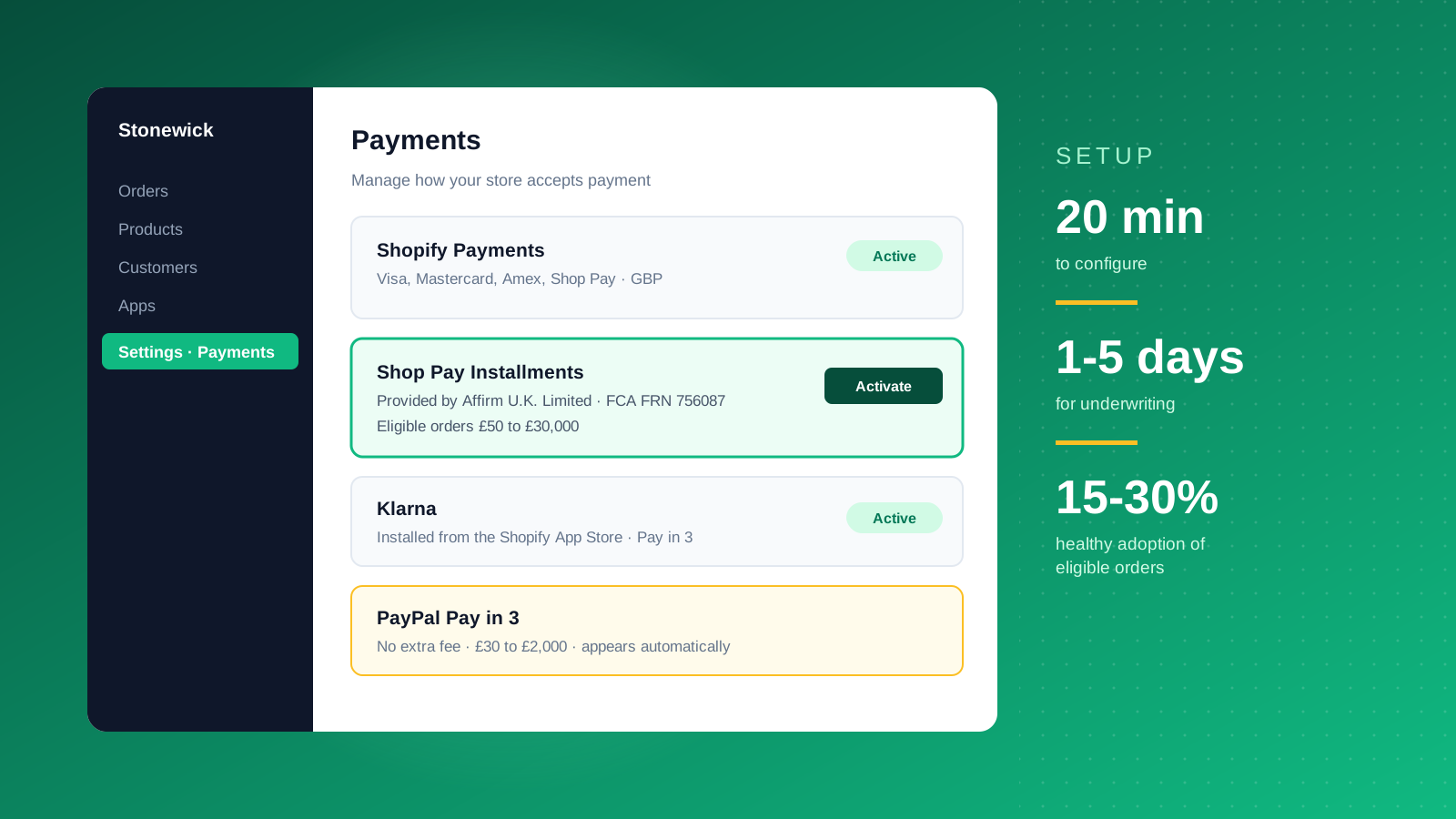
The technical setup is the easy part. Most of these apps take twenty to thirty minutes to configure, and the real waiting is the provider's underwriting decision on your business, which typically runs one to five business days.
Step one: check your eligibility before you start
Shop Pay Installments has the tightest eligibility criteria. Your store must be based in the United States, selling in USD, with Shopify Payments active and Shop Pay switched on. If you run a third-party gateway instead of Shopify Payments, Shop Pay Installments is not available to you at any price, and that alone is often the argument for moving. For third-party providers the gate is commercial rather than technical: expect them to ask for trading history, monthly volume and your product categories.
Step two: install from the Shopify App Store
Afterpay, Affirm, Klarna, Sezzle, Zip and Splitit all publish apps in the Shopify App Store, and installation follows the standard flow: search the app, review the permissions it requests, install, then connect it to your merchant account or open a new one. Shop Pay Installments needs no app; you enable it from Settings, then Payments, inside your Shopify admin. PayPal Pay Later needs nothing either if you already accept PayPal Checkout.
Before installation, read what each app asks for. Payment apps request access to orders, customers and checkout, which is appropriate, but check the permissions against the app's stated function and confirm the vendor's security and data handling standards. Every provider in this list is PCI compliant and none require you to handle card data yourself, which is one of the quieter advantages of using an established company over a bespoke installment plugin.
Step three: turn on on-site messaging
This is where the conversion actually comes from, and it is where most stores stop too early. Every major provider ships an on-site messaging component that renders the installment breakdown on your product pages, in the cart and at checkout. Add it through the theme editor as an app block, position it directly beneath the price rather than below the fold, and check it updates correctly when a customer switches variant. A hard-coded price in a messaging block will show the wrong figure on a more expensive size or colorway.
Step four: order your payment methods deliberately
In Settings, then Payments, you control the order that payment methods appear at checkout. Cards first, then your primary BNPL option, then anything else. Offering five installment providers in a stack does not increase conversions, it increases the time a customer spends comparing them, and comparison at the payment step is where carts go to die.
Step five: test properly before you announce it
Place a real low-value test order through each provider and take it all the way to a completed order, then refund it and watch what happens to the installment plan, because refund handling differs between providers and is the thing your customer support team will be asked about first. Check the messaging renders on Safari on iOS and Chrome on Android, not just on desktop, since most BNPL traffic is mobile. Confirm the order appears in your Shopify admin with the right gateway attributed, and confirm settlement lands on the schedule the provider promised.
Step six: measure adoption, then optimize
Track what share of eligible orders actually use BNPL. Somewhere between 15% and 30% of eligible orders is a healthy range for a store with prominent messaging. If you are below that, the usual cause is placement rather than provider choice, and moving the messaging above the fold on product pages is the highest-leverage fix. Shopify's own data suggests adding an installments banner to product and cart pages can lift installment order volume by up to 55%.
Merchant Fees and the Real Cost Per Order
Merchant fees are what store owners worry about most and model least. Getting this right is what separates BNPL that lifts conversions from BNPL that quietly eats margin across a whole year of online sales.
Model the decision properly rather than shopping on headline rate. Take a $150 order at a 45% gross margin, so $67.50 of gross profit. A 5% BNPL processing fee costs $7.50, taking gross profit to $60, an 11% reduction. For that to be worth doing, BNPL needs to generate more than 11% incremental gross profit through some combination of higher conversions and higher order values. On the published uplift figures it comfortably does. The math gets uncomfortable at low margin: the same 5% fee on a product carrying a 20% margin consumes a quarter of your gross profit, and at that point BNPL needs to be pulling in genuinely incremental orders rather than cannibalizing card payments you would have won anyway.
The cannibalization question is the one nobody asks. If half your BNPL orders are customers who would have paid by card regardless, you are paying a processing fee premium on those orders for nothing. The way to test it is to look at what happened to total orders, not to BNPL orders, in the eight weeks after you switched it on. If total order volume moved, the fee is buying you something. If only the payment mix moved, it is not.
Processing fees are not the only line worth modeling. Some providers require a down payment or deposit from the customer at the point of purchase, typically the first of four installments. Others charge a monthly account minimum. Ask specifically how processing fees are applied to partial refunds, chargebacks and currency conversion before you sign, because those three are where the effective rate drifts above the headline rate. Refunds usually do not return the processing fee, so a high-return category pays it twice in effect. And settlement timing varies: most providers pay within one to three business days, slower than card settlement and worth factoring into cash flow if you order stock against incoming revenue.
Pros and Cons of the Main Providers at a Glance
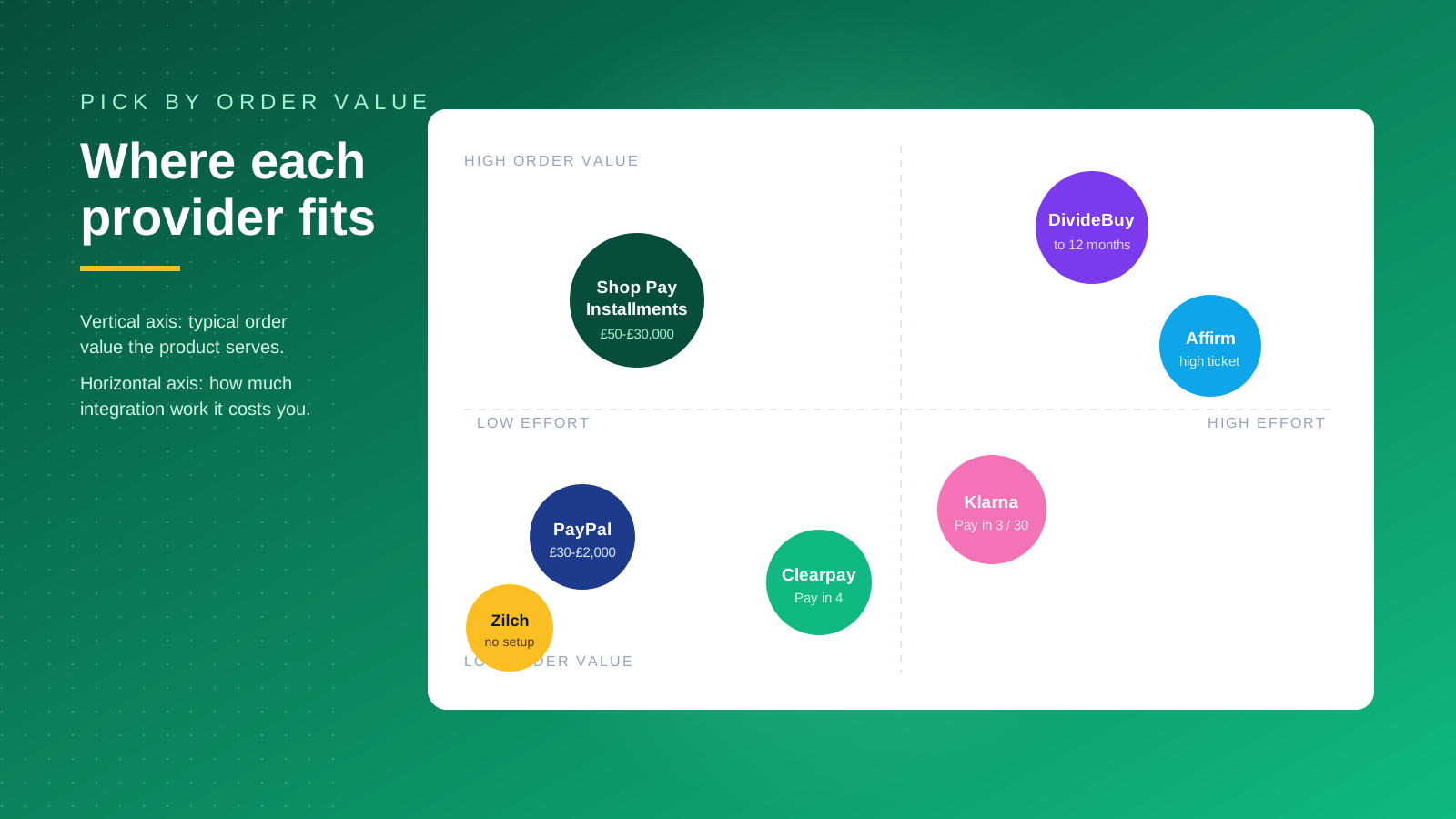
Every provider trades something away to be good at something else. Below are the pros and cons of each, written for store owners deciding where to spend integration time rather than for shoppers comparing companies.
Shop Pay Installments
Pros: No redirect, no app, no separate merchant account, no additional app fee, and the widest order value range in the list. The Standard package covers orders from $50 to $1,000 and the eligibility-gated Premium package covers $35 to $30,000 with monthly installments up to 24 months. Lending is provided by Affirm and Affirm's lending partners, so Affirm carries the repayment risk and you are paid in full up front. Cons: Requires Shopify Payments, which rules it out entirely if you use another gateway. Less consumer brand recognition than Affirm or Afterpay carry in their own right.
Affirm
Pros: The strongest option for high-ticket items, with terms running from pay-in-four biweekly out to 60 months and credit lines up to $30,000. It financed over 31.3 million purchases in Q3 2025 across more than 350,000 merchant partners, so the underwriting is mature. Interest runs 0% to 36% depending on term and buyer. Cons: Higher merchant cost than pay-in-four products, and irrelevant if your average order value sits under $200.
Afterpay
Pros: Genuinely strong with younger buyers, a simple four-payment structure over six weeks with no interest, and a large user base at over 24 million customers across 348,000-plus brands. Now owned by Block following its acquisition by Square, and rebranded to Cash App Afterpay in the US in March 2025. Cons: One payment structure only, so no route to serve high-value order values. Spend limits often start low, around $600, which frustrates first-time buyers.
Klarna
Pros: Three payment structures rather than one, mature on-site messaging, and real brand pull. It became Walmart's official US BNPL partner in March 2025 and listed on the NYSE in September 2025 under the ticker KLAR. Interest runs 0% for Pay in 30 Days and Pay in 4, and 0% to 35.99% for monthly financing. Cons: A redirect flow that adds a step, and no published merchant rate card.
PayPal Pay Later, Sezzle, Zip and Splitit
Pros: PayPal Pay in 4 caps at $1,500 per transaction with Pay Monthly up to a $10,000 credit line, and it appears automatically if you already accept PayPal. Sezzle offers 0% pay-in-four plus monthly financing at 5.99% to 34.99% and processed $3.6 billion between September 2024 and September 2025. Zip runs a six-week, four-payment structure. Splitit is the outlier: it uses the customer's existing credit card balance rather than issuing new credit, so there is no application at all, and it partnered with Samsung Wallet in 2025 across 21 states and DC. Cons: Each is narrower than the big three. Zip has no US monthly financing product. Splitit only works for customers who already have available credit.
What the Shopify App Store Reviews Actually Tell You
Before you install anything, read the app listing reviews rather than the marketing page, because the two describe different products. Review counts and star ratings on the Shopify App Store are the single best free signal of what integrating a provider is actually like, and they consistently surface three things the vendor pages never mention.
The first is support responsiveness. Payment apps break in ways that cost money immediately, and the reviews are where you find out whether a provider answers within hours or within weeks. Look specifically at the one-star and two-star reviews and check whether the vendor has replied to them, because a vendor that publicly answers complaints tends to answer tickets too.
The second is theme compatibility. On-site messaging blocks are the most common failure point, and reviews tell you whether a provider's widget works cleanly with Dawn and the standard Online Store 2.0 themes or whether merchants are routinely paying developers to make it render.
The third is settlement and reconciliation. Merchants complain in reviews about payout timing and about how transactions map into their accounting exports long before any of that appears in a comparison article. If a provider has a pattern of reconciliation complaints, that is a real cost in your finance team's time even though it never appears in the fee.
Star ratings on their own are a weak signal. Read what the stars are attached to, and look at the size of the user base behind the score, because twenty reviews from a niche app and two thousand from a major provider carry very different weight. Read the most recent thirty reviews rather than the overall score, particularly for providers that have rebuilt their integration on Shopify's checkout extensibility framework in the last eighteen months.
Testing, Troubleshooting and the Problems You Will Actually Hit
Once the setup process is done, the failures are predictable. These are the ones that come up on almost every build, with the fix for each.
The installment figure is wrong on variant change
A messaging block that renders $30.00 on the small and still says $30.00 on the large is the most common bug, and it happens when the block reads the product's base price rather than the selected variant. Test every product template. Some themes need the app block re-added after a theme update because the section reference breaks silently.
The badge does not render on some browsers
Check Safari on iOS and Chrome on Android specifically. Provider scripts are usually fine on desktop and occasionally fail on older mobile browsers where a content security policy or a lazy-loading script blocks them. Since the majority of BNPL traffic is mobile, a badge that only renders on desktop is close to worthless.
Refunds and partial refunds
Issue a real refund on a test order and watch what happens to the customer's repayment options. Full refunds cancel the remaining installment plan cleanly with every major provider. Partial refunds are where behavior diverges: some providers reduce the final payment, others recalculate the whole schedule, and your customer support team needs to know which before a customer asks.
The app is approved but nothing shows at checkout
Usually a currency or country mismatch. Shop Pay Installments will silently not appear if your store's default currency is not USD. PayPal Pay in 4 is unavailable in six states, so a customer in Georgia, New Mexico, North Dakota, Missouri, South Dakota or Wisconsin will not see it. Providers also apply order value floors and ceilings, so a $22 basket will not show an option with a $30 minimum, and that is correct behavior rather than a fault.
Reconciliation does not match your accounts
Each provider settles on its own schedule and its own fee deduction pattern, which is the strongest practical argument for running two providers rather than five. Export a month of transactions from each provider and reconcile them against your Shopify payouts before you consider the integration finished, because finding a mismatch in month one is an afternoon and finding it at year end is a week.
Where BNPL Sits in the Rest of Your Payment Stack
Buy now pay later is one payment method among several, and it works best when the rest of the stack is deliberate. Digital wallets now carry a majority of ecommerce transactions, so Shop Pay, Apple Pay and Google Pay belong at the top of your checkout ahead of installment options, because a returning customer wants speed rather than credit. Installments are for the moment the total gives someone pause, which is a different job.
Think about it by order value. Under about $50, installments rarely change a decision and a fast wallet checkout converts better. Between $50 and $600, pay-in-four does real work. Above $600 you are into genuine point-of-sale financing with a longer term, which is a different product. Mapping your order value distribution against those bands is a twenty-minute exercise in Shopify analytics that will tell you more than any comparison article, including this one.
The same logic applies to your gateway choice. If you run a third-party payment gateway rather than Shopify Payments, you are locked out of Shop Pay Installments entirely, and that is a large cost to carry for a small saving on card rates. Our guides on Shopify conversion rate optimization and choosing the right Shopify payment gateway cover the neighboring decisions, and if you sell internationally, international pricing on Shopify affects which installment options a customer is offered in each market.
Buy Now Pay Later Trends for 2026
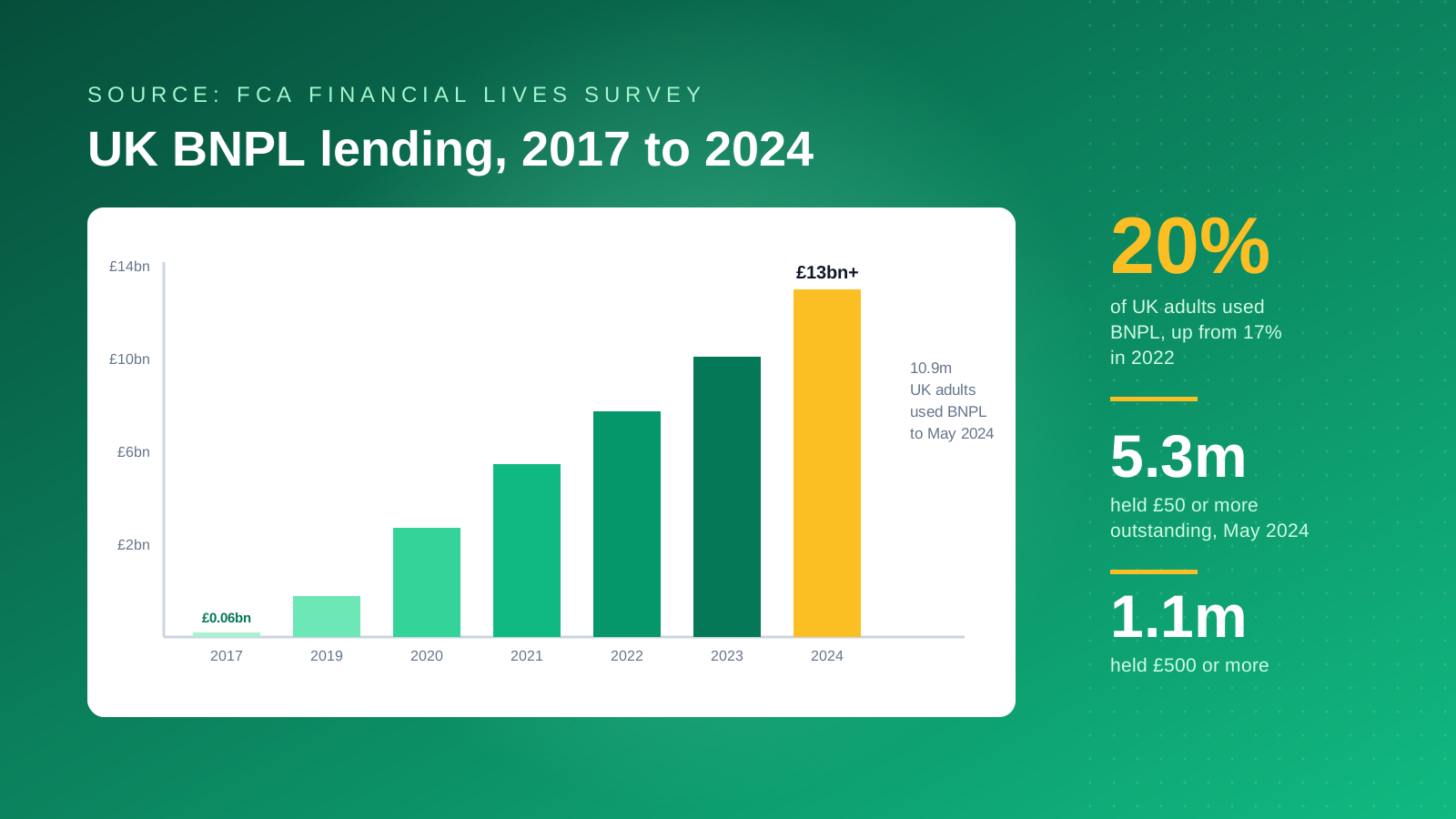
Regulation is reshaping BNPL in 2026. The CFPB (Consumer Financial Protection Bureau) and state regulators are introducing affordability requirements and responsible lending practices that BNPL providers must now follow. This means slower approval decisions for some providers and more stringent verification for others. However, it also means customers have greater protections, which increases trust in BNPL products overall.
AI-powered credit decisions are becoming increasingly sophisticated. Providers are using machine learning to make real-time decisioning based on hundreds of data points, not just credit score and income. This means approval rates are improving even as lending becomes more responsible. Customers are being approved faster with more nuanced underwriting that reduces both chargebacks and over-lending.
B2B BNPL is emerging as a significant growth area. While this article focuses on consumer-facing Shopify stores, many BNPL providers are expanding to support Shopify Plus merchants selling to other businesses. The ability to offer BNPL to business customers is opening new market opportunities.
BNPL in subscription commerce is gaining traction. More subscription box services and membership-based Shopify stores are integrating BNPL to allow customers to split their subscription costs across installments. This is particularly valuable for premium subscriptions where the monthly cost is high.
Integration with Shopify's checkout extensibility API is becoming the standard. Rather than BNPL providers building custom integrations, they are leveraging Shopify's native extensibility framework to provide seamless experiences that require minimal merchant configuration. This makes BNPL integration simpler and more reliable for Shopify merchants.
Risks and Considerations for Shopify Merchants
Merchant fees can erode margins if you do not plan carefully. A BNPL fee of 5-6% on a product with a 20% gross margin is consuming 25-30% of your profit. Before implementing BNPL, calculate whether the conversion uplift justifies the fee impact. In most cases it does, but for low-margin products or mature categories, BNPL fees can be problematic.
Chargebacks and disputed transactions remain a risk despite BNPL providers' fraud prevention. If a customer claims they did not make a purchase or disputes a charge, the BNPL provider may reverse the payment, leaving you without both the product and the payment. Fraud prevention is improving but represents an ongoing risk compared to cash-in-hand transactions.
Consumer over-spending is a valid concern that regulators and responsible lenders are working to address. When a customer can split any purchase into installments, the temptation to buy beyond their means increases. Responsible BNPL providers like Sezzle and transparent lenders like Affirm implement safeguards to prevent over-lending, but this remains an area of societal concern that may lead to further regulation.
Regulatory changes in the US continue to evolve. What is allowed today may be restricted tomorrow. The CFPB's regulation of BNPL is still developing, and additional restrictions on lending or merchant fees could impact your ability to use BNPL effectively. Stay informed about regulatory developments affecting BNPL in your markets.
Too many BNPL options can create decision fatigue at checkout. If you offer five different BNPL providers, customers may spend excessive time comparing options rather than completing purchase. We typically recommend two to three BNPL providers maximum. Choose one or two primary options and potentially one backup alternative.
Why We'd Start With Two Providers, Not Five
The most common thing we fix on a Shopify Plus checkout is not a missing BNPL provider. It is four of them.
We picked up an apparel client last year who had accumulated Affirm, Afterpay, PayPal Pay Later and a fourth provider a previous agency had added for a campaign and never removed. Four installment logos in the payment selector, three sets of on-site messaging fighting for space under the price, and a product page that took noticeably longer to render because each provider was loading its own script. Their BNPL adoption rate was not four times higher than a single-provider store. It was slightly lower, and their mobile page speed was materially worse.
We took it down to two: Shop Pay Installments as the default because it stays inside the Shopify checkout, and Afterpay alongside it because their customers specifically look for that badge. Adoption went up. Page weight went down. The finance team stopped reconciling four settlement schedules.
So here is our position, stated plainly. If you are on Shopify Payments, enable Shop Pay Installments first and treat it as your default. It costs no additional app fee, it does not redirect the customer away from your checkout, and Affirm carries the repayment risk while you are paid in full up front. Then add exactly one brand-recognition provider chosen by who your customers are, Afterpay if you skew young, Klarna if you sell fashion and lifestyle, PayPal Pay Later if your audience is older and card-shy. Stop there.
The exception is order value. If you sell furniture, high-end electronics or anything routinely over $1,500, a pay-in-four product does not solve your customer's problem and you need genuine financing from Affirm sitting behind the installment option. That is a third provider with a job to do, which is different from a third provider you forgot to switch off.
The thing we would push back on hardest is the instinct to chase the lowest merchant fee. We have never seen a store where the difference between a 4% and a 5% BNPL rate mattered more than where the messaging sat on the product page. Fix placement first, negotiate rates second.
Questions Store Owners Ask Us Before They Commit
Do I need a free trial to evaluate a provider? No, and none of the major BNPL apps offer one in the usual sense, because the app itself is free to install and the cost only starts when a transaction settles. You can install, configure and see real results without committing spend. What you cannot trial is the commercial rate, which is fixed at onboarding.
Which factors actually decide it? In order: your gateway, your order value distribution, your customer age profile, and only then the fee. If you want one number to look at, look at the share of your orders that fall inside each provider's eligible range, because a provider that cannot serve half your basket sizes is not a real option however good its brand is.
What does the customer experience look like day to day? A customer picks the option at checkout, completes a short approval process, and from then on manages the balance and repayment schedule in the provider's own app. They see their installment plans, upcoming due dates and payment history there, not on your store, which is worth knowing when a customer emails you asking where their next payment went. Point them at the provider's app and its resources rather than trying to answer from your admin.
Will it work with my theme? Almost certainly, with some customization. The checkout side is standardized and reliable. The on-site messaging side is where the friction is, and heavily customized themes sometimes need a developer for an hour to place the block correctly and stop it clashing with a badge row you already have. Budget for that hour rather than being surprised by it.
How do I know it is working? Look at three results eight weeks after launch: total order volume, average order value, and the share of eligible orders using installments. If total orders moved, the fee is buying incremental revenue. If only the payment mix moved, the optimization work is to reduce the number of providers rather than add more. That ease of measurement is an advantage BNPL has over most conversion levers, and it is worth using.