 Nic Dunn, CEO, Charle Agency
Why Shopify SEO Apps Matter in 2026
Quick answer: for most Shopify stores in 2026, the right SEO app stack is two or three tools, not ten. We pair TinyIMG (image optimization, JSON-LD, IndexNow) with Sherpas Smart SEO or Booster SEO (AI meta tags and bulk editing). Stores chasing AI search visibility add StoreSEO or Lumos AI SEO for AEO and LLMs.txt. Anything beyond that stacks duplicate code and slows your store down.
Organic search is still the most efficient traffic source in ecommerce. It drives roughly 43% of all visits to Shopify stores and around a quarter of revenue, and it keeps compounding long after the work is done. Paid traffic stops the moment your card declines. Search does not.
Shopify handles the basics. It generates sitemaps automatically, gives you clean URLs, and lets you edit meta titles and descriptions one page at a time. That is roughly the floor of what a modern ecommerce site needs. To compete in 2026 you need bulk metadata, automated JSON-LD, image optimization and speed optimization at catalog scale, and reliable technical SEO audits. The apps in this guide fill the gaps Shopify's admin will not, and they help you build the visibility, traffic and conversions that compound month over month.
Three things have changed since the last time we wrote this article. First, AI Overviews and ChatGPT-style search are now the front door for a growing share of product research, and the brands cited in those answers are the ones with clean schema, well-written product copy, and an LLMs.txt file describing how AI systems should read their site. Second, Google made Interaction to Next Paint (INP) a confirmed Core Web Vital in 2024, which has quietly punished image-heavy themes that previously passed on LCP alone. Third, Shopify Magic now handles the easy meta generation tasks for free, which means a paid SEO app needs to do more than write a title tag to justify the subscription.
The apps we recommend below cover four jobs that every serious Shopify store needs done well: site speed and image optimization, metadata at scale, structured data, and the emerging AEO layer. Most stores need two or three apps total. Stacking five or six is how stores end up with duplicate JSON-LD, conflicting meta tags, and a slower site than they started with.

For a fuller picture of Shopify search optimization, see our complete Shopify SEO guide. If you also want the non-SEO essentials, the best Shopify apps guide covers the wider stack.
How We Tested These Apps
Charle is a Senior Shopify Plus Partner. We have installed, audited and replaced SEO apps on 100+ Shopify Plus stores across DTC fashion, food and drink, luxury, B2B and subscription brands. The shortlist below comes from that working list, refreshed for 2026 against current Shopify App Store ratings, review counts, and live pricing. Where an app overlaps with the work an off-platform tool like Ahrefs or Semrush would do better (keyword research, backlink analysis, deep competitor audits), we say so. We do not run an affiliate programme on this article. Nothing is here because someone paid us to recommend it.
Our criteria are straightforward:
- Ease of setup: can a non-technical merchant get real value in under an hour?
- Feature depth: does it own at least one pillar of the stack properly, rather than half-doing five?
- Site speed impact: we benchmark Lighthouse and INP scores before and after installation.
- Support quality: response time and accuracy when something breaks in production.
- Value for money: features per pound at the tier most stores actually buy.
- Measurable results: ranking and indexing changes we can attribute to the app, not the broader campaign.
We weight our own client data more heavily than App Store ratings. A five-star app with 6,000 reviews can still be the wrong choice for a 12,000 SKU catalog, and a newer app with 200 reviews can be the right one if it owns a discipline (LLMs.txt, for example) that nothing else does well yet.
Quick Comparison: Best Shopify SEO Apps
| App | Best For | Starting Price | Rating |
|---|---|---|---|
| TinyIMG | Image optimization + JSON-LD | Free / $14/mo | 5.0 (2,400+) |
| Booster SEO | All-in-one automation | Free / $39/mo | 4.9 (6,400+) |
| Avada SEO | Comprehensive features | Free / $34.95/mo | 4.9 (6,300+) |
| Sherpas: Smart SEO | AI-powered meta tags | Free / $9.99/mo | 4.9 (1,200+) |
| SearchPie | Speed + backlink analysis | Free / $39/mo | 4.9 (3,500+) |
| Tapita SEO | Multi-language stores | Free / $9.99/mo | 4.8 (1,000+) |
| SEO Manager | Beginners | Free / $9/mo | 4.7 (1,700+) |
| Ilana's JSON-LD | Advanced schema | $33.25/mo | 5.0 (500+) |
| Schema Plus | Schema simplicity | $14.99/mo | 4.9 (400+) |
| Plug In SEO | SEO audits | $29.99/mo | 4.7 (2,500+) |
| SEO King | Multi-AI content + descriptions | Free / $19/mo | 4.8 (700+) |
| StoreSEO | AI SEO + AEO | Free / $9.99/mo | 5.0 (570+) |
| SEOAnt (SEOWILL) | SEO automation + blogs | Free / $15.99/mo | 4.8 (1,400+) |
| AltText.ai | Alt tags specialist | Pay-as-you-go | 4.9 (200+) |
| Webrex AI SEO Schema | AI schema markup | Free | 4.9 (665+) |
| Lumos AI SEO | AEO + llms.txt | Free / $9.99/mo | 4.8 (100+) |
1. TinyIMG: Best for Image Optimization
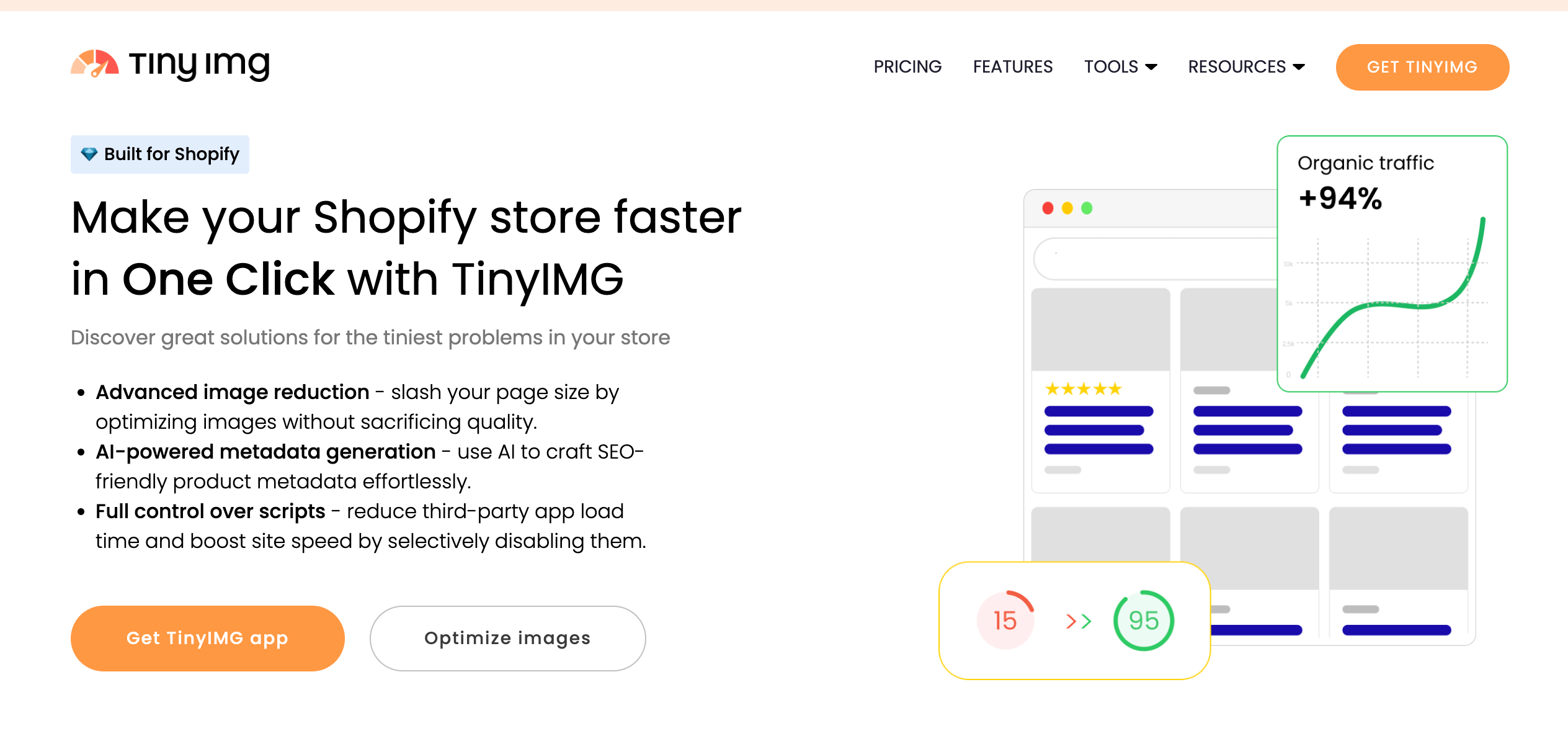
TinyIMG has become our go-to recommendation for image optimization on Shopify. It compresses images without visible quality loss, adds proper alt text automatically, and implements JSON-LD structured data across your store. The app also includes lazy loading and IndexNow integration for faster indexing of new content.
Key Features
- Automatic image compression with up to 70% file size reduction
- Bulk alt text generation using AI
- JSON-LD schema markup for products, collections, and articles
- Lazy loading for improved Core Web Vitals
- IndexNow integration for instant search engine notifications across Google, Bing and Yandex
- Broken link detection and redirect management
Pricing
Free plan available with limited compressions. Paid plans start at $14/month for unlimited image optimization, with higher tiers adding more advanced SEO features.
Pros & Cons
Pros:
- Excellent image compression without visible quality loss
- Combines image SEO and structured data in one app
- Measurable Core Web Vitals improvements
- Built for Shopify badge - meets highest quality standards
Cons:
- Free plan has limited monthly compressions
- Advanced schema features require higher-tier plans
- Some features overlap with other SEO apps
Our Verdict
TinyIMG is the app we install most often on Charle clients in 2026. The Advanced plan covers image optimization, JSON-LD, IndexNow and the new LLMs.txt generation in a single subscription that costs less than running three single-purpose apps. On a recent fashion client doing approximately $300K/month, we saw mobile Lighthouse climb from 38 to 71 within fourteen days of a clean install, with a measurable INP improvement on collection pages and a noticeable lift in conversions on slow-loading product pages. With 2,400+ five-star reviews and Built for Shopify certification, it is the safest first install for any image-heavy store.
View TinyIMG in the Shopify App Store

2. Booster SEO & Image Optimizer: Best All-in-One Solution
Booster SEO is one of the most popular SEO apps on Shopify for good reason. It combines meta tag optimization, image compression, structured data, and SEO health monitoring in a single package. The autopilot feature automatically fixes common SEO issues without requiring manual intervention.
Key Features
- Bulk meta tag editing for titles and descriptions
- Automated alt text generation with customizable templates
- JSON-LD structured data for rich snippets
- SEO health score with actionable recommendations
- Autopilot mode for hands-off optimization
- Weekly SEO performance reports
Pricing
Free plan covers basic features. Paid plans at $39/month and $69/month include bulk editing, autopilot features, and priority support.
Pros & Cons
Pros:
- Comprehensive all-in-one solution reduces app clutter
- Autopilot saves significant time on routine tasks
- Excellent customer support with fast response times
- Regular updates with new features
Cons:
- Autopilot can make unwanted changes if not monitored
- Higher pricing than single-purpose alternatives
- Some advanced features locked behind expensive tiers
Our Verdict
Booster SEO works well for store owners who want comprehensive coverage without managing multiple apps. With 6,400+ verified reviews on the Shopify App Store and a 4.9 rating, it is one of the most battle-tested options on this list. The autopilot feature saves significant time on routine SEO issues like missing meta descriptions, broken links, and 404 redirects, though we recommend reviewing its suggestions before letting it run unsupervised. The app's consistent updates and responsive support team make it a reliable long-term choice for established stores wanting performance, rankings and bulk editing under one subscription.
View Booster SEO in the Shopify App Store
3. Avada SEO & Image Optimizer: Best for Comprehensive Features
Avada SEO offers one of the most feature-rich free plans in the category. Beyond the standard image optimization and meta tag tools, it includes Google Search Console verification, automatic sitemap submission, and detailed SEO analysis. The app's dashboard provides a clear overview of your store's SEO health with prioritized recommendations.
Key Features
- Image optimization with WebP conversion
- Google Search Console integration
- Automatic sitemap generation and submission
- 404 error detection and redirect management
- Structured data for products, reviews, and breadcrumbs
- AI-powered SEO analysis and suggestions
Pricing
Generous free plan available. Pro plan at $34.95/month adds unlimited image optimization, advanced structured data, and premium support.
Pros & Cons
Pros:
- Best-in-class free plan with substantial features
- Native Google Search Console integration
- Excellent for large product catalogs
- Clear, actionable SEO health dashboard
Cons:
- Free plan has monthly image limits
- Interface can feel overwhelming for beginners
- Some features require technical understanding
Our Verdict
Avada SEO punches above its weight, particularly on the free plan, which covers basic JSON-LD, alt text generation, image optimization with WebP conversion and Google Search Console verification before you pay a penny. With 6,300+ reviews and a 4.9 rating, it is the most generous free SEO solution we recommend. The Pro plan at $34.95/month adds unlimited image compression and deeper schema markup, which makes it particularly effective for stores with large product catalogs that need bulk optimization tools and visibility across thousands of pages.
View Avada SEO in the Shopify App Store
4. Sherpas: Smart SEO: Best for AI-Powered Optimization
Sherpas Smart SEO stands out for its integration with ChatGPT-4 for meta tag generation. The AI can write unique, compelling meta descriptions and alt text at scale, saving hours of manual work. The app also handles structured data, broken link detection, and multi-language SEO for international stores.
Key Features
- ChatGPT-4 powered meta tag and alt text generation
- Multi-language support for international SEO
- JSON-LD structured data automation
- Broken link scanning and fixing
- Backlink monitoring and reporting
- SEO templates for consistent optimization
Pricing
Free plan with limited AI generations. Paid plans from $9.99/month to $29.99/month based on AI usage and features.
Pros & Cons
Pros:
- Best-in-class AI content generation quality
- Excellent multi-language support
- Affordable entry-level pricing
- Saves hours on manual meta tag writing
Cons:
- AI generations limited on free and lower tiers
- Requires review of AI outputs for accuracy
- Less comprehensive than all-in-one alternatives
Our Verdict
The AI-generated meta tags are genuinely impressive. They are not generic templates but contextually relevant descriptions that read naturally and pick up product-specific keywords from your metadata. With 4.9 stars across 1,200+ reviews and integrated ChatGPT-4 Turbo, this is the AI meta tag and metadata optimization specialist we pair with TinyIMG most often. For stores with hundreds or thousands of products, this alone justifies the subscription. The multi-language support (more than ten languages including Bokmål) makes it the strongest choice for brands selling across multiple European markets where a single English meta tag would underperform.
View Sherpas Smart SEO in the Shopify App Store
5. SearchPie: Best for Speed and Backlink Analysis
SearchPie combines traditional SEO tools with speed optimization and backlink analysis. The app monitors your backlink profile, helping you understand which sites link to your store and identify potentially harmful links. The speed optimization features address Core Web Vitals directly.
Key Features
- Keyword optimization and tracking
- Backlink analysis and monitoring
- Page speed optimization tools
- JSON-LD structured data
- Broken link detection and 301 redirects
- Local SEO features for physical stores
Pricing
Free installation with a free plan available. Paid plans range from $39/month to $399/month based on store size and features.
Pros & Cons
Pros:
- Unique backlink monitoring feature
- Comprehensive speed optimization tools
- Local SEO features for physical retailers
- Built for Shopify certification
Cons:
- Higher pricing than many competitors
- Premium features require expensive tiers
- Can be overkill for smaller stores
Our Verdict
SearchPie's backlink monitoring and keyword research features fill a gap that most Shopify SEO apps ignore. Understanding your backlink profile is crucial for off-page SEO, and having this data within your Shopify admin is convenient for store owners who would otherwise have to leave the platform. To be clear, SearchPie's backlink and keyword data is not as deep as dedicated platforms like Ahrefs or Semrush, so if SEO is a core marketing channel you should still run one of those alongside whatever Shopify app you choose. SearchPie's strength is making basic off-page visibility accessible without forcing every merchant to learn a third-party tool. With 4.9 stars and 3,500+ reviews, the higher pricing tiers are better suited to larger stores with significant SEO budgets.
View SearchPie in the Shopify App Store
6. Tapita SEO & Speed Optimizer: Best Value for Multi-Language Stores
Tapita SEO delivers solid SEO fundamentals at a competitive price point. The standout feature is its multi-language meta tag support, allowing you to optimize titles and descriptions for each language version of your store. The speed optimization tools address page load times without requiring technical knowledge.
Key Features
- Multi-language meta tag management
- Bulk editing for titles, descriptions, and alt text
- Page speed optimization with lazy loading
- JSON-LD structured data
- SEO audit and health scoring
- Google Search Console integration
Pricing
Free plan available. Paid plans from $9.99/month to $49.99/month.
Pros & Cons
Pros:
- Excellent multi-language SEO support
- Very competitive pricing
- Works seamlessly with translation apps
- Simple, intuitive interface
Cons:
- Fewer advanced features than premium alternatives
- Limited reporting capabilities
- Smaller user base means fewer community resources
Our Verdict
Tapita offers excellent value, particularly for stores selling internationally. The multi-language SEO features work seamlessly with Shopify's translation apps, ensuring your SEO efforts carry across all market versions including French, German, Spanish and Italian. At sub-$10/month for the entry paid tier, it is accessible for growing brands and small businesses that need real keyword research and SEO audit functionality without paying premium prices. The dashboard is simpler than Booster or SearchPie, which makes it a sensible second app on a stack that already has TinyIMG handling images.
View Tapita SEO in the Shopify App Store
7. SEO Manager: Best for Beginners
SEO Manager has been a Shopify mainstay for years. The app's strength lies in its educational approach, guiding users through SEO improvements with clear explanations and tutorials. Real-time feedback shows how changes affect your SEO score before you save.
Key Features
- Real-time SEO feedback and scoring
- Bulk editing for meta tags and URLs
- AI-powered keyword suggestions
- Broken link detection and management
- Built-in tutorials and guidance
- Google Search Console data integration
Pricing
7-day free trial. Free plan with basic features. Paid plans from $9/month to $59/month.
Pros & Cons
Pros:
- Excellent educational content for SEO beginners
- Real-time feedback helps learning
- Long-established with proven track record
- Affordable entry-level pricing
Cons:
- Educational approach may feel slow for experts
- Interface feels dated compared to newer apps
- Fewer automation features
Our Verdict
SEO Manager is ideal for merchants new to SEO. With 4.7 stars across 1,700+ reviews and a track record going back to the early Shopify ecosystem, it is the educational specialist on this list. The in-app tutorials walk users through specific SEO issues as they appear (missing meta descriptions, duplicate titles, broken internal links) and explain why each one affects visibility. More experienced users might find the guidance slow, but for building SEO knowledge alongside optimizing your store, it is hard to beat. Pair it with Google Search Console for the data SEO Manager doesn't surface itself.
View SEO Manager in the Shopify App Store
8. Ilana's JSON-LD for SEO: Best for Advanced Schema Markup
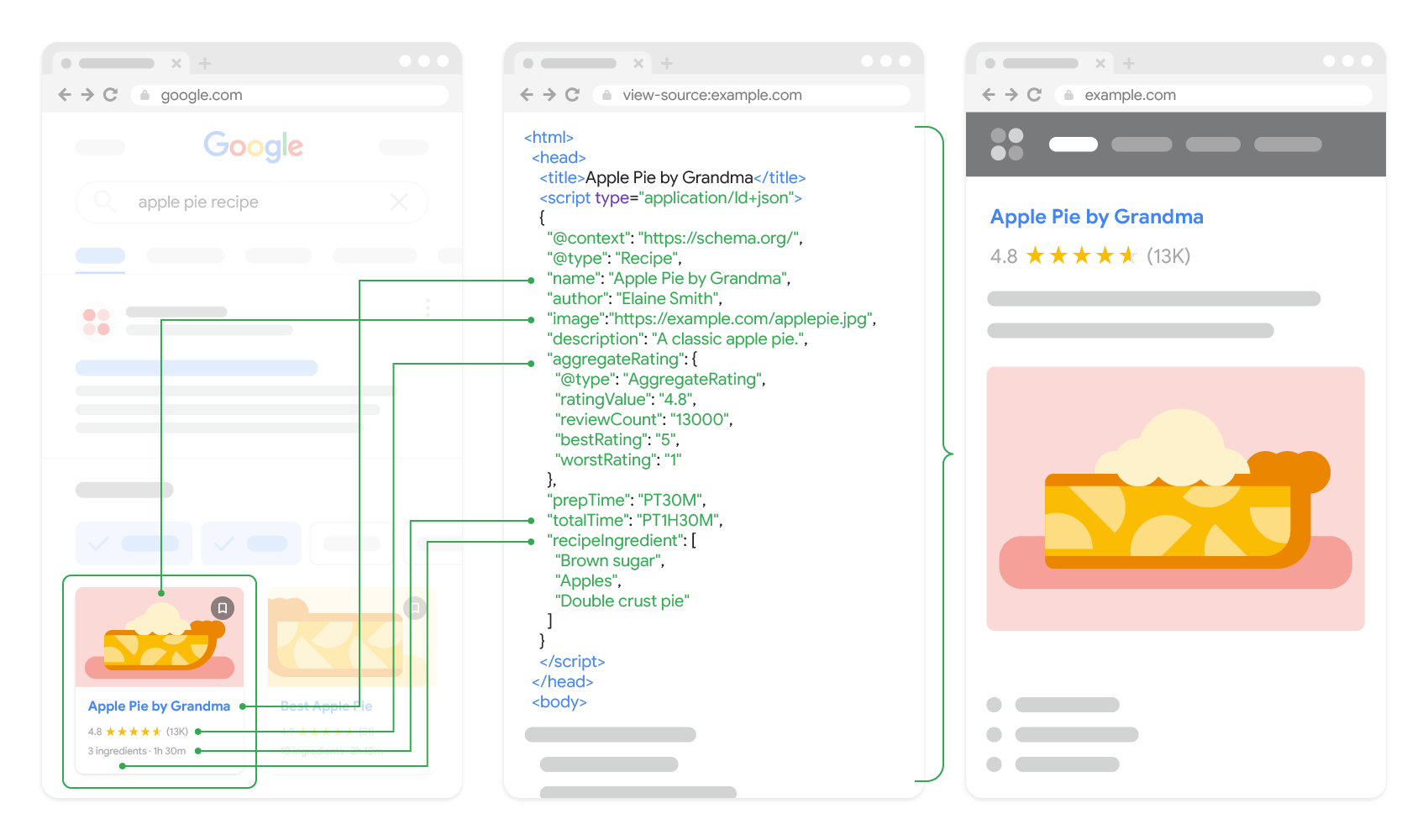
Ilana's JSON-LD for SEO specialises in one thing: structured data. Rather than trying to be an all-in-one solution, it focuses on implementing comprehensive schema markup that drives rich snippets in search results. The app supports more schema types than most competitors and requires no coding knowledge.
Key Features
- Product, collection, and article schema
- FAQ and How-To schema support
- Review and aggregate rating markup
- Organization and local business schema
- Automatic updates when schema standards change
- Validation tools to check implementation
Pricing
$33.25/month with a 14-day free trial. No free plan available.
Pros & Cons
Pros:
- Most comprehensive schema coverage available
- Automatic updates for changing standards
- Excellent validation and testing tools
- Proven track record with rich snippet results
Cons:
- Higher price point than alternatives
- No free plan to test before committing
- Schema-only focus means you need other apps too
Our Verdict
If rich snippets are a priority and you want comprehensive schema coverage, Ilana's JSON-LD is worth the investment. The app implements schema types that most competitors miss, and the automatic updates ensure your markup stays compliant as Google's requirements evolve. We often pair this with an image optimization app for complete coverage.
View Ilana's JSON-LD in the Shopify App Store
9. Schema Plus for SEO: Best Schema Simplicity
Schema Plus offers a more streamlined approach to structured data. The app handles the essential schema types most stores need, with a simpler interface and lower price point than specialist alternatives. Setup takes minutes, and the app updates schema automatically as you add products.
Key Features
- Product and collection schema automation
- Review and rating markup
- Breadcrumb and organization schema
- Simple dashboard with validation
- Automatic updates for new products
- Compatible with most Shopify themes
Pricing
$14.99/month with a 7-day free trial. No free plan available.
Pros & Cons
Pros:
- Simple setup takes just minutes
- Lower price than specialist alternatives
- Covers most common schema needs
- Works with virtually all themes
Cons:
- Fewer schema types than premium options
- No free plan available
- Limited customization options
Our Verdict
Schema Plus is the pragmatic choice for stores that want solid schema implementation without complexity. It covers the schema types that drive the majority of rich snippet opportunities, and the simpler interface means less time configuring settings. For most stores, this level of schema support is sufficient.
View Schema Plus in the Shopify App Store
10. Plug In SEO: Best for SEO Audits
Plug In SEO has been helping Shopify merchants identify SEO issues since 2012. The app's audit functionality scans your entire store, identifies problems, and provides clear instructions for fixing them. The keyword tracking feature lets you monitor rankings for target terms directly within Shopify.
Key Features
- Comprehensive SEO audits with prioritized recommendations
- Keyword rank tracking
- Structured data implementation
- Broken link and redirect management
- Page title and meta description templates
- Speed optimization suggestions
Pricing
Plans from $29.99/month to $79.99/month. No free plan available.
Pros & Cons
Pros:
- Industry-leading audit capabilities
- Prioritized recommendations save time
- Long track record since 2012
- Keyword tracking included
Cons:
- No free plan available
- Higher starting price than competitors
- Best suited for stores with SEO budgets
Our Verdict
Plug In SEO's strength is its audit capability. The reports identify issues you might otherwise miss, and the prioritisation helps you focus on high-impact fixes first. The lack of a free plan means it's better suited to stores with an established SEO budget, but the insights justify the cost for serious SEO efforts.
View Plug In SEO in the Shopify App Store
11. SEO King: Best Multi-AI Powerhouse for Content
SEO King has quietly become one of the more interesting AI SEO apps on Shopify. Rather than picking one model and locking in, it routes content generation across multiple AI tools (ChatGPT, Claude, Gemini) and lets you pick the model that performs best for your category. The app handles bulk meta tag writing, product description generation, image alt text, and AI-driven keyword research at scale, which makes it a useful alternative to Sherpas for brands writing about technical or specialist categories where one model consistently outperforms another.
Key Features
- Multi-AI content generation (ChatGPT, Claude, Gemini)
- Bulk product description rewriting
- AI-powered keyword research and competitor analysis
- Meta tag and alt text automation
- JSON-LD schema markup generation
- SEO audit and on-page recommendations
- Analytics dashboard showing AI-driven content performance
Pricing
Free plan available with limited AI generations. Paid plans from $19/month for higher AI quotas, bulk editing, and access to the premium model selection.
Pros & Cons
Pros:
- Model flexibility lets you pick the best AI for each task
- Strong for technical, beauty, fashion and specialist categories
- Bulk editing across hundreds of products in minutes
- Keyword research data anchored in real SERP results
Cons:
- Three-model setup needs configuration up front, not zero-setup
- AI outputs still need human review for brand voice
- Newer than Sherpas, so the long-term reliability is shorter
Our Verdict
SEO King belongs on the shortlist for any store where content is the SEO battleground. For category pages, blog content, and product descriptions at scale, it is often a better fit than the single-model AI apps because no one AI is best at every category. We have seen it perform particularly well on technical and specialist niches where ChatGPT's defaults read as generic but Claude or Gemini land closer to how a category expert would write. It is not the right first install for an image-heavy fashion or Shop-Pay-driven boutique store (TinyIMG wins there), but for brands competing on content depth it is increasingly difficult to ignore.
View SEO King in the Shopify App Store
12. StoreSEO: Best for AI-Powered SEO & AEO
StoreSEO has quickly become one of the most talked-about SEO optimizers in the Shopify ecosystem. Beyond traditional SEO, it's one of the first apps to properly address AEO (Answer Engine Optimization) for AI search engines like ChatGPT and Google's Gemini. The app uses artificial intelligence throughout, from generating product descriptions and meta tags to analyzing competitor keywords and providing actionable marketing insights.
Key Features
- AI-powered SEO analysis with real-time suggestions
- AEO optimization for AI search engines (ChatGPT, Gemini, Perplexity)
- Meta tag and product description generation
- Bulk image alt text generation
- Google Search Console and Analytics integration
- Competitor analysis and keyword tracking
- SEO scoring and monitoring dashboard
Pricing
Generous free plan available covering basic features. Paid plans from $9.99/month add bulk editing, advanced analytics, and priority customer support.
Pros & Cons
Pros:
- Leading AEO features for AI search optimization
- Excellent free plan with genuine value
- Forward-thinking approach to emerging search
- Responsive customer support
Cons:
- AEO benefits still emerging and unproven long-term
- Newer app with smaller track record
- Some features overlap with established competitors
Our Verdict
StoreSEO represents where SEO apps are heading. The AEO features are particularly forward-thinking. As more customers use AI assistants to find products, optimizing for these search engines becomes crucial. The free plan is genuinely useful for anyone starting out, and the responsive customer support team has earned consistently positive reviews.
View StoreSEO in the Shopify App Store
13. SEOAnt (SEOWILL): Best for SEO Automation & Blogging
SEOAnt, now rebranded as SEOWILL, has been a consistent performer in the Shopify SEO space. The app excels at SEO automation, setting up rules that continuously optimize your pages without manual intervention. It is particularly strong for stores that want to maintain an active blog alongside their product pages, with AI-powered content generation that can produce SEO-optimized articles.
Key Features
- Automated SEO rules for hands-off optimization
- AI blog post generator for content marketing
- Bulk meta tag and alt text editing
- Broken link scanner with auto-redirect
- JSON-LD structured data automation
- Page speed analysis and recommendations
- Keyword suggestions based on your products and categories
Pricing
Free plan with basic SEO features. Paid plans from $15.99/month to $79.99/month for advanced automation and AI content generation.
Pros & Cons
Pros:
- Excellent automation saves significant time
- AI blog writer helps content marketing
- Established app with proven track record
- Comprehensive feature set
Cons:
- AI content needs human review and editing
- Higher tiers can get expensive
- Automation rules require initial setup time
Our Verdict
SEOAnt's automation features save significant time for busy store owners. The AI blog writer is genuinely useful for maintaining content freshness without dedicating hours to writing. While the generated content benefits from human editing, it provides a solid starting point. The app's been around long enough that the number of positive reviews reflects genuine value.
View SEOAnt (SEOWILL) in the Shopify App Store
14. AltText.ai: Best for Alt Tags Specialist
AltText.ai takes a focused approach: it does one thing exceptionally well. The app uses advanced AI to analyze your product images and generate descriptive, SEO-optimized alt tags that help search engines understand your visual content. For stores with hundreds or thousands of product images missing alt text, this specialist approach can transform your image SEO overnight.
Key Features
- AI-powered image analysis for accurate descriptions
- Bulk alt text generation for entire catalogs
- Integration with your product metadata for context
- Support for multiple languages including Bokmål and other European languages
- Natural-sounding descriptions that include relevant keywords
- Browser-based preview before applying changes
Pricing
Pay-as-you-go model based on the number of images processed. No monthly subscription required, so you only pay for what you use.
Pros & Cons
Pros:
- Specialist focus means excellent alt text quality
- Pay-as-you-go is budget-friendly
- Supports multiple languages
- Fast bulk processing
Cons:
- Single-purpose tool requires other apps for full SEO
- Costs can add up for very large catalogs
- No ongoing monitoring or updates
Our Verdict
If your store has significant alt tag gaps, AltText.ai is worth considering. The pay-as-you-go pricing makes it accessible for stores of any size, and the quality of the generated descriptions is noticeably better than generic templates. We've used it to quickly optimize image-heavy stores where manual alt text would take weeks.
View AltText.ai in the Shopify App Store
15. Webrex AI SEO Schema: Best Free Schema Option
Webrex stands out by offering genuinely useful AI-powered schema markup completely free. The app automatically generates JSON-LD structured data for your products, collections, and pages, helping search engines display rich results that drive more clicks. For stores that want schema without the cost of specialist apps, Webrex delivers impressive value.
Key Features
- Automatic JSON-LD schema for products and collections
- AI-powered schema suggestions based on your content
- Rich snippet preview showing how your pages appear in search
- Support for FAQ, How-To, and organization schema
- No coding or technical knowledge required
- Regular updates as schema standards evolve
Pricing
Completely free with no hidden costs or premium tiers.
Pros & Cons
Pros:
- Completely free with no catch
- Delivers functionality competitors charge for
- Easy setup with no technical knowledge
- Regular updates for changing standards
Cons:
- Fewer schema types than paid specialists
- Limited customization options
- Smaller support team than premium apps
Our Verdict
Webrex's free offering is remarkable. The app delivers schema functionality that competitors charge $15-35/month for, with no catch. For stores testing whether schema markup improves their search engine rankings before committing to paid options, Webrex is the obvious starting point.
View Webrex AI SEO Schema in the Shopify App Store
16. Lumos AI SEO: Best for Future-Proofing (AEO & llms.txt)
Lumos represents the cutting edge of ecommerce SEO. While traditional SEO focuses on Google, Lumos optimizes your store for AI search engines and large language models (LLMs) that increasingly influence purchasing decisions. The app manages your llms.txt file, a new standard that tells AI systems how to read and recommend your products.
Key Features
- llms.txt file management for AI search optimization
- AEO (Answer Engine Optimization) tools for ChatGPT, Claude, and Gemini
- Control over how AI systems interpret your products
- Structured data optimized for AI understanding
- Analytics showing AI-driven traffic and recommendations
- Regular updates as AI search standards evolve
Pricing
Free plan available with basic llms.txt management. Paid plans from $9.99/month for advanced AEO features and analytics.
Pros & Cons
Pros:
- Cutting-edge AEO and llms.txt features
- First-mover advantage in emerging space
- Free plan for experimentation
- Forward-thinking approach
Cons:
- AEO ROI still unproven for most stores
- Very new with limited track record
- Benefits may take years to fully materialise
Our Verdict
Lumos is forward-looking, and the AEO category is still settling. We do not recommend buying a paid plan as your first SEO app, but the free tier is a low-risk way to start producing an LLMs.txt file and watch what shows up in ChatGPT, Claude and Perplexity searches for your category. Brands that get cited in AI answers in 2026 will be the ones who started early. The track record is short and the ROI is unproven, but the downside of doing nothing is much larger than the cost of running the free tier.
View Lumos AI SEO in the Shopify App Store
Best Free Shopify SEO Apps
Budget constraints shouldn't prevent you from improving your search engine rankings. Several apps on this list offer genuinely useful free plans that cover the SEO fundamentals most stores need:
Best overall free option: Avada SEO's free plan includes image optimization, basic structured data, and Google Search Console integration. It's the most comprehensive free offering we've tested.
Best free schema app: Webrex AI SEO Schema is completely free with no premium tier. You get proper JSON-LD implementation without paying a penny.
Best free for AI features: StoreSEO's free plan includes AI-powered meta tag suggestions and basic AEO features. It's surprisingly capable for a free tier.
Best free for image optimization: TinyIMG's free plan handles limited image compression and basic alt text. Upgrade when you need bulk processing.
Best free for blogging: SEOAnt (SEOWILL) offers free blog SEO tools alongside basic on-page optimization.
Start with one or two free apps to establish your SEO foundation. As your sales grow and you can measure the return on investment, consider upgrading to paid plans that add bulk editing, automation, and advanced analytics.
Do You Even Need an SEO App?
This is the honest question every Shopify merchant should ask before installing anything. Plenty of stores rank well with the SEO Shopify already gives you out of the box: a sitemap, clean URLs, editable meta tags per page, basic ecommerce schema, and SSL. If your store has under 200 SKUs, a clean theme, decent product copy and you have time to edit titles and descriptions manually, you might not need an SEO app at all. The Reddit threads and Designful's review make this point fairly: apps and SEO plugins speed up repetitive work, but they do not write your category copy, choose your target keywords, or earn your backlinks.
The answer flips as soon as scale enters the picture. With more than 200 products, bulk metadata editing in Shopify's admin becomes painful enough that a $14/month app pays for itself in the first day. Image-heavy categories (fashion, food, home, jewellery) almost always benefit from a dedicated image optimizer because page speed is the single biggest performance gap between fast Shopify themes and slow ones. Multilingual stores need schema markup that translates, which Shopify does not provide natively. And brands chasing AI search visibility (citations in ChatGPT, Claude, Perplexity, Google's AI Overviews) need an LLMs.txt file and structured data that Shopify Magic alone will not generate.
The pragmatic test we run with new clients: spend thirty minutes auditing your store against the basics first. Are titles unique and keyword-relevant? Are meta descriptions written rather than auto-generated? Do your product images have descriptive alt text? Are your H1s and H2s in a clean hierarchy? Is your sitemap submitted to Google Search Console? If the answer to any of those is no, fix that before installing anything. An SEO app will not paper over weak fundamentals, and a slow store with one app is still faster than a slow store with five.
Common Mistakes With Shopify SEO Apps
Every store we audit has at least one of these. They are also the issues that suppress rankings without obvious symptoms, so they go unnoticed for months.
1. Installing too many SEO apps. The most common mistake by a wide margin. Three SEO apps running in parallel try to handle everything at once and generate three sets of JSON-LD schema markup, three meta tag systems, and three sets of injected scripts that compete on every page load. Page speed drops, Google sees duplicate schema, and the apps actively undo each other's work. Most stores need two or three apps total: one for image optimization, one for metadata and audits, and optionally one for AEO or schema specialism. More than that is stacking.
2. Ignoring Core Web Vitals after install. Quality SEO apps should improve your page speed, not harm it. The autopilot features on apps like Booster, SearchPie and SEOWILL inject schema, image processing logic and tag rewriters that can quietly add a hundred milliseconds to your LCP. Always run a Lighthouse audit and Google PageSpeed Insights on a mobile profile before AND after installing any SEO app. INP, which became a confirmed Core Web Vital in March 2024, is the one most stores fail. If an app costs you INP, the SEO benefits will not outweigh the rankings hit.
3. Trusting AI-generated meta tags without editing. AI meta tag generators (Sherpas, StoreSEO, SEO King, SEOWILL) are excellent at draft quality and terrible at brand voice. They produce contextually relevant descriptions that read as generic AI output if you publish them untouched. Treat AI as a starting point. Spend two minutes editing each generated meta title and meta description for the top fifty products, and the difference in click-through rate is measurable. Generate, edit, publish. Never generate, publish, forget.
4. Skipping technical SEO for content SEO. Most SEO apps lead with content features (meta tags, alt text, AI descriptions) because they are easier to demonstrate. But the highest-impact issues are usually technical: broken links, slow images, missing schema, malformed sitemaps, duplicate page titles across collections, and indexing gaps in Google Search Console. Run a Plug In SEO audit or Avada SEO health scan first to surface the technical issues, fix those, and only then turn to content optimization and content optimization at the section and product-page level. The order matters because content fixes on a technically broken site rarely move rankings.
5. Not monitoring results. Installing an SEO app without setting up Google Search Console is like running ads without checking the ad platform. Track three things weekly: organic traffic by landing page (which content is gaining or losing), average position for your top twenty target keywords (which ranks are improving), and INP / LCP scores across your top-traffic pages (which improvements are real). If you cannot tie an app's features to one of those three, uninstall it.
6. Expecting overnight results. SEO compounds over four to twelve months. Technical fixes (image compression, schema, sitemap submission) can show ranking lifts within days as Google recrawls. But meta tag and content optimization typically takes two to four months to land in rankings, and AEO citations in ChatGPT or Perplexity can take longer still. If an app promises one-click SEO or 70% traffic in thirty days, treat it as marketing rather than evidence.
Recommended App Stacks by Store Stage
The right stack depends almost entirely on where you are in your store's growth. Below are the three combinations we recommend most often, organised by stage. None require more than three apps.
Bootstrapped or under 500 SKUs ($0/month):
- Avada SEO (free plan) for image optimization, basic JSON-LD, alt text generation and Google Search Console verification.
- Webrex AI SEO Schema (free) for additional schema markup including FAQ, How-To and organization types.
- StoreSEO (free plan) as your AEO and AI meta tag starter, useful for testing AI suggestions before you pay for them.
This stack covers the SEO fundamentals and basic SEO optimization at zero cost. It is genuinely viable for stores up to about $12K/month revenue. The trade-off is that automation quotas are limited, so bulk editing across hundreds of products requires patience.
Growing DTC ($10K–$500K/month, ~$25–$60/month app spend):
- TinyIMG Advanced ($23/mo) for image optimization, JSON-LD, IndexNow and LLMs.txt generation in one subscription.
- Sherpas Smart SEO ($9.99-29.99/mo) for AI meta tags at scale across product descriptions and collections.
- Optional: SEO Manager or Plug In SEO for audits and educational guidance if your team is still building SEO knowledge.
This is the stack we install most often. TinyIMG handles the speed and structured data pillar, Sherpas handles the metadata pillar, and Shopify's native settings handle the basics. Total monthly cost is under $35, and the combined impact on rankings and click-through rates is consistently the strongest per pound on this list.
Shopify Plus / 8-figure brands ($100K-$400K/month app spend tier):
- TinyIMG Expert ($49/mo) for catalog-scale image optimization, LLMs.txt and schema.
- Booster SEO Premium ($39-69/mo) or SearchPie ($39+/mo) for autopilot SEO management plus backlink analysis.
- Ilana's JSON-LD for SEO ($33.25/mo) for advanced schema types most apps miss (Recipe, How-To, Course, Event etc.).
- External tools (not Shopify apps): Ahrefs or Semrush for keyword research and competitor analysis at a level no Shopify app reaches.
At this tier the calculation shifts. Apps are no longer the bottleneck. Content depth, internal linking strategy, and off-page authority are. The stack above provides solid technical coverage, and the agency or in-house SEO lead does the strategy work. We typically pair this with a quarterly app audit because Shopify Plus stores accumulate redundant apps fast.

Choosing the Right SEO Apps for Your Store
Sixteen apps is a long list. Most Shopify stores only need two or three of them. The mistake we see most often is stacking, where a store buys whatever the latest top-rated app is, never uninstalls the previous one, and ends up with duplicate JSON-LD, two competing meta tag systems, conflicting links, and a Lighthouse score that has quietly dropped twenty points. The framework below covers the questions to ask before you click install.

Questions to ask yourself:
- Do you prioritize speed optimization, metadata management, or technical SEO audits?
- Do you need bulk editing for hundreds of products, or are you managing a smaller catalog?
- Is AI-powered content generation useful, or do you prefer manual control over your product descriptions?
- Do you sell internationally and need multi-language SEO support?
- Are rich snippets and schema markup a priority for your product categories?
- What is your budget? Are you looking for free options or ready to invest in premium features?
- How important is customer support when issues arise?
Recommended app combinations:
For new stores with limited budget: Start with Avada SEO's free plan or Webrex AI SEO Schema (completely free). Both cover the fundamentals without cost. Add StoreSEO's free tier for AI-powered suggestions. Upgrade to paid plans as your sales and traffic grow.
For growing stores ready to invest: Pair TinyIMG (image optimization) with either Booster SEO or Sherpas Smart SEO (metadata and general SEO). This combination covers the most important bases for improving search engine rankings.
For established stores prioritizing rich snippets: Add Ilana's JSON-LD or Schema Plus alongside your image and meta tag apps. The additional schema coverage can significantly improve clicks from search results by displaying star ratings, pricing, and availability.
For international stores: Prioritize Tapita SEO or Sherpas Smart SEO for their multi-language capabilities, including support for languages like Bokmål and other European markets. Proper SEO across all language versions is essential for international success.
For stores needing technical guidance: SEO Manager's educational approach helps anyone learn while optimizing. Plug In SEO's audits identify specific issues across your pages and provide actionable recommendations.
For future-focused stores exploring AEO: Add StoreSEO or Lumos AI SEO to your stack. As more customers use AI assistants to discover products, optimizing for these answer engines gives you an early advantage in emerging channels.
For content-heavy stores with blogs: SEOAnt (SEOWILL) excels at SEO automation for both product pages and blog content. The AI blog writer helps maintain content freshness for your marketing efforts.
Avoiding common mistakes:
Do not install multiple apps that do the same thing. Two SEO boosters running simultaneously can create conflicts, duplicate metadata, and slow down your browser and pages. Choose one primary app for each function: one for image optimization, one for meta tags, one for schema if needed.
Check your page speed before and after installing any new app. Quality SEO apps should improve or maintain your speed optimization scores, not harm them. If an app significantly slows your pages, the SEO benefits won't outweigh the user experience costs.
Apps are tools, not strategy. They make SEO tasks easier, but they will not write your category copy, earn your backlinks or decide which collections deserve the bulk of your effort. Pick two or three apps that own a clear pillar each, leave the rest alone, and put your real attention on content depth, internal linking, and the experience customers actually have when they land. For a structured way through the rest, our Shopify SEO checklist walks through every area worth covering.
If you want a second pair of expert eyes on your current SEO app stack, our ecommerce SEO services include app audits as part of every engagement. Get in touch and we'll tell you what to keep, what to uninstall and what to add.
What we'd actually run on a brand-new Shopify Plus store in 2026
If we were spinning up a fresh Shopify Plus build for a client tomorrow, say a $2.5M/year fashion brand migrating from Magento. Here is exactly what we would install on day one.
TinyIMG on the Advanced plan, for image optimization, JSON-LD product schema, IndexNow and LLMs.txt generation. Then Sherpas Smart SEO on the Premium tier for bulk AI meta tags and alt text generation across the whole catalog. That is it. Two apps. Total monthly cost around $35-50 depending on store size. No autopilot management apps, no separate schema specialists, no AEO-first apps until we have data to justify them.
The reason we avoid the all-in-one stacks (Booster SEO, SearchPie, StoreSEO) on new Plus builds is specific: they install too much code, run too many automations, and overwrite client work. On a recent migration project, Booster's autopilot rewrote 200 product meta descriptions during the first weekend after launch. They were descriptions we had spent days writing by hand for the brand's voice. The app was uninstalled the next Monday. The autopilot feature is genuinely useful for under-resourced merchant teams; it is the wrong tool when you have an agency or in-house copywriter producing real SEO content.
The contrarian view we hold, which the SERP for "best Shopify SEO apps" largely ignores: the highest-impact SEO work on a Shopify Plus store in 2026 is still off-app. It is collection page structure, internal linking from blog content into commercial collections, real product copy written by someone who knows the category, and earning citations from publications your customers actually read. Apps make that work faster to execute. They do not replace it, and no single account-level dashboard delivers what real on-page work does. We think TinyIMG plus Sherpas covers 80% of the app-shaped problems on a typical Plus store, and the remaining 20% is better spent on content depth and technical SEO that no app can deliver.